 An official website of the United States government




Strategic Plan: Fiscal Years 2022–2026
This strategic plan reflects NIDA’s commitment to advancing all aspects of addiction science - from basic to translational, clinical, and health services research - in the service of enhancing fundamental knowledge and improving people’s lives. Today’s landscape of substance use poses both unique challenges and unprecedented opportunities to leverage the profound potential of science toward those goals. While we have made impressive progress, there is more to be done.
NIDA will continue to support cutting-edge research informed by people with lived experience across all facets of our scientific portfolio, while remaining nimble enough to take advantage of new scientific opportunities and address emerging public health needs.
- Read an introduction to the Strategic Plan.
- Read about the strategic planning process.
- Read about NIDA's organizational structure.

Strategic Plan Framework
- Cross-Cutting Priorities (inner circle) reflect key priorities that are critical across NIDA’s scientific portfolio.
- Priority Scientific Areas (outer circles) articulate how NIDA will advance research across its portfolio to build fundamental knowledge and address the evolving addiction and overdose crisis.
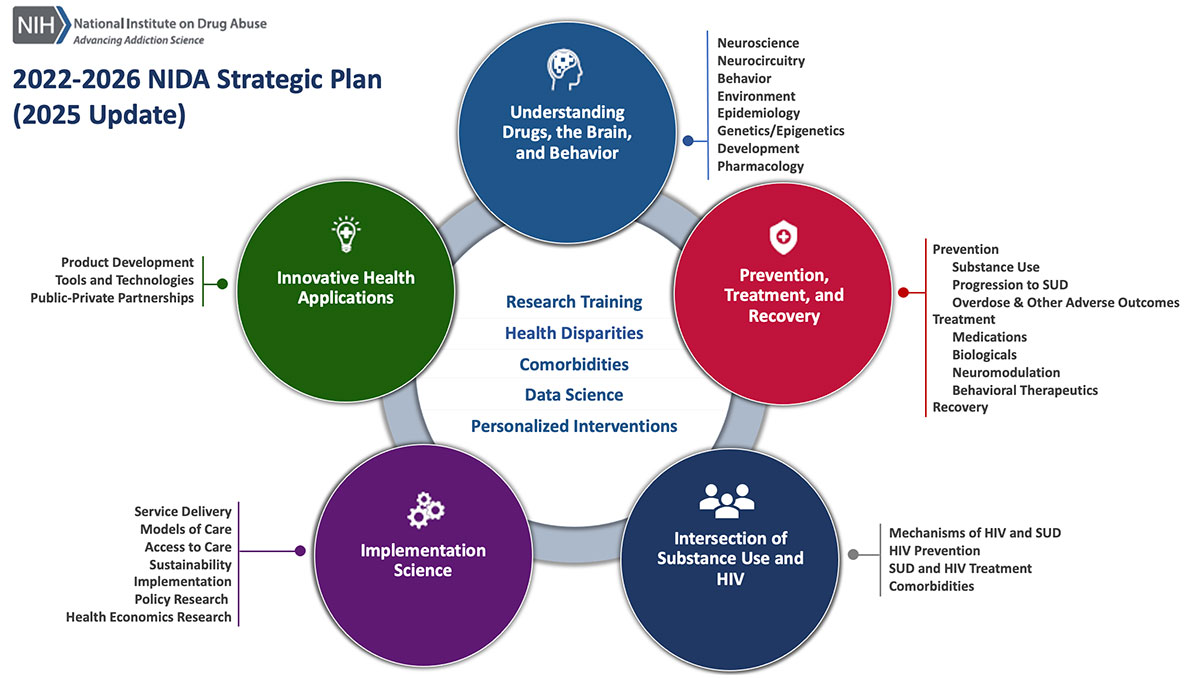
Cross-Cutting Priorities
Cross-cutting Priorities span NIDA’s portfolio and will contribute substantially to our mission over the next five years:
- Train the Next Generation of Scientists
- Identify and Develop Approaches to Reduce Health Disparities
- Understand Interactions Between Substance Use, HIV, and other Comorbidities
- Leverage Data Science and Analytics to Understand Real-World Complexity
- Develop Personalized Interventions Informed by People with Lived Experience
Priority Scientific Areas
Priority Scientific Area 1: Understand Drugs, the Brain, and Behavior
Basic and behavioral research are transforming our understanding of drug use and addiction. Research has made significant advances in understanding how the brain functions, how drugs interact with brain processes, and how SUDs develop and resolve. Epidemiological studies have provided insight into how substance use patterns evolve and relate to risk and protective factors, while policy research has illuminated how laws and regulations related to drug use impact health. NIDA will continue to support research in each of these areas, with a focus on the following goals:
- Priority Scientific Area 1: Understand Drugs, the Brain, and Behavior
- Goal 1.1: Expand our understanding of the pharmacological and biological mechanisms underlying drug use, addiction, treatment responses, and their impact on health and behavior throughout the lifespan
- Goal 1.2: Advance research on how environmental factors impact brain development, substance use, and addiction
- Goal 1.3: Enhance our knowledge of the real-world landscape of drug use patterns and trends, and trajectories to addiction
Priority Scientific Area 2: Develop and Test Novel Prevention and Therapeutic Interventions
Developing new and improved pharmacological and non-pharmacological strategies to prevent and treat SUDs, reduce adverse outcomes associated with drug use, and support long-term recovery of people following treatment are top priorities for NIDA research. As our understanding of addiction evolves, there are increasing opportunities to make interventions more holistic, nuanced, and dynamic, similar to interventions for other medical illnesses. NIDA’s goals for intervention research include:
- Priority Scientific Area 2: Develop and Test Novel Prevention and Therapeutic Interventions
- Goal 2.1: Develop and test novel strategies for preventing drug use, SUDs, and their consequences
- Goal 2.2: Expand the range of treatment options for SUDs and their consequences
- Goal 2.3: Advance the science of recovery support
Priority Scientific Area 3: Accelerate Research on the Intersection of Substance Use and HIV
Despite scientific advances, rates of HIV remain unacceptably high. Substance use plays a significant role in HIV transmission, and indeed the opioid crisis has been associated with marked increases in the number of people who inject drugs in the U.S. and with localized HIV outbreaks. NIDA has long recognized the intertwined nature of substance use and HIV and will continue to support innovative and multidisciplinary research in this area. NIDA goals for HIV research include:
- Priority Scientific 3: Accelerate Research on the Intersection of Substance Use and HIV
- Goal 3.1: Increase understanding of the etiology, pathogenesis, spread, and persistence of HIV/AIDS among people who use drugs
- Goal 3.2: Prevent new infections and transmission of HIV among people who use drugs and their sexual and/or injection partners
- Goal 3.3: Address comorbidities and improve health outcomes among people living with HIV who use drugs
Priority Scientific Area 4: Improve the Implementation of Evidence-Based Strategies in Real-World Settings
Although effective interventions exist for preventing and treating substance use and SUDs, their reach has been limited. To scale up research-based interventions across settings, it is essential to understand and address the many factors that promote or impede implementation. NIDA will continue to support a robust implementation science portfolio aimed at bridging the gaps among research, practice, and policy with a focus on the following goals:
- Priority Scientific Area 4: Improve the Implementation of Evidence-Based Strategies in Real-World Settings
- Goal 4.1: Study approaches to improve the integration of SUD care into medical practice
- Goal 4.2: Develop and test strategies for overcoming barriers to access and continuity of care
- Goal 4.3: Support research to scale up the application of evidence-based interventions for SUDs
Priority Scientific Area 5: Translate Research into Innovative Health Applications
NIDA is a leader in leveraging the power of small-business innovation to develop new tools and technologies for preventing, diagnosing, and treating SUD. To continue to innovate in this space, NIDA’s goals include:
- Priority Scientific Area 5: Translate Research into Innovative Health Applications
- Goal 5.1: Facilitate research translation through education and partnerships
- Goal 5.2: Capitalize on new technologies to deliver prevention, treatment, and recovery interventions
Scientific Stewardship Priorities
- Setting NIDA research priorities
- Fostering collaboration with public and private partners
- Communicating research to inform policy and practice
Management and Accountability
- Supporting a cutting edge research infrastructure and workforce
- Reducing administrative burden
- Managing risk
HEAL Opioid Use Disorder and Overdose Strategic Plan
To ensure that NIDA’s Helping to End Addiction Long-term® (HEAL) Initiative research investments are optimized to meet evolving scientific and public health needs, NIDA has developed a separate strategic plan for HEAL with a focus on research priorities to address OUD and overdose, and the intersection of opioid use and pain, that are not already addressed in NIDA’s Strategic Plan. The NIDA HEAL Opioid Use Disorder and Overdose Strategic Plan FY 2025-2029 was developed using input from an array of stakeholders—including scientists, health care providers, advocacy groups, and people with lived and living experience—as well as existing research frameworks.