 An official website of the United States government




Each year, the National Institutes of Health’s Brain Research Through Advancing Innovative Neurotechnologies® Initiative, or The BRAIN Initiative®, receives its budget from the United States Congress. The NIH BRAIN Initiative is made up of, and managed by, 10 Institutes and Centers (ICs) at NIH , whose missions and current research portfolios both complement and benefit from the goals of the BRAIN Initiative.
The NIH BRAIN Initiative is funded by Congress from two streams:
- As line items in the budgets of the 10 BRAIN Initiative ICs . This is known as the base allocation.
- From funding authorized by the 21st Century Cures Act . The Cures Act funding is a congressional supplement signed into law in 2016 and designed to boost key innovation programs, such as the BRAIN Initiative, with predetermined, varying annual amounts starting in fiscal year (FY) 2017 and ending in FY 2026.
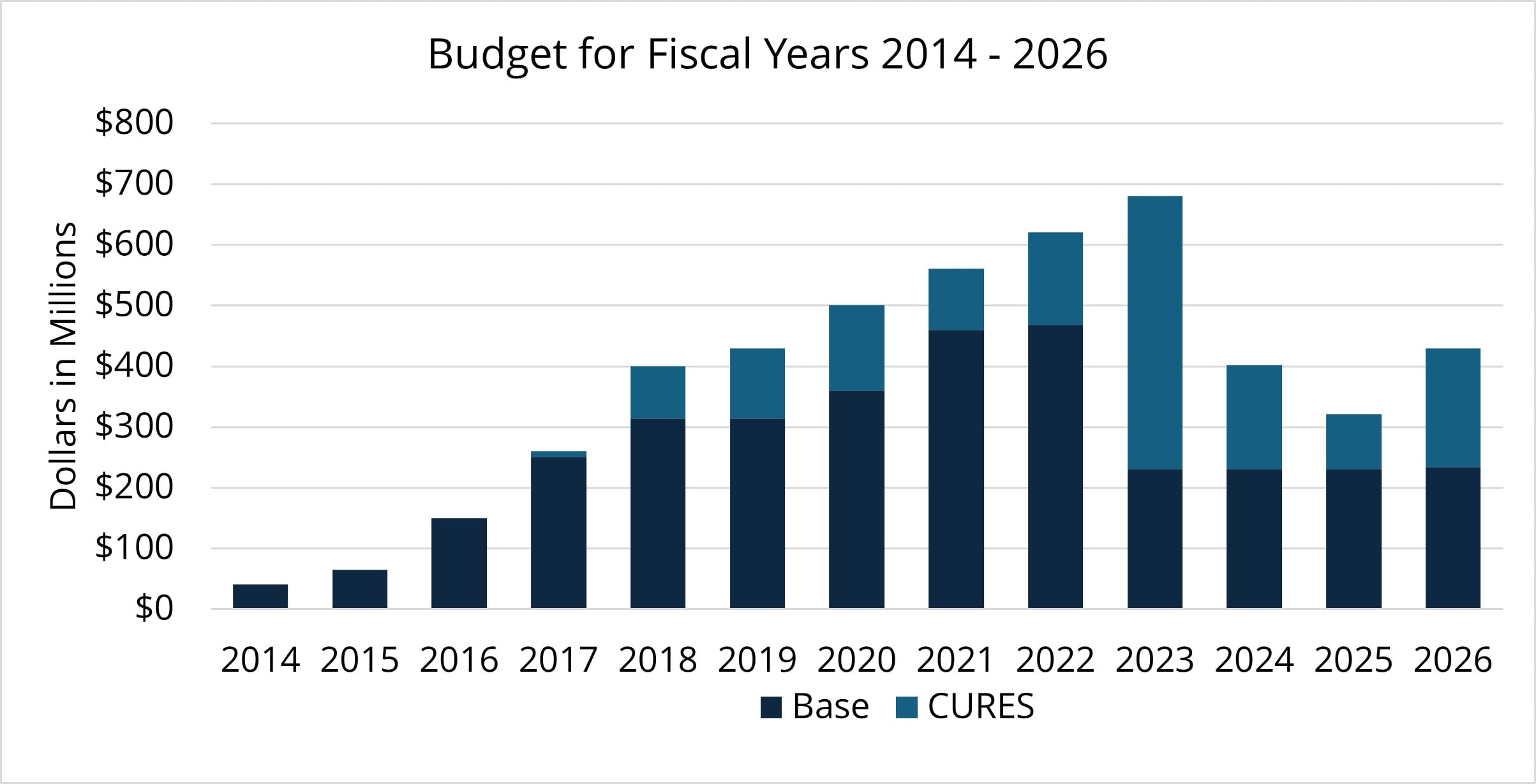
BRAIN Initiative Budget for Fiscal Years 2014 - 2026 (Dollars in Millions) for base allocations and 21st Century Cures Act authorization. 21st Century Cures Act authorization jumped from $152 million in FY 2022 to $450 million in FY 2023, representing an increase of $298 million. In FY 2023, Congress reduced the NIH BRAIN Initiative’s base allocation by $238 million, bringing it down to $230 million. BRAIN’s total allocation for FY 2023 still reflected a $60 million increase, from $620 million to $680 million ($450 million from 21st Century Cures Act plus $230 million in base funding). In FY 2024, the base allocation remained flat at $230 million and the 21st Century Cures Act funds dropped to $172 million (as determined in advance), resulting in a total allocation of $402 million for BRAIN, or 40% less than the FY 2023 budget. In FY 2025, Cures Act funding dropped another $81 million. That decrease, coupled with the BRAIN Initiative’s base allocation remaining flat at $230 million, led to a total appropriated budget of $321 million. In FY 2026, Cures Act funding increased to $195 million. That increase, coupled with the BRAIN Initiative’s base allocation increasing by $4 million to $234 million, led to a total appropriated budget of $429 million.
Frequently Asked Questions
Below are answers to both general questions we have received about the NIH BRAIN Initiative's budget and questions specifically for researchers. We will continue to update the community as new information becomes available.
About the NIH BRAIN Initiative budget
- NIH BRAIN Initiative projects span a range of disciplines, each one embodying what remains central to the Initiative—innovative, collaborative, open, and ethical neuroscience.
- BRAIN Initiative research results to date have allowed us to better understand healthy brain function as well as dysfunction, which provides a path to pioneering precision treatments for individuals with brain disorders.
High-priority programs will continue to focus on the development and training of early-stage investigators, platform tools & technologies, and other resources that will accelerate discovery across the NIH neuroscience portfolio.
We are looking closely at all of our programs and will make decisions to best maintain the momentum we’ve built over the past decade, while considering overall portfolio balance of innovative neuroscience research and neurotechnology development.
Funds are provided to the BRAIN Initiative on an annual basis by Congress. We will know the level of funding once the budget for FY 2027 is enacted. This budget would cover Oct. 1, 2026–September 30, 2027.
We are grateful for Congress’s support of the BRAIN Initiative since it launched in 2014. While Cures Act funding expires after FY2026, the NIH BRAIN Initiative will continue with funds available through annual appropriations to the NIH Institutes and Centers participating in BRAIN. The level of funding will determine the size and scope of the program.
For researchers
The BRAIN Initiative continues to fund highly meritorious grant applications. Current NIH BRAIN Initiative funding opportunities can be found on the BRAIN Initiative website; potential applicants should check here before preparing an application for BRAIN funding. As always, we encourage applicants to follow and search the NIH Guide to find funding opportunities that best fit their proposed projects. Parent announcement mechanisms may be good options; we encourage applicants to speak with NIH program staff to discuss their options for securing competitive federal funding to support their research.
All applications received in response to a published BRAIN Initiative funding opportunity are reviewed for scientific and technical merit by scientific peer review. Well-scored applications are then prioritized for funding, based on relevance of the proposed project to NIH program priorities. However, the only way to definitively know if an application has been funded is through the issuance of a Notice of Award. Applicants are encouraged to reach out to NIH program staff with further questions.
The BRAIN Initiative will consider highly meritorious supplement applications including administrative, re-entry/re-integration/re-training, and continuity supplements.