 An official website of the United States government




About
ORIP’s Division of Construction and Instruments (DCI) supports research infrastructure in three areas: the S10 Instrumentation Programs (acquisition of state-of-the-art research instruments), the S15 Equipment Program (acquisition of modern research or auxiliary equipment to enhance operations of shared-use biomedical research facilities, formerly under the R24 activity code), and Extramural Construction Programs (construction and modernization of research facilities).
For more information on the S10 and S15 programs, view DCI's fact sheets:
S10 Instrumentation Programs
ORIP's S10 Instrumentation Grant Programs support purchases of state-of-the-art commercially available instruments to enhance research of NIH-funded investigators. Watch the S10 Instrumentation Programs Overview video to become familiar with the program and watch the S10 Instrumentation Programs Application Information video to learn about application requirements.
S10 Office Hours
Wednesdays: 2–3 pm ET
Join via Teams
No advanced reservation required.
Requirements and Eligibility
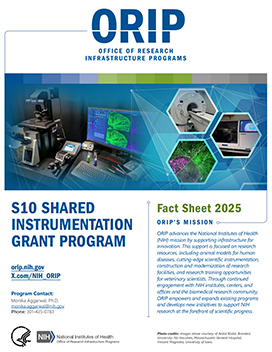
Instruments that are awarded are typically too expensive to be obtained by an individual investigator with a research project grant. Every instrument awarded by an S10 grant is to be used on a shared basis, which makes the programs cost-efficient and beneficial to thousands of investigators in hundreds of institutions nationwide. S10 awards are made to domestic public and private institutions of higher education, as well as nonprofit domestic institutions, such as hospitals, health professional schools, and research organizations. To be eligible for an S10 award, an institution must identify three or more principal investigators with active NIH research awards who demonstrate a substantial need for the requested instrument. View the notices of funding opportunities (NOFOs) for the S10 programs.
S10 Contact
Monika Aggarwal, Ph.D.: monika.aggarwal@nih.gov
Phone: 301-435-0783
S15 Equipment Program
In fiscal year 2021, ORIP introduced the Modern Equipment Program to support the acquisition and installation of modern research-supporting equipment to enhance the operations and protocols in biomedical research facilities, originally using the R24 code. Core facilities, animal research facilities, and other similar shared-use facilities are spaces targeted by this program. Any request for equipment through this program must be justified by the research-related demands of the shared-use facility. Requests for multiple units of the same equipment, if justified, are allowed within the budgetary requirements of the funding opportunity announcement. This program does not support the acquisition of scientific instruments that directly produce scientific data and/or research-essential materials. These instruments can be requested through ORIP’s S10 Instrumentation Programs.
The S15 Equipment Program will issue awards to only domestic academic (public and private) and nonprofit institutions for 1 year. Equipment awarded through this program should provide long-term benefits to the research infrastructure and operations of the proposed shared-use space in the applicant institution.
Examples of equipment supported by the S15 Equipment Program include, but are not limited to, animal research–supporting equipment (e.g., modern ventilated cages for rodents, automated feeding systems, tunnel washers, environmental management devices, telemetry and other electronic systems for management of animal colonies) and biomedical research–supporting equipment (e.g., autoclaves/sterilizers, cryogenic gas recovery/recycling systems, 3D printers, automated cell processing equipment, glass washers, fume hoods, high-speed centrifuges, freezers, biosafety cabinets).
For more information on the S15 program, view the Modern Equipment Program Fact Sheet.
The following are active notices of funding opportunities for the R24/S15 Equipment Programs:
- Receipt date: September 25, 2024, 2025, and 2026
- Budget: Up to $350,000 in direct costs only
- Earliest start date: July 2025
- Receipt date: September 25, 2024, 2025, and 2026
- Budget: Up to $400,000 in direct costs only
- Earliest start date: July 2025
Past funding opportunity:
- Receipt date: November 15, 2023
- Budget: $50,000–$350,000 in direct costs only
- Earliest start date: July 2024

Modern Equipment Program: Frequently Asked Questions
Extramural Construction Programs
ORIP's Division of Construction and Instruments (DCI) supports programs that fund the construction, renovation, and modernization of research space by issuing Notices of Funding Opportunities (NOFOs) when congressional appropriations are available.
The overall objective of these programs is to provide modernized physical infrastructure that meets up-to-date engineering requirements to conduct cutting-edge NIH-funded biomedical research. Such an investment in infrastructure offers long-term benefits because federally funded space must be used to support biomedical research for the next 10 years, depending on the regulatory requirement of an individual program. These investments impact research funded by essentially all NIH Institutes and Centers, benefiting all areas of biomedical sciences from fundamental biology to clinical translational research.
ORIP oversees the use of more than 300 research facilities in 45 states and in Puerto Rico that were funded in the last 20 years. These facilities provide new laboratory space, and set up environments for specialized research protocols and clinical investigations. For example, special facilities support antibody engineering for the development of cancer therapeutics and the synthesis of probes for positron emission tomography. The projects created designated space, such as barrier facilities to study pathogens and prions, animal facilities in nonhuman primate research centers to research infectious diseases, and shielded rooms for magnetic resonance imaging.
Active C06 NOFO
This NOFO supports two existing construction programs: the Biomedical Research Facilities (BRF) program and the HIV/AIDS Research Facilities (HRF) program.
Award Budget
BRF: $2M to $8M
HRF: $2M to $4M
| Application Due Dates | Review and Award Cycles | ||
|---|---|---|---|
| New Submission | Scientific Merit Review | Advisory Council Review | Earliest Start Date |
| April 6, 2026 | June 2026 | October 2026 | December 2026 |
| January 25, 2027 | June 2027 | October 2027 | December 2027 |
| January 25, 2028 | June 2028 | October 2028 | December 2028 |
Office Hour
Wednesdays: 2–3 pm ET
Join via Teams
No advanced reservation is required.
Expired C06 NOFOs
Award Budget: $2M to $8M
Deadline: January 27, 2025
Award Budget: $2M to $4M
Deadline: January 7, 2025
American Recovery and Reinvestment Act (ARRA) Program
The American Recovery and Reinvestment Act of 2009 (ARRA) created a $1 billion investment for the construction and renovation of biomedical research facilities across the United States. This budget comprised approximately 10% of the total NIH ARRA funding appropriation. The ARRA investment was expected to stimulate the nation’s economy by creating and maintaining American jobs. A total of 148 ARRA awards were granted through ORIP to support the construction or renovation of 64 animal facilities, 56 research laboratories, 17 clinical research facilities or laboratories, 8 imaging facilities, and 7 data centers. These facilities have helped enable research in a broad array of scientific areas, including HIV/AIDS, aging, cancer, cardiovascular diseases, respiratory diseases, and infectious diseases. Read more about ORIP-supported ARRA awards, including several featured awardees.

ORIP oversaw and supported other special initiatives, such as the Extramural Research Facilities Restoration Program: Hurricane Sandy Disaster Relief, to recover the biomedical research capacity in affected states. Two ORIP grant awards funded the rebuilding of rodent housing facilities and laboratory research space that were lost because of hurricane damage.
Since its creation, ORIP has directed significant efforts toward the modernization of animal research facilities. The funded projects, based on current technologies and engineering principles, improve resource efficiencies, contribute to the accuracy of experimental protocols, and benefit animal care.
Various environmental factors may affect the physiology, metabolism, responses to drugs, and other experimental outcomes at the genetic, cellular, and whole organism levels. For example, a rodents’ ability to hear high-frequency sounds makes them sensitive to noise and vibrations that are generated by heating, ventilation, and air conditioning (HVAC) units in a laboratory setting. Modern HVAC units provide an improved environment for research animals. Similarly, new automated systems monitor and adjust light cycles and intensity to match natural circadian rhythms of animals. The installation of robotic feeding and watering systems allow accurate assessments of caloric intake, eating patterns, and food preferences. Often, new biological discoveries necessitate the modernization of laboratory space, so that targeted experimental protocols can be performed under well-defined conditions. For example, a gnotobiotic environment is needed to conduct some studies that research the role of the microbiome in health and disease.
Based on the aforementioned examples, the creation, renovation, and modernization of infrastructures are necessary to support cutting-edge biomedical research. Emerging scientific fields require the support of novel and advanced engineering solutions to conduct robust and reproducible biomedical research. ORIP’s long-standing experience in supporting successful improvements to infrastructures, demonstrates its ability to continue these efforts.
Search Awarded Grants
Information on grants awarded by NIH may be searched by using the Research Portfolio Online Reporting Tools (RePORT). RePORT provides access to reports, data, and analyses of NIH research activities, including information on NIH expenditures and the results of NIH-supported research.
Staff Contacts
| Name | Title | Phone | |
|---|---|---|---|
| Xiang-Ning Li, M.D., Ph.D. | Director | xiang-ning.li@nih.gov | 301-435-0766 |
| Monika Aggarwal, Ph.D. | Health Scientist Administrator | monika.aggarwal@nih.gov | 301-435-0783 |
| Yong Chen, Ph.D. | Health Scientist Administrator | yong.chen@nih.gov | 301-594-1187 |
| Jeffrey Spector, Ph.D. | Health Scientist Administrator | jeff.spector@nih.gov | 301-435-0777 |