 An official website of the United States government




NIAAA funds research on fetal alcohol spectrum disorders (FASD) with projects on preventing prenatal alcohol exposure, treating women with alcohol use disorder, improving the diagnosis of FASD, establishing more precise prevalence estimates of FASD in the United States, increasing our understanding of the effects of alcohol on the unborn child, and developing effective interventions to mitigate the health effects on individuals prenatally exposed to alcohol.
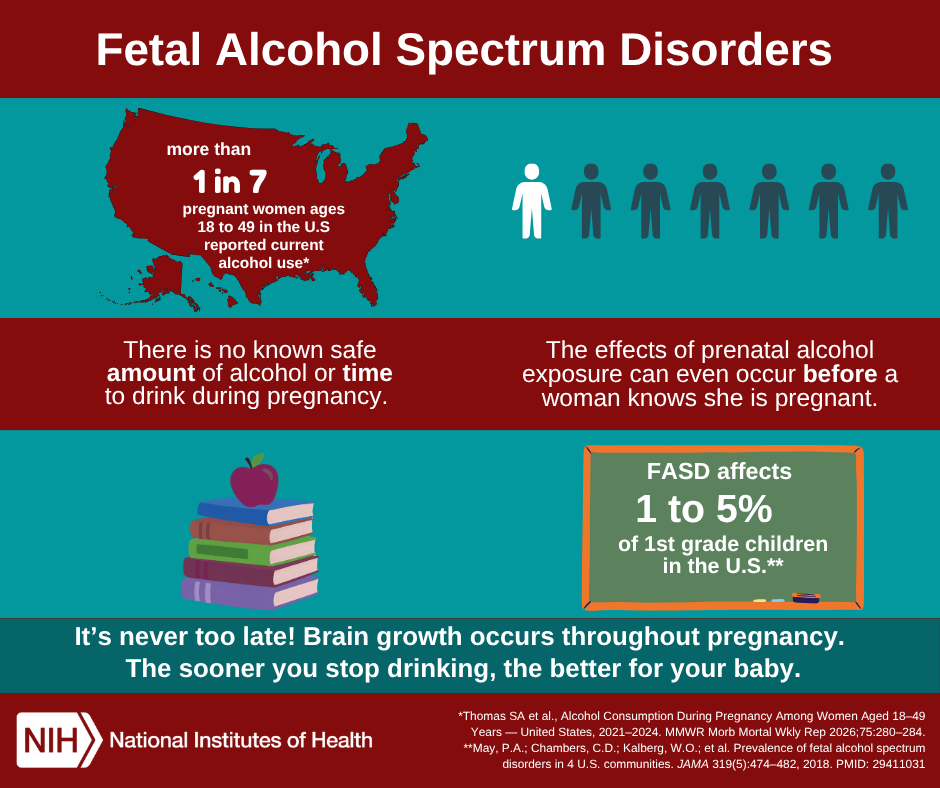
Prenatal alcohol exposure is a leading preventable cause of birth defects and neurodevelopmental deficits in the United States. It can cause a range of intellectual and behavioral problems, which appear at any time during childhood and last a lifetime. FASD is an umbrella term for a range of physical, cognitive, and behavioral disorders caused by prenatal alcohol exposure. Depending on the features identified, the medical disorders labeled as FASD include: Fetal Alcohol Syndrome (FAS), partial FAS (pFAS), alcohol-related neurodevelopmental disorder (ARND), alcohol-related birth defects (ARBD), and neurobehavioral disorder associated with prenatal alcohol exposure (ND-PAE). Recent prevalence studies estimate that approximately 1 to 5 percent of U.S. first-grade children have FASD.
Historically, medical professionals did not recognize the risks posed by alcohol use during pregnancy. In 1973, responding to Jones and Smith’s publication on the original syndrome FAS, NIAAA initiated several epidemiological and animal studies on prenatal alcohol exposure. By 1977, this research facilitated NIAAA issuing the first government health advisory to limit alcohol use during pregnancy. NIAAA continues to provide leadership and support as the largest funder of biomedical research on FASD in the United States.
Research Priorities
NIAAA's FASD Research priorities can be found in the NIAAA Strategic Plan.
NIAAA’s FASD portfolio is comprised of research project grants, cooperative agreements, training grants, center grants, fellowships, and career development awards, that collectively address FASD prevention, diagnosis, treatment, and etiology.
NIAAA also funds conference grants that support the annual meeting of the FASD Study Group and the annual International Conference on FASD. A list of NIH funded FASD-related projects may be found at NIH RePORTER, selecting FASD under the NIH Spending Category of the Advanced Project Search.
Research Centers and Consortia working on FASD
- The Collaborative Initiative on Fetal Alcohol Spectrum Disorders (CIFASD) is a multidisciplinary consortium of domestic and international projects established by NIAAA in 2003 to address prevention of FASD, diagnosis of the full range of birth defects associated with prenatal alcohol exposure, and ameliorative interventions for affected individuals. CIFASD aims to accelerate the translation of key research findings by fostering collaboration and by coordinating clinical, basic, and translational research.
- The Developmental Exposure Alcohol Research Center (DEARC) is a NIAAA-designated specialized Alcohol Research Center located at Binghamton University. The research of the DEARC focuses on the two primary developmental periods during which alcohol exposure occurs: prenatally/postnatally through maternal use and during adolescence.
- The Native Center for Alcohol Research and Education (NCARE) is a NIAAA-designated comprehensive Alcohol Research Center located at Washington State University. NCARE seeks to advance Indigenous, community-driven approaches to prevent alcohol misuse among AI/AN youth and young adults through intervention co-development, evaluation, training and dissemination (e.g., Indigenous determinants of health-based efforts).
- The New Mexico Alcohol Research Center (NMARC) is a NIAAA-designated specialized Alcohol Research Center located at the University of New Mexico Health Sciences Center. NMARC is one of just twenty Alcohol Research Centers in the United States, and the only such center focused solely on Fetal Alcohol Spectrum Disorders (FASD). NMARC’s central focus is on understanding the neurobiological mechanisms underlying the behavioral problems associated with FASD and how to use this knowledge to help develop better methods of early diagnoses and more effective interventions for patients with FASD.
Funding
Funding opportunities
To find active funding opportunities from NIAAA, visit the NIH Grants. Search by using keywords "FASD," "prenatal alcohol exposure," or "alcohol during pregnancy." Sort by grant type, release date, expiration date, contact information, and more.
Highlighted topics
Learn about Highlighted Topics by selecting NIAAA from the drop-down menus for “Lead ICO” and “Participating ICO, and using the search term "FASD," "prenatal alcohol exposure," or "alcohol during pregnancy".
Federal and Professional Partners
- The Interagency Coordinating Committee on Fetal Alcohol Spectrum Disorders (ICCFASD)
- Centers for Disease Control and Prevention (CDC)
- American Academy of Pediatrics (AAP)
- American College of Obstetricians and Gynecologists (ACOG)
- FASD United (formerly NOFAS)
- PROOF Alliance
Contact
Email NIAAAFASD@nih.gov with questions about the NIAAA FASD program.