 An official website of the United States government




Initiative Snapshot
New biomedical research constantly drives scientific discoveries that advance our understanding of human health and provide new ways to treat disease. Independent replication can benefit researchers by providing additional data that could be used to support eventual IND applications and/or commercialization, bolster novel findings that may serve as the basis for future research projects, and validate novel tools, technologies, and methods that may be used in a wide variety of biomedical research applications.
Through the Replication to Enhance Research Impact Initiative (Replication Initiative), the NIH Common Fund is launching an effort to provide support to independently replicate significant lines of research and validate novel technologies. The Replication Initiative will support replication efforts for preclinical, translational, and technology development research studies from Common Fund programs and NIH-supported research across different scientific research areas.
The Replication Initiative supports partnerships between independent contract research organizations (CROs) and researchers to replicate important lines of research and validate novel technologies. The Common Fund will provide support to researchers through NOT-RM-24-009 and NOT-RM-24-013 to engage with CROs and perform preparatory activities, which may include exchanging unique experimental reagents or protocols. Separately, the Common Fund will provide funds to the CROs who will then perform the replication activities. These activities are detailed in the figure below:
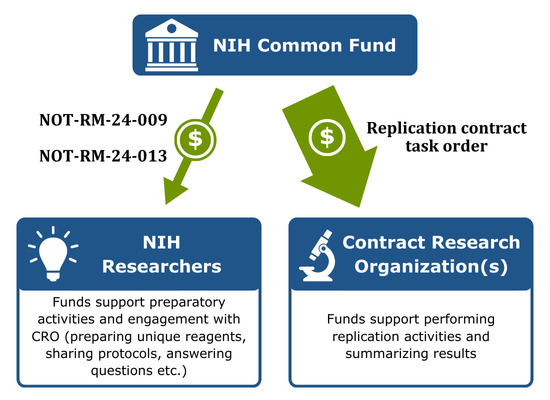
This effort will explore if directly replicating certain preclinical, translational, and technology development studies, or validating key technologies, are fruitful approaches to improve research reproducibility. It will determine which types of studies and under what conditions this is beneficial, in support of the wider NIH efforts to enhance research rigor and reproducibility. The Replication Initiative will leverage results from the replication studies, analysis of the processes used to design and implement the replications, and input from researchers and CROs to define best practices and lessons learned.
Initiative Updates
The Common Fund has launched the Replication Prize, a competition to advance scientific research by collecting ideas and strategies to make important lines of biomedical research more replicable. Learn more and join the challenge at the Replication Prize website.
Learn more about replicability efforts across NIH: Strengthening Replication and Reproducibility of NIH-funded Research.
Replication Initiative featured by the NIH Extramural NEXUS
Check out the Open Mike Blog post about the Replication Initiative and NIH efforts to enhance research reproducibility!
Interested in receiving initiative updates?
Sign up for the NIH Common Fund Replication Initiative email listserv to receive periodic updates on initiative planning and activities.
Funded Research
| PI Name | Institution Name | Title |
|---|---|---|
| CHOUDHURY, SANGITA | BOSTON CHILDREN'S HOSPITAL | Admin Supplement - Detection and Characterization of Somatic Mutations in Human Tissue Utilizing Duplex-Consensus Sequencing |
| PERANTEAU, WILLIAM H | CHILDREN'S HOSP OF PHILADELPHIA | Replication study of in vivo postnatal gene editing for metabolic liver disease in the nonhuman primate model |
| SAHA, KRISHANU | UNIVERSITY OF WISCONSIN-MADISON | Replication Study of Off-Target Assays for Guide RNAs in CRISPR-Based Therapeutics |
| PI Name | Institution Name | Title |
|---|---|---|
| DITTMER, DIRK P | UNIV OF NORTH CAROLINA CHAPEL HILL | Replication studies for Kaposi Sarcoma mice |
| LI, YUQING | UNIVERSITY OF FLORIDA | Supplement: Pathophysiology of DYT1 dystonia: Targeted Mouse Models |
| LIU, TIEMING | OKLAHOMA STATE UNIVERSITY STILLWATER | SCH: Harnessing Tensor Information to Improve EHR Data Quality for Accurate Data-driven Screening of Diabetic Retinopathy with Routine Lab Results |
| OKUDA, KENICHI | UNIVERSITY OF NORTH CAROLINA AT CHAPEL HILL | Mucociliary innate defense mechanism in the human distal airway |
| SHAFIRSTEIN, GAL | HEALTH RESEARCH INC. AND ROSWELL PARK CANCER INSTITUTE | Interstitial Photodynamic Therapy Following Palliative Radiotherapy for Patients with Inoperable Malignant Central Airway Obstruction |
Emory University in Atlanta, Georgia, has been selected as a scientific replication center for the Replication to Enhance Research Impact Initiative. Emory offers a breadth of resources and innovative technologies to support research and discovery and advance multidisciplinary research excellence, including Emory’s Integrated Core Facilities, Emory Brain Organoid Hub, the Emory National Primate Research Center and the Atlanta Center for Microsystems Engineered Point-of-Care Technologies (ACME POCT).