 An official website of the United States government




Congressional Justification FY 2017
DEPARTMENT OF HEALTH AND HUMAN SERVICES
NATIONAL INSTITUTES OF HEALTH
National Center for Complementary and Integrative Health (NCCIH)
On this page:
- Organization Chart
- Appropriation Language
- Amounts Available for Obligation
- Budget Mechanism Table
- Major Changes in Budget Request
- Summary of Changes
- Budget Graphs
- Budget Authority by Activity
- Authorizing Legislation
- Appropriations History
- Justification of Budget Request
- Budget Authority by Object Class
- Salaries and Expenses
- Detail of Full-Time Equivalent Employment (FTE)
- Detail of Positions
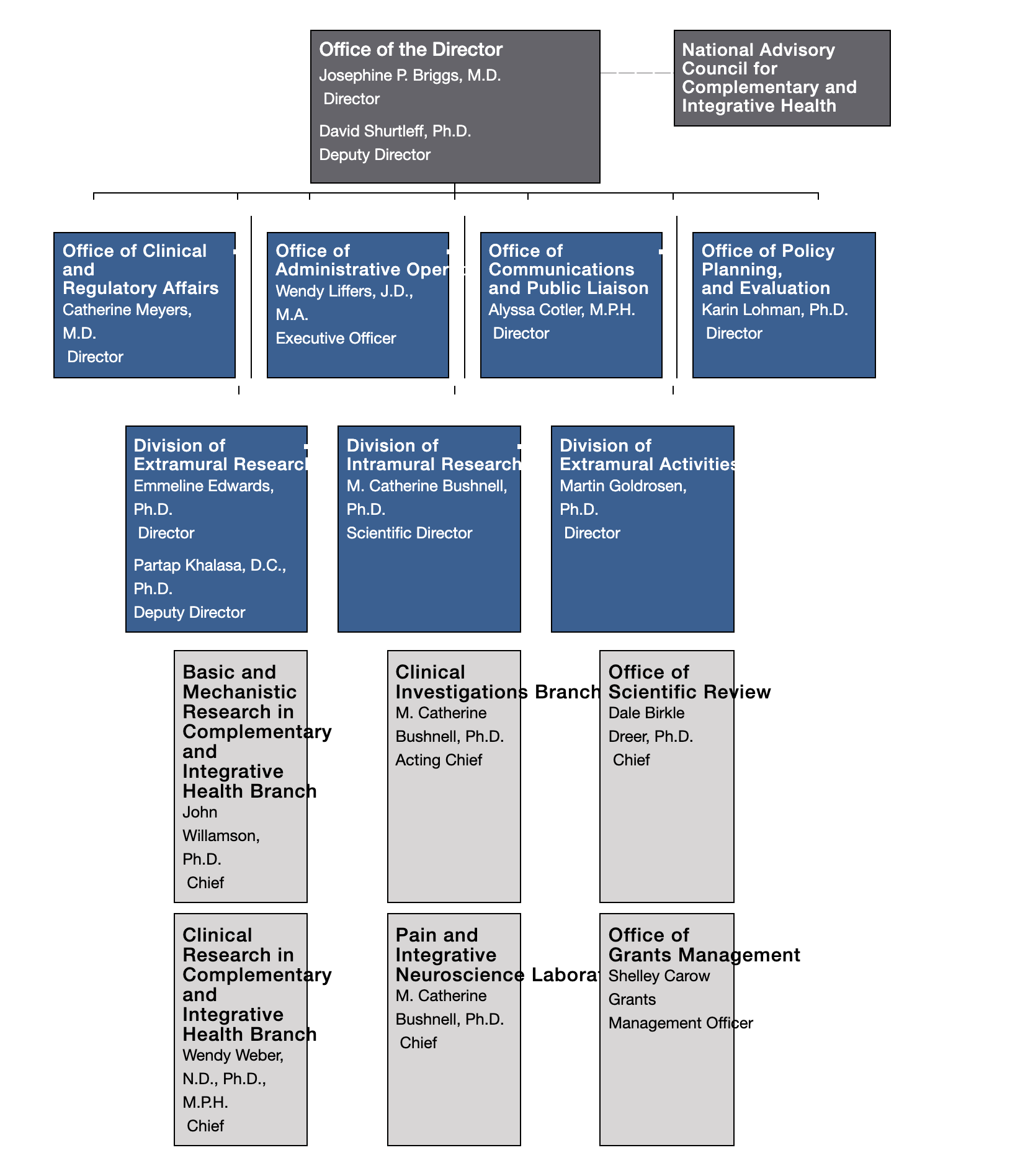
NATIONAL INSTITUTES OF HEALTH
National Center for Complementary and Integrative Health
For carrying out section 301 and title IV of the PHS Act with respect to complementary and integrative health, [$130,789,000]$126,673,000
NATIONAL INSTITUTES OF HEALTH
National Center for Complementary and Integrative Health
Amounts Available for Obligation1
(Dollars in Thousands)
| Source of Funding | FY 2015 Actual | FY 2016 Enacted | FY 2017 President’s Budget |
|---|---|---|---|
| Appropriation | $124,681 | $130,789 | $129,941 |
| Mandatory Appropriation: (non-add) | |||
| Type 1 Diabetes | (0) | (0) | (0) |
| Other Mandatory financing | (0) | (0) | (3,268) |
| Rescission | 0 | 0 | 0 |
| Sequestration | 0 | 0 | 0 |
| FY 2015 First Secretary's Transfer | 0 | 0 | 0 |
| FY 2015 Second Secretary's Transfer | 0 | 0 | 0 |
| Subtotal, adjusted appropriation | $124,681 | $130,789 | $129,941 |
| OAR HIV/AIDS Transfers | -619 | -848 | 0 |
| National Children's Study Transfers | 0 | 0 | 0 |
| Subtotal, adjusted budget authority | $124,062 | $129,941 | $129,941 |
| Unobligated balance, start of year | 0 | 0 | 0 |
| Unobligated balance, end of year | 0 | 0 | 0 |
| Subtotal, adjusted budget authority | $124,062 | $129,941 | $129,941 |
| Unobligated balance lapsing | -16 | 0 | 0 |
| Total obligations | $124,046 | $129,941 | $129,941 |
NATIONAL INSTITUTES OF HEALTH
National Center for Complementary and Integrative Health
Budget Mechanism - Total1
(Dollars in Thousands)
| MECHANISM | FY 2015 Actual | FY 2016 Enacted | FY 2017 President’s Budget 3 | FY 2017 +/- FY 2016 | ||||
|---|---|---|---|---|---|---|---|---|
| No. | Amount | No. | Amount | No. | Amount | No. | Amount | |
| Research Projects: | ||||||||
| Noncompeting | 120 | $56,509 | 107 | $54,527 | 109 | $56,728 | 2 | $2,201 |
| Administrative Supplements | (8) | 1,106 | (6) | 500 | (6) | 500 | ||
| Competing: | ||||||||
| Renewal | 2 | 722 | ||||||
| New | 32 | 13,644 | 45 | 19,902 | 34 | 15,050 | -11 | -4,851 |
| Supplements | ||||||||
| Subtotal, Competing | 34 | $14,366 | 45 | $19,902 | 34 | $15,050 | -11 | -$4,851 |
| Subtotal, RPGs | 154 | $71,981 | 152 | $74,929 | 143 | $72,279 | -9 | -$2,650 |
| SBIR/STTR | 12 | 3,279 | 20 | 4,643 | 21 | 4,905 | 1 | 262 |
| Research Project Grants | 166 | $75,259 | 172 | $79,572 | 164 | $77,183 | -8 | -$2,388 |
| Research Centers: | ||||||||
| Specialized/Comprehensive | 4 | $4,267 | 4 | $4,059 | 4 | $5,116 | $1,057 | |
| Clinical Research | ||||||||
| Biotechnology | 2 | 933 | 2 | 912 | 2 | 905 | -6 | |
| Comparative Medicine | ||||||||
| Research Centers in Minority Institutions | ||||||||
| Research Centers | 6 | $5,200 | 6 | $4,970 | 6 | $6,021 | $1,051 | |
| Other Research: | ||||||||
| Research Careers | 32 | $4,269 | 31 | $4,100 | 31 | $4,100 | ||
| Cancer Education | ||||||||
| Cooperative Clinical Research | ||||||||
| Biomedical Research Support | ||||||||
| Minority Biomedical Research Support | ||||||||
| Other | 5 | 1,623 | 7 | 1,500 | 7 | 1,500 | ||
| Other Research | 37 | $5,893 | 38 | $5,600 | 38 | $5,600 | ||
| Total Research Grants | 209 | $86,351 | 216 | $90,142 | 208 | $88,805 | -8 | -$1,337 |
| Ruth L Kirchstein Training Awards: | FTTPs | FTTPs | FTTPs | FTTPs | ||||
| Individual Awards | 9 | $480 | 14 | $600 | 14 | $620 | $20 | |
| Institutional Awards | 48 | 3,339 | 45 | 3,296 | 45 | 3,354 | 58 | |
| Total Research Training | 57 | $3,820 | 59 | $3,896 | 59 | $3,974 | $78 | |
| Research & Develop. Contracts | 10 | $9,788 | 10 | $10,594 | 10 | $11,094 | $500 | |
| (SBIR/STTR) (non-add) 2 | (2) | (28) | (2) | (30) | (2) | (41) | (11) | |
| Intramural Research | 9 | $8,140 | 9 | $8,709 | 9 | $8,970 | $261 | |
| Res. Management & Support | 63 | 15,963 | 64 | 16,601 | 64 | 17,099 | 498 | |
| Res. Management & Support (SBIR Admin) (non-add) 2 | (294) | (-294) | ||||||
| Office of the Director - Appropriation 2 | ||||||||
| Office of the Director - Other | ||||||||
| ORIP/SEPA (non-add) 2 | ||||||||
| Common Fund (non-add) 2 | ||||||||
| Buildings and Facilities | ||||||||
| Appropriation | ||||||||
| Type 1 Diabetes | ||||||||
| Program Evaluation Financing | ||||||||
| Cancer Initiative Mandatory Financing | ||||||||
| Other Mandatory Financing | -3,268 | -3,268 | ||||||
| Subtotal, Labor/HHS Budget Authority | $124,062 | $129,941 | $126,673 | -$3,268 | ||||
| Interior Appropriation for Superfund Res. | ||||||||
| Total, NIH Discretionary B.A. | $124,062 | $129,941 | $126,673 | -$3,268 | ||||
| Type 1 Diabetes | ||||||||
| Proposed Law Funding | ||||||||
| Cancer Initiative Mandatory Financing | ||||||||
| Other Mandatory Financing | 3,268 | 3,268 | ||||||
| Total, NIH Budget Authority | $124,062 | $129,941 | $129,941 | |||||
| Program Evaluation Financing | ||||||||
| Total, Program Level | $124,062 | $129,941 | $129,941 | |||||
Major Changes in the Fiscal Year 2017 President’s Budget Request
Major changes by budget mechanism and/or budget activity detail are briefly described below.
Research Project Grants (-$2.4 million; total $77.2 million): NCCIH will support a total of 164 Research Project Grant (RPG) awards in FY 2017. Noncompeting RPGs will increase by $2.2 million. Competing RPG awards will decrease by $4.9 million.
NATIONAL INSTITUTES OF HEALTH
National Center for Complementary and Integrative Health
Summary of Changes1
(Dollars in Thousands)
| FY 2016 Enacted | $129,941 |
| FY 2017 President’s Budget | $129,941 |
| Net change | $0 |
NATIONAL INSTITUTES OF HEALTH
National Center for Complementary and Integrative Health
Summary of Changes1 (continued)
(Dollars in Thousands)
| CHANGES | FY 2017 President’s Budget1 | Change from FY 2015 | ||
|---|---|---|---|---|
| FTEs | Budget Authority | FTEs | Budget Authority | |
| A. Built-in: | ||||
| 1. Intramural Research: | ||||
| a. Annualization of January 2016 pay increase & benefits | $2,529 | $74 | ||
| b. January FY 2017 pay increase & benefits | 2,529 | 32 | ||
| c. Two less days of pay | 2,529 | -20 | ||
| d. Differences attributable to change in FTE | 2,529 | 0 | ||
| e. Payment for centrally furnished services | 1,437 | 42 | ||
| f. Increased cost of laboratory supplies, materials, other expenses, and non-recurring costs | 5,004 | 133 | ||
| Subtotal | $261 | |||
| 2. Research Management and Support: | ||||
| a. Annualization of January 2016 pay increase & benefits | $9,720 | $282 | ||
| b. January FY 2017 pay increase & benefits | 9,720 | 119 | ||
| c. Two less days of pay | 9,720 | -77 | ||
| d. Differences attributable to change in FTE | 9,720 | 0 | ||
| e. Payment for centrally furnished services | 195 | 6 | ||
| f. Increased cost of laboratory supplies, materials, other expenses, and non-recurring costs | 7,184 | 168 | ||
| Subtotal | $498 | |||
| Subtotal, Built-in | $759 | |||
| No. | Amount | No. | Amount | |
| B. Program: | ||||
| 1. Research Project Grants: | ||||
| a. Noncompeting | 109 | $57,228 | 2 | $2,201 |
| b. Competing | 34 | 15,050 | -11 | -4,851 |
| c. SBIR/STTR | 21 | 4,905 | 1 | 262 |
| Subtotal, RPGs | 164 | $77,183 | -8 | -$2,388 |
| 2. Research Centers | 6 | $6,021 | 0 | $1,051 |
| 3. Other Research | 38 | 5,600 | 0 | 0 |
| 4. Research Training | 59 | 3,974 | 0 | 78 |
| 5. Research and development contracts | 10 | 11,094 | 0 | 500 |
| Subtotal, Extramural | $103,873 | -$759 | ||
| FTEs | FTEs | |||
| 6. Intramural Research | 9 | $8,970 | 0 | $0 |
| 7. Research Management and Support | 64 | 17,099 | 0 | 0 |
| 8. Construction | 0 | 0 | ||
| 9. Buildings and Facilities | 0 | 0 | ||
| Subtotal, program | 73 | $129,941 | 0 | -$759 |
| Total changes | $0 | |||
Fiscal Year 2017 Budget Graphs
History of Budget Authority and FTEs:
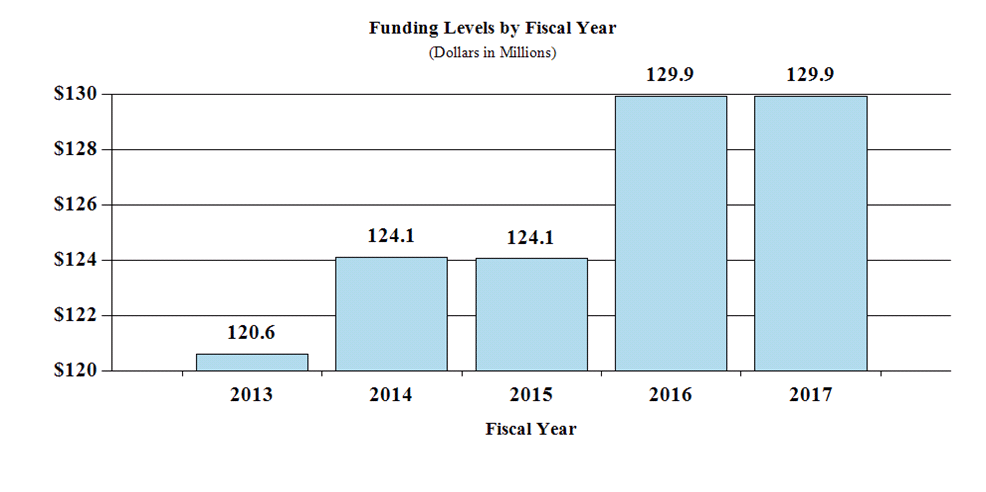
Funding Levels by Fiscal Year
| Fiscal Year | Dollars in Millions |
|---|---|
| 2012 | $120.6 |
| 2013 | $124.1 |
| 2014 | $124.1 |
| 2015 | $129.9 |
| 2016 | $129.9 |
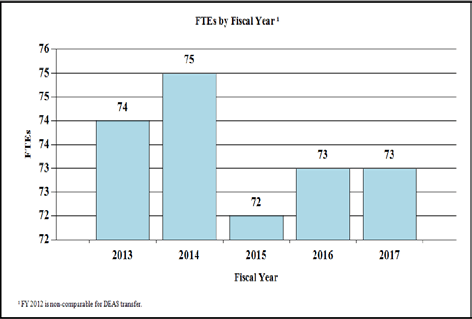
Full-Time Employees by Fiscal Year
| FY | FTEs |
|---|---|
| 2013 | 74 |
| 2014 | 75 |
| 2015 | 72 |
| 2016 | 73 |
| 2017 | 73 |
Distribution by Mechanism
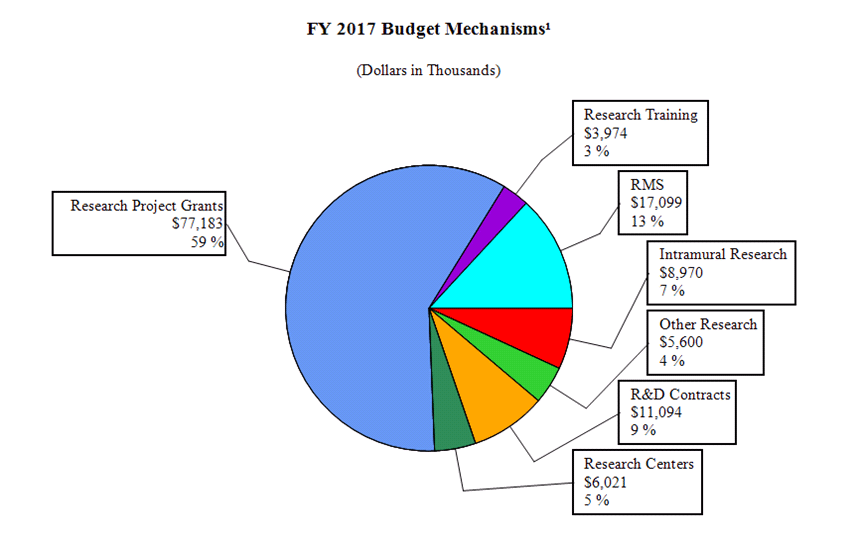
FY 2017 Budget Mechanism
| Mechanism | Dollars | Percent of Budget |
|---|---|---|
| Research Project Grants | $77,183,402 | 59.40% |
| Research Centers | $6,021,267 | 4.63% |
| Other Research | $5,600,000 | 4.31% |
| Research Training | $3,973,855 | 3.06% |
| R&D Contracts | $11,094,000 | 8.54% |
| Intramural Research | $8,969,961 | 6.90% |
| RMS | $17,098,515 | 13.16% |
1 Includes mandatory financing.
Change by Selected Mechanism
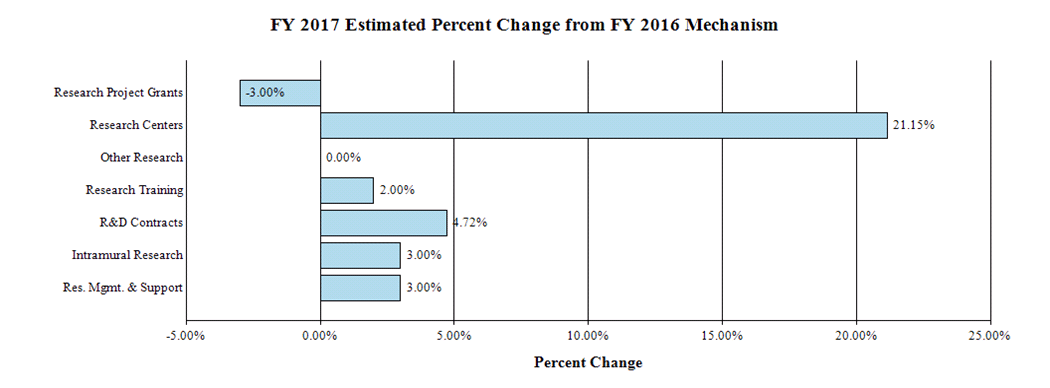
FY 2017 Estimated Percent Change from FY 2016 Mechanism
| Mechanism | Percent Change |
|---|---|
| Research Project Grants | -3.00% |
| Research Centers | 21.15% |
| Other Research | 0.00% |
| Research Training | 2.00% |
| R&D Contracts | 4.72% |
| Intramural Research | 3.00% |
| Res. Mgmt. & Support | 3.00% |
NATIONAL INSTITUTES OF HEALTH
National Center for Complementary and Integrative Health
Budget Authority by Activity1
(Dollars in Thousands)
| FY 2015 Actual | FY 2016 Enacted | FY 2017 President’s Budget2 | FY 2017 +/- FY 2016 | |||||
|---|---|---|---|---|---|---|---|---|
| Extramural Research | FTEs | Amount | FTEs | Amount | FTEs | Amount | FTEs | Amount |
| Detail | ||||||||
| Clinical Research | $51,036 | $53,569 | $53,860 | $291 | ||||
| Basic Research | 45,103 | 47,167 | 46,039 | -1,129 | ||||
| R&D Training | 3,820 | 3,896 | 3,974 | 78 | ||||
| Subtotal, Extramural | $99,959 | $104,632 | $103,873 | -$759 | ||||
| Intramural Research | 9 | $8,140 | 9 | $8,709 | 9 | $8,970 | 0 | $261 |
| Research Management & Support | 63 | $15,963 | 64 | $16,601 | 64 | $17,099 | 0 | $498 |
| TOTAL | 72 | $124,062 | 73 | $129,941 | 73 | $129,941 | 0 | $0 |
NATIONAL INSTITUTES OF HEALTH
National Center for Complementary and Integrative Health
Authorizing Legislation
| PHS Act/Other Citation | U.S. Code Citation | 2016 Amount Authorized | FY 2016 Enacted | 2017 Amount Authorized | FY 2017 President’s Budget 1 | ||
|---|---|---|---|---|---|---|---|
| Research and Investigation | Section 301 | 42§241 | Indefinite |
Image

| Indefinite |
Image
| |
| $129,941,000 | $126,673,000 | ||||||
| National Center for Complementary and Integrative Health | Section 401(a) | 42§281 | Indefinite | Indefinite | |||
| Total, Budget Authority | $129,941,000 | $126,673,000 | |||||
NATIONAL INSTITUTES OF HEALTH
National Center for Complementary and Integrative Health
Appropriations History
| Fiscal Year | Budget Estimate to Congress | House Allowance | Senate Allowance | Appropriation |
|---|---|---|---|---|
| 2007 | $120,554,000 | $120,554,000 | $121,982,000 | $121,576,000 |
| Rescission | $0 | |||
| 2008 | $121,699,000 | $123,380,000 | $124,213,000 | $121,577,000 |
| Rescission | $2,162,000 | |||
| Supplemental | $647,000 | |||
| 2009 | $121,695,000 | $125,878,000 | $125,082,000 | $125,471,000 |
| Rescission | $0 | |||
| 2010 | $127,241,000 | $129,953,000 | $127,591,000 | $128,844,000 |
| Rescission | $0 | |||
| 2011 | $132,004,000 | $131,796,000 | $128,844,000 | |
| Rescission | $1,131,327 | |||
| 2012 | $131,002,000 | $131,002,000 | $126,275,000 | $128,299,000 |
| Rescission | $242,485 | |||
| 2013 | $127,930,000 | $128,318,000 | $128,056,515 | |
| Rescission | $256,113 | |||
| Sequestration | ($6,427,556) | |||
| 2014 | $129,041,000 | $128,183,000 | $124,296,000 | |
| Rescission | $0 | |||
| 2015 | $124,509,000 | $124,681,000 | ||
| Rescission | $0 | |||
| 2016 | $127,521,000 | $127,585,000 | $130,162,000 | $130,789,000 |
| Rescission | $0 | |||
| 2017 1 | $129,941,000 |
Justification of Budget Request
National Center for Complementary and Integrative Health
Authorizing Legislation: Section 301 and title IV of the Public Health Service Act, as amended.
Budget Authority (BA):
| FY 2015 Actual | FY 2016 Enacted | FY 2017 President’s Budget | FY 2017 +/- FY 2016 | |
|---|---|---|---|---|
| BA | $124,062,000 | $129,941,000 | $129,941,000 | 0 |
| FTE | 72 | 73 | 73 | 0 |
Program funds are allocated as follows: Competitive Grants/Cooperative Agreements; Contracts; Direct Federal/Intramural and Other.
Director's Overview
The National Center for Complementary and Integrative Health (NCCIH) is the lead Federal agency for scientific research on the usefulness and safety of complementary and integrative health practices. Complementary and integrative health approaches include mind-body interventions, such as massage, acupuncture, yoga, and meditation, and natural products, such as dietary supplements and probiotics. To address the need for objective evidence as to the safety and efficacy of many of these approaches, NCCIH supports rigorous scientific investigation to better understand how these interventions work, for whom, and the optimal method of practice and delivery.
Results from the 2012 National Health Interview Survey (NHIS), conducted by the Centers for Disease Control and Prevention (CDC) with support from NCCIH, indicate that one-third of U.S. adults aged 18 and older use complementary and integrative health approaches. Many of these individuals seek complementary and integrative health approaches to improve their health and well-being or to manage symptoms of chronic diseases or the side effects of conventional medicine. Natural products (dietary supplements other than vitamins and minerals) are the most commonly used complementary health approach, followed by deep breathing exercises and yoga.
Reducing Pain and Improving Symptom Management
Pain is a major public health problem and is the most common reason Americans turn to complementary and integrative health practices. Data from the 2012 NHIS found that an estimated 25.3 million adults in the United States (11.2 percent) experience daily pain – pain every day for the three months prior to the survey. In addition, nearly 40 million adults (17.6 percent) experience severe levels of pain and are also likely to have worse health status than the general public.1 The cost of complementary care for adults using complementary health approaches to treat or manage pain is estimated to be $14.9 billion in out-of-pocket expenses, according to the 2007 NHIS. This amount accounts for 20-25 percent of all out-of pocket spending to treat or manage pain, including complementary and conventional care.2
CDC has classified fatal overdoses involving opioid analgesics, medications used to treat pain, as an epidemic. NCCIH’s research investment in pain, particularly the non-pharmacologic management of pain, helps address the critical need for improved pain management strategies. NCCIH’s intramural research program is devoted to studying the role of the brain in perceiving, modifying, and managing pain. Specifically, scientists are investigating the role of the brain in pain processing and how factors such as emotion, environment, and genetics affect its perception. In addition, NCCIH is involved in ongoing collaborations across NIH, the Department of Veterans Affairs, and the Department of Defense to develop and test efficacious and effective non-pharmacological approaches to pain management and comorbidities (including opioid misuse, abuse, and disorder) in military personnel, veterans, and their families. NCCIH’s extramural research program supports investigators examining the safety and efficacy of complementary health approaches for pain management. Furthermore, NCCIH participates in the NIH BRAIN (Brain Research through Advancing Innovative Neurotechnologies) Initiative, which is accelerating the development and application of technologies to study the brain. Additionally, NCCIH is leveraging its resources through the NIH Common Fund’s Stimulating Peripheral Activity to Relieve Conditions (SPARC) program in order to better understand the mechanisms of action and the development of “electroceuticals” for therapies in which nerves are stimulated to control organ function.
Advancing Research on Natural Products
Nearly one in five U.S. adults use botanical supplements and other non-vitamin, non-mineral dietary supplements, such as fish oil/omega-3 fatty acids and probiotics, according to the 2012 NHIS. The use of dietary supplements at times poses risks. For example, adverse events related to dietary supplements are estimated to contribute to 23,000 emergency department visits in the United States each year.3 To better inform consumers and their health care providers, NCCIH supports research on the biological mechanisms of the benefits and potential harmful effects of natural products, such as their interaction with medications and liver toxicity. To accelerate research on this important public health problem, NCCIH established a Center of Excellence for Natural Product-Drug Interaction Research in FY 2015. The new Center is systematically examining methods for studying natural product-drug interactions; developing standardized protocols to clarify which interactions have clinical impact; and disseminating the study findings and resources broadly. In essence, the new Center is developing a roadmap for the study of natural product-drug interactions with the ultimate goal of improving the body of knowledge available to health care providers, patients, and researchers.
To further enhance NCCIH’s natural products portfolio, NCCIH partnered with the NIH’s Office of Dietary Supplements (ODS) to fund five research centers in FY 2015. These centers focus on the safety of natural products, how they work within the body, and the development of cutting-edge research technologies. Specifically, the three Botanical Dietary Supplements Research Centers will advance the understanding of the mechanisms through which complex botanical dietary supplements may affect human health and resilience. The two Centers for Advancing Natural Products Innovation and Technology will propel chemical and biological investigation of natural products. They also will disseminate innovative methodology and good research practices. (For more details on this basic research effort, see the Program Portrait .)
Inspiring Public Trust through Stewardship
NCCIH works diligently to be an efficient steward of the resources provided by Americans. Currently, NCCIH is undertaking strategic planning activities focused on future research investments in complementary and integrative health and ensuring that research workforce needs are met. NCCIH continues to support research and leverage its strategic partnerships to build the scientific evidence needed by consumers, health care providers, and policymakers regarding the safety and efficacy of complementary and integrative health practices. NCCIH makes research findings available to the public through multiple platforms, including video, social media, and mobile applications. In addition, NCCIH engages the public directly through X chats with leading health experts.
1 Nahin RL. Estimates of pain prevalence and severity in adults: United States, 2012. Journal of Pain. 2015;16(8):769–780.
2 Nahin RL, Stussman BJ, Herman PM. Out-of-pocket expenditures on complementary health approaches associated with painful health conditions in a nationally representative adult sample. Journal of Pain. August 27, 2015. Epub ahead of print.
3 Geller, AI, et al. Emergency department visits for adverse events related to dietary supplements. N Engl J Med, 2015;373:1131–40.
Program Descriptions and Accomplishments
Extramural Clinical Research: The NCCIH extramural research program funds clinical investigations on complementary and integrative health practices and interventions. Projects range from small pilot studies to large-scale clinical trials and epidemiological studies, including several collaborations between NIH ICs and other Federal agencies. For instance, NCCIH and NHLBI are co-funding a replication trial to determine the potential cardiovascular benefits of chelation therapy for older patients with diabetes. Chelation is a chemical process in which a substance is delivered intravenously (through the veins) to bind atoms of metals or minerals and hold them tightly so that they can be removed from the body. While chelation is used as a treatment for heavy metal (for example, lead) poisoning, its use for treating heart disease is unproven.
Budget Policy:
The FY 2017 President’s Budget estimate for extramural clinical research is $53.860 million, which is an increase of $0.291 million or 0.5 percent compared to the FY 2016 Enacted level.
Extramural Basic Research: Basic research on fundamental biological effects and active components of interventions is central to the development of the evidence base on complementary and integrative health approaches, and underpins the design of clinical research. NCCIH supports investigator-initiated basic research and will continue, through targeted initiatives, its support for basic and translational research on promising complementary interventions. For example, NCCIH and ODS jointly funded three Botanical Dietary Supplements Research Centers. The three interdisciplinary and collaborative centers will advance understanding of the mechanisms through which complex botanical dietary supplements may affect human health and resilience. In addition, NCCIH and ODS funded two Centers for Advancing Natural Products Innovation and Technology, which are featured in the Program Portrait on the next page.
Program Portrait: Advancing Natural Products Innovation and Technology
FY 2016 Level: $1.0 million
FY 2017 Level: $1.0 million
Change: $0.0 million
To propel research innovation, NCCIH and ODS jointly funded two new Centers for Advancing Natural Products Innovation and Technology. The Centers will develop pioneering methods and techniques to catalyze new research approaches and technologies that will have significant impact on the chemical and biological investigation of natural products. Once developed, the Centers will disseminate those resources to the larger natural products research community.
Each of the new Centers will tackle unique research challenges, and ultimately their resources will help advance NCCIH’s natural products portfolio as a whole. Specifically, the Center for High-throughput Functional Annotation of Natural Products at the University of Texas Southwestern Medical Center will improve the speed, breadth, and precision of the chemical and biological characterization of natural products. Its team will develop innovative cell-based screening approaches to uncover bioactive molecules of interest and their corresponding molecular targets. The team at the University of Illinois at Chicago Natural Products Technology Center will coordinate and disseminate state-of the art research technologies aimed at mining bioanalytical knowledge of natural products. This center will also develop and share cutting-edge bioanalytical methodologies that address important biomedical questions and advance a more holistic research approach regarding natural products and their metabolomic complexity.
Through its investment in these two Centers, NCCIH is energizing the research community to overcome the methodologic and technologic obstacles hindering natural products research.
Budget Policy:
The FY 2017 President’s Budget estimate for extramural basic research is $46.039 million, which is a decrease of $1.129 million or 2.4 percent compared to the FY 2016 Enacted level.
Extramural Research Training and Capacity Building: Improving the capacity of the field to carry out rigorous research of complementary health interventions is a high priority for NCCIH. To increase the number, quality, and diversity of investigators who conduct research on complementary health approaches, NCCIH supports a variety of training and career development activities for pre- and post-doctoral students, researchers, and clinicians. As part of its strategic planning effort, NCCIH established a working group of its Advisory Council to identify workforce needs for clinician-scientists and potential roles for NCCIH in developing a research workforce that can conduct rigorous studies of complementary health approaches. Its recommendations will help shape NCCIH’s future training and career development programs.
Budget Policy:
The FY 2017 President’s Budget estimate for extramural research training and capacity building is $3.974 million, which is an increase of $0.078 million or 2.0 percent compared to the FY 2016 Enacted level.
Intramural Research: NCCIH’s intramural research program is focused on understanding the central mechanisms of pain and its modulation, with the long-term goal of improving clinical management of chronic pain through the integration of pharmacologic and non-pharmacologic approaches. Among topics of particular interest are the pathways and mechanisms by which emotion, attention, placebo effects, and other such processes modulate pain or pain processing. The program both engages and leverages the exceptional basic and clinical research talent and resources of other neuroscience and neuroimaging efforts within the NIH intramural community.
Budget Policy:
The FY 2017 President’s Budget estimate for intramural research is $8.970 million, which is an increase of $261 thousand or three percent compared to the FY 2016 Enacted level.
Research Management and Support (RMS): Through its RMS activities, NCCIH provides administrative, budgetary, logistical, and scientific support in the review, award, monitoring, and management of research grants, training awards, and contracts. In addition, NCCIH provides reliable, objective, and science- and evidence-based information to the public, scientists, and healthcare providers so that they may make informed decisions about the use of complementary and integrative health therapies.
Budget Policy:
The FY 2017 President’s Budget estimate for research management and support is $17.099 million, which is an increase of $498 thousand or 3.0 percent compared to the FY 2016 Enacted level.
NATIONAL INSTITUTES OF HEALTH
National Center for Complementary and Integrative Health
Budget Authority by Object Class1
(Dollars in Thousands)
| FY 2016 Enacted | FY 2017 President’s Budget2 | FY 2017 +/- FY 2016 | ||
|---|---|---|---|---|
| Total compensable workyears: | ||||
| Full-time employment | 73 | 73 | 0 | |
| Full-time equivalent of overtime and holiday hours | 0 | 0 | 0 | |
| Average ES salary | $0 | $0 | $0 | |
| Average GM/GS grade | 12.6 | 12.6 | 0.0 | |
| Average GM/GS salary | $108 | $108 | $0 | |
| Average salary, grade established by act of July 1, 1944 (42 U.S.C. 207) | $96 | $98 | $1 | |
| Average salary of ungraded positions | $177 | $178 | $1 | |
| OBJECT CLASSES | FY 2016 Enacted | FY 2017 President’s Budget | FY 2017 +/- FY 2016 | |
| Personnel Compensation: | ||||
| 11.1 Full-Time Permanent | $6,123 | $6,169 | $47 | |
| 11.3 Other Than Full-Time Permanent | 2,044 | 2,059 | 16 | |
| 11.5 Other Personnel Compensation | 145 | 146 | 1 | |
| 11.7 Military Personnel | 290 | 292 | 2 | |
| 11.8 Special Personnel Services Payments | 732 | 737 | 6 | |
| 11.9 Subtotal Personnel Compensation | $9,333 | $9,404 | $71 | |
| 12.1 Civilian Personnel Benefits | $2,665 | $2,718 | $53 | |
| 12.2 Military Personnel Benefits | 126 | 127 | 1 | |
| 13.0 Benefits to Former Personnel | 0 | 0 | 0 | |
| Subtotal Pay Costs | $12,124 | $12,248 | $125 | |
| 21.0 Travel & Transportation of Persons | $244 | $248 | $4 | |
| 22.0 Transportation of Things | 34 | 35 | 1 | |
| 23.1 Rental Payments to GSA | 15 | 15 | 0 | |
| 23.2 Rental Payments to Others | 0 | 0 | 0 | |
| 23.3 Communications, Utilities & Misc. Charges | 102 | 104 | 2 | |
| 24.0 Printing & Reproduction | 0 | 0 | 0 | |
| 25.1 Consulting Services | $367 | $374 | $7 | |
| 25.2 Other Services | 5,995 | 6,103 | 108 | |
| 25.3 Purchase of goods and services from government accounts | 13,625 | 14,576 | 951 | |
| 25.4 Operation & Maintenance of Facilities | $26 | $27 | $0 | |
| 25.5 R&D Contracts | 2,053 | 2,090 | 37 | |
| 25.6 Medical Care | 114 | 117 | 3 | |
| 25.7 Operation & Maintenance of Equipment | 123 | 125 | 2 | |
| 25.8 Subsistence & Support of Persons | 0 | 0 | 0 | |
| 25.0 Subtotal Other Contractual Services | $22,304 | $23,412 | $1,108 | |
| 26.0 Supplies & Materials | $826 | $841 | $15 | |
| 31.0 Equipment | 255 | 259 | 5 | |
| 32.0 Land and Structures | 0 | 0 | 0 | |
| 33.0 Investments & Loans | 0 | 0 | 0 | |
| 41.0 Grants, Subsidies & Contributions | 94,038 | 92,779 | -1,259 | |
| 42.0 Insurance Claims & Indemnities | 0 | 0 | 0 | |
| 43.0 Interest & Dividends | 0 | 0 | 0 | |
| 44.0 Refunds | 0 | 0 | 0 | |
| Subtotal Non-Pay Costs | $117,817 | $117,693 | -$125 | |
| Total Budget Authority by Object Class | $129,941 | $129,941 | $0 | |
NATIONAL INSTITUTES OF HEALTH
National Center for Complementary and Integrative Health
Salaries and Expenses
(Dollars in Thousands)
| OBJECT CLASSES | FY 2016 Enacted | FY 2017 President’s Budget | FY 2017 +/- FY 2016 |
|---|---|---|---|
| Personnel Compensation | |||
| Full-Time Permanent (11.1) | $6,123 | $6,169 | $47 |
| Other Than Full-Time Permanent (11.3) | 2,044 | 2,059 | 16 |
| Other Personnel Compensation (11.5) | 145 | 146 | 1 |
| Military Personnel (11.7) | 290 | 292 | 2 |
| Special Personnel Services Payments (11.8) | 732 | 737 | 6 |
| Subtotal Personnel Compensation (11.9) | $9,333 | $9,404 | $71 |
| Civilian Personnel Benefits (12.1) | $2,665 | $2,718 | $53 |
| Military Personnel Benefits (12.2) | 126 | 127 | 1 |
| Benefits to Former Personnel (13.0) | 0 | 0 | 0 |
| Subtotal Pay Costs | $12,124 | $12,248 | $125 |
| Travel & Transportation of Persons (21.0) | $244 | $248 | $4 |
| Transportation of Things (22.0) | 34 | 35 | 1 |
| Rental Payments to Others (23.2) | 0 | 0 | 0 |
| Communications, Utilities & Misc. Charges (23.3) | 102 | 104 | 2 |
| Printing & Reproduction (24.0) | 0 | 0 | 0 |
| Other Contractual Services: | |||
| Consultant Services (25.1) | 342 | 348 | 6 |
| Other Services (25.2) | 5,995 | 6,103 | 108 |
| Purchases from government accounts (25.3) | 9,372 | 10,209 | 837 |
| Operation & Maintenance of Facilities (25.4) | 26 | 27 | 0 |
| Operation & Maintenance of Equipment (25.7) | 123 | 125 | 2 |
| Subsistence & Support of Persons (25.8) | 0 | 0 | 0 |
| Subtotal Other Contractual Services | $15,859 | $16,812 | $953 |
| Supplies & Materials (26.0) | $826 | $841 | $15 |
| Subtotal Non-Pay Costs | $17,065 | $18,040 | $975 |
| Total Administrative Costs | $29,188 | $30,288 | $1,100 |
"NATIONAL INSTITUTES OF HEALTH National Center for Complementary and Integrative Health Detail of Full-Time Equivalent Employment (FTE) " OFFICE/DIVISION FY 2014 Actual FY 2015 Est. FY 2016 Est. Civilian Military Total Civilian Military Total Civilian Military Total
NATIONAL INSTITUTES OF HEALTH
National Center for Complementary and Integrative Health
Detail of Full-Time Equivalent Employment (FTE)
| OFFICE/DIVISION | FY 2015 Actual | FY 2016 Est. | FY 2017 Est. | ||||||
|---|---|---|---|---|---|---|---|---|---|
| Civilian | Military | Total | Civilian | Military | Total | Civilian | Military | Total | |
| Office of the Director | |||||||||
| Direct: | 5 | - | 5 | 5 | - | 5 | 5 | - | 5 |
| Reimbursable: | - | - | - | - | - | - | - | - | - |
| Total: | 5 | - | 5 | 5 | - | 5 | 5 | - | 5 |
| Office of Clinical and Regulatory Affairs | |||||||||
| Direct: | 3 | 1 | 4 | 4 | 1 | 5 | 4 | 1 | 5 |
| Reimbursable: | - | - | - | - | - | - | - | - | - |
| Total: | 3 | 1 | 4 | 4 | 1 | 5 | 4 | 1 | 5 |
| Office of Administrative Operations | |||||||||
| Direct: | 15 | - | 15 | 13 | - | 13 | 13 | - | 13 |
| Reimbursable: | - | - | - | - | - | - | - | - | - |
| Total: | 15 | - | 15 | 13 | - | 13 | 13 | - | 13 |
| Office of Communications and Public Liaison | |||||||||
| Direct: | 9 | - | 9 | 10 | - | 10 | 10 | - | 10 |
| Reimbursable: | - | - | - | - | - | - | - | - | - |
| Total: | 9 | - | 9 | 10 | - | 10 | 10 | - | 10 |
| Office of Policy, Planning, and Evaluation | |||||||||
| Direct: | 5 | - | 5 | 4 | - | 4 | 4 | - | 4 |
| Reimbursable: | - | - | - | - | - | - | - | - | - |
| Total: | 5 | - | 5 | 4 | - | 4 | 4 | - | 4 |
| Division of Extramural Research | |||||||||
| Direct: | 8 | 1 | 9 | 8 | 1 | 9 | 8 | 1 | 9 |
| Reimbursable: | - | - | - | - | - | - | - | - | - |
| Total: | 8 | 1 | 9 | 8 | 1 | 9 | 8 | 1 | 9 |
| Basic and Mechanistic Research in Complementary and Integrative Health Branch | |||||||||
| Direct: | 2 | - | 2 | 2 | - | 2 | 2 | - | 2 |
| Reimbursable: | - | - | - | - | - | - | - | - | - |
| Total: | 2 | - | 2 | 2 | - | 2 | 2 | - | 2 |
| Behavioral Section | |||||||||
| Direct: | 1 | - | 1 | 1 | - | 1 | 1 | - | 1 |
| Reimbursable: | - | - | - | - | - | - | - | - | - |
| Total: | 1 | - | 1 | 1 | - | 1 | 1 | - | 1 |
| Molecular and Cellular Section | |||||||||
| Direct: | 1 | - | 1 | 1 | - | 1 | 1 | - | 1 |
| Reimbursable: | - | - | - | - | - | - | - | - | - |
| Total: | 1 | - | 1 | 1 | - | 1 | 1 | - | 1 |
| Neuroimaging Branch | |||||||||
| Direct: | 1 | - | 1 | 1 | - | 1 | 1 | - | 1 |
| Reimbursable: | - | - | - | - | - | - | - | - | - |
| Total: | 1 | - | 1 | 1 | - | 1 | 1 | - | 1 |
| Clinical Research in Complementary and Integrative Health Branch | |||||||||
| Direct: | 1 | - | 1 | 2 | - | 2 | 2 | - | 2 |
| Reimbursable: | - | - | - | - | - | - | - | - | - |
| Total: | 1 | - | 1 | 2 | - | 2 | 2 | - | 2 |
| Division of Intramural Research Program | |||||||||
| Direct: | 3 | 1 | 4 | 4 | 1 | 5 | 4 | 1 | 5 |
| Reimbursable: | - | - | - | - | - | - | - | - | - |
| Total: | 3 | 1 | 4 | 4 | 1 | 5 | 4 | 1 | 5 |
| Pain and Integrative Neuroscience Laboratory | |||||||||
| Direct: | 2 | - | 2 | 1 | - | 1 | 1 | - | 1 |
| Reimbursable: | - | - | - | - | - | - | - | - | - |
| Total: | 2 | - | 2 | 1 | - | 1 | 1 | - | 1 |
| Division of Extramural Activities | |||||||||
| Direct: | 2 | - | 2 | 2 | - | 2 | 2 | - | 2 |
| Reimbursable: | - | - | - | - | - | - | - | - | - |
| Total: | 2 | - | 2 | 2 | - | 2 | 2 | - | 2 |
| Office of Scientific Review | |||||||||
| Direct: | 6 | - | 6 | 5 | - | 5 | 5 | - | 5 |
| Reimbursable: | - | - | - | - | - | - | - | - | - |
| Total: | 6 | - | 6 | 5 | - | 5 | 5 | - | 5 |
| Office of Grants Management | |||||||||
| Direct: | 5 | - | 5 | 6 | - | 6 | 6 | - | 6 |
| Reimbursable: | - | - | - | - | - | - | - | - | - |
| Total: | 5 | - | 5 | 6 | - | 6 | 6 | - | 6 |
| HCS Collaboratory Thru FY18 | |||||||||
| Direct: | - | - | - | - | - | - | - | - | - |
| Reimbursable: | - | 1 | 1 | 1 | 1 | ||||
| Total: | - | 1 | 1 | 1 | 1 | ||||
| Total1 | 69 | 3 | 72 | 70 | 3 | 73 | 69 | 4 | 73 |
| FTEs supported by funds from Cooperative Research and Development Agreements. | 0 | 0 | 0 | 0 | 0 | 0 | 0 | 0 | 0 |
NATIONAL INSTITUTES OF HEALTH
National Center for Complementary and Integrative Health
Detail of Full-Time Equivalent Employment (FTE) (continued)
| FISCAL YEAR | Average GS Grade |
|---|---|
| 2013 | 12.7 |
| 2014 | 12.7 |
| 2015 | 12.6 |
| 2016 | 12.6 |
| 2017 | 12.6 |
NATIONAL INSTITUTES OF HEALTH
National Center for Complementary and Integrative Health
Detail of Positions1
| GRADE | FY 2015 Actual | FY 2016 Enacted | FY 2017 President’s Budget |
|---|---|---|---|
| Total, ES Positions | 0 | 0 | 0 |
| Total, ES Salary | 0 | 0 | 0 |
| GM/GS-15 | 12 | 12 | 12 |
| GM/GS-14 | 15 | 16 | 16 |
| GM/GS-13 | 13 | 13 | 13 |
| GS-12 | 8 | 8 | 8 |
| GS-11 | 7 | 7 | 7 |
| GS-10 | 0 | 0 | 0 |
| GS-9 | 2 | 2 | 2 |
| GS-8 | 1 | 1 | 1 |
| GS-7 | 3 | 3 | 3 |
| GS-6 | 0 | 0 | 0 |
| GS-5 | 0 | 0 | 0 |
| GS-4 | 0 | 0 | 0 |
| GS-3 | 1 | 1 | 1 |
| GS-2 | 0 | 0 | 0 |
| GS-1 | 0 | 0 | 0 |
| Subtotal | 62 | 63 | 63 |
| Grades established by Act of July 1, 1944 (42 U.S.C. 207) | |||
| Assistant Surgeon General | 0 | 0 | 0 |
| Director Grade | 0 | 0 | 0 |
| Senior Grade | 2 | 2 | 2 |
| Full Grade | 1 | 1 | 1 |
| Senior Assistant Grade | 0 | 0 | 0 |
| Assistant Grade | 0 | 0 | 0 |
| Subtotal | 3 | 3 | 3 |
| Ungraded | 22 | 22 | 22 |
| Total permanent positions | 64 | 65 | 65 |
| Total positions, end of year | 87 | 88 | 88 |
| Total full-time equivalent (FTE) employment, end of year | 72 | 73 | 73 |
| Average ES salary | 0 | 0 | 0 |
| Average GM/GS grade | 12.6 | 12.6 | 12.6 |
| Average GM/GS salary | 108,977 | 108,043 | 108,043 |