 An official website of the United States government




NCATS’ Mission and Vision
Our mission is to turn research observations into health solutions through translational science. Our vision is more treatments for all people more quickly.
About Translational Science
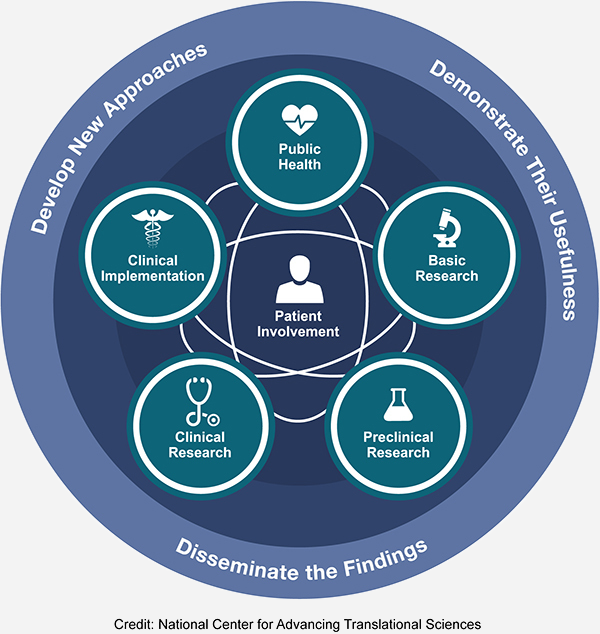
We tackle ongoing challenges in research so that new treatments can reach people faster. We do this by advancing translational science.
Translation is the process of turning observations in the laboratory, clinic and community into interventions that improve the health of individuals and the public — from diagnostics and therapeutics to medical procedures and behavioral changes.
Translational science is the field that generates scientific and operational innovations that overcome longstanding challenges along the translational research pipeline. These include scientific, operational, financial and administrative innovations that transform the way that research is done, making it faster, more efficient, and more impactful.
Translational Science Spectrum
The translational science spectrum represents the stages of research involved in bringing more treatments to all people more quickly.
The translational science spectrum shows the stages of translational research. The stages do not happen in a straight line or in one direction. Each stage builds upon and informs the others. At all stages, our staff and grantees come up with new approaches, prove their usefulness and share the findings. Patient involvement is a key feature of all stages in translation.
Basic Research
Basic research involves scientific exploration that can reveal fundamental mechanisms of biology, disease or behavior. Every stage of the translational research spectrum builds upon and informs basic research. NCATS scientists typically do not conduct basic research; however, insights gained from the center’s studies along the translational spectrum can inform basic research.
Preclinical Research
Preclinical research connects the basic science of disease with human medicine. During this stage, scientists develop model interventions to further understand the basis of a disease or disorder and find ways to treat it. Testing is carried out using cell or animal models of disease; samples of human or animal tissues; or computer-assisted simulations of drug, device or diagnostic interactions within living systems.
Related Research
- Assay Development
- Data Science and Informatics
- Platform Technologies
- Stem Cells
- Therapeutic Discovery and Development
Clinical Research
Clinical research includes studies to better understand a disease in humans and relate this knowledge to findings in cell or animal models; testing and refinement of new technologies in people; testing of interventions for safety and effectiveness in those with or without disease; behavioral and observational studies; and outcomes and health services research. The goal of many clinical trials is to obtain data to support regulatory approval for an intervention.
Related Research
- Clinical Research Network
- Patient and Community Engagement
- Rare Diseases
Clinical Implementation
Clinical implementation involves the adoption of interventions that have been demonstrated to be useful in a research environment into routine clinical care for the general population. This stage also includes implementation research to evaluate the results of clinical trials and to identify new clinical questions and gaps in care.
Related Research
- Clinical Research Network
- Rare Diseases
Public Health
Public health includes studying health outcomes at the population level to determine the effects of diseases and efforts to prevent, diagnose and treat them. Findings help guide scientists working to assess the effects of current interventions and to develop new ones.
Related Research
- Emergent Diseases
Translational Science Principles
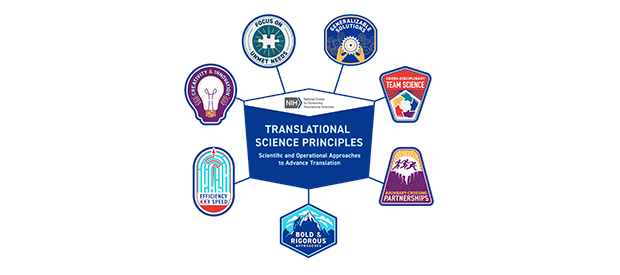
The NCATS Translational Science Principles characterize effective translational science approaches.
NCATS’ mission is to turn biomedical research discoveries into health solutions — including diagnostics, treatments, and interventions — through the application of translational science.
Translational science is the field that generates innovations that overcome longstanding challenges along the translational research pipeline. These include scientific, operational, financial and administrative innovations that transform the way that research is done, making it faster, more efficient, and more impactful.
The NCATS Translational Science Principles stem in part from in-depth case studies of three highly successful NCATS-led or -supported initiatives that span the translational continuum and pursue varied scientific goals. These initiatives use diverse scientific and operational strategies to advance translational progress. But the case studies identified underlying principles that characterized the strategies used across these initiatives.
The NCATS Translational Science Principles also build upon scholarship identifying core competencies for translational science. This includes the Core Competencies in Clinical and Translational Research produced by the CTSA Education Core Competency Working Group, and the Characteristics of a Translational Scientist, produced by Translation Together.
These Principles are intentionally broad. They apply to research anywhere along the translational continuum. They do not prescribe particular strategies, but may be helpful to those involved in the translational enterprise to develop strategies that are specific to their own research goals and aligned with these principles. In addition, they are relevant not only to researchers but to everyone who enables, facilitates or supports translation, including those involved in science leadership, management, and administration, and patient and community engagement.
We see the NCATS Translational Principles as a work-in-progress that will continue to be refined to reflect the community’s growing expertise in translational science. This webpage will be updated periodically to reflect these refinements.
Prioritize Initiatives That Address Unmet Needs
Focus on pursuing scientific goals that address unmet scientific, patient or population health needs.
Example approaches:
- Scientific Needs: Contribute to research advances in under-investigated areas of science or on scientific questions that present unique research challenges or disincentives (e.g., currently untreatable diseases; de-risking targets).
- Patient and Population Health Needs: Advance research to develop solutions for unmet patient and population health needs.
Produce Generalizable Solutions for Common and Persistent Challenges
Develop innovations that address persistent challenges to advancing translational progress that are found across multiple research initiatives or projects, or span research on multiple diseases or conditions.
Example approaches:
- Across Multiple Projects or Initiatives: Advance research by identifying, developing and/or testing solutions to common bottlenecks or roadblocks that have stymied multiple projects. These may be scientific, operational, or administrative in nature.
- Across Diseases or Conditions: Approach research challenges and develop solutions by seeking commonalities across research projects on a range of diseases or conditions.
- Organizational Environment: Enable development and testing of generalizable solutions through organizational policies, organizational structure, and shared resources.
Emphasize Creativity and Innovation
Leverage creativity and innovation in research design, conduct, and facilitating factors, with the goal of increasing the impact of the research.
Example approaches:
- Research Design and Implementation: Pose innovative research questions and develop and implement innovations in research methods, technologies, and approaches that increase the impact of the research, as through pursuit of paradigm-changing goals, or innovations that are generalizable to advancing research across multiple initiatives, diseases and conditions.
- Research Processes and Structures: Develop and implement innovations in research team interactions, leadership and management, partnerships, and operations that facilitate and support the quality and impact of the research.
- Organizational Environment: Enable creativity and innovation through policies that encourage innovations and do not penalize failures.
Leverage Cross-Disciplinary Team Science
Engage team members with expertise across disciplines, fields, and professions to produce research that advances translation along the translational research continuum.
Example approaches:
- Leverage Broad Expertise: Engage colleagues from across disciplines, fields, and professions to advance research along the translational continuum. This may involve leveraging scientific, administrative, financial and operational expertise.
- Integrate Knowledge: Integrate concepts, theories, methods, technologies, and approaches from the range of disciplines, fields, and professions that can contribute to advancing the research goals. Leverage knowledge integration to produce more holistic research designs and findings that are therefore more relevant to real-world applications.
- Organizational Environment: Enable team science via organizational policies, team leadership and management, shared instrumentation and space, and recognition and reward systems.
Enhance the Efficiency and Speed of Translational Research
Implement evidence-informed practices and scientific and operational innovations to accelerate the pace of translational research.
Example approaches:
- Scientific Efficiencies: Develop and implement innovations in scientific approaches, methods and technologies that accelerate the pace of translational research.
- Collaboration Efficiencies: Implement evidence-informed practices to enhance the speed at which collaborations and teams form, develop a shared vision and goals, effectively communicate, and coordinate work tasks.
- Project Management Efficiencies: Implement milestone-based decision making to enable rapid agreement on go/no-go decisions, to enable resources to be used most efficiently.
- Organizational Environment: Reward efficiency, enable rapid failures and encourage redirection of resources to subsequent attempts.
Utilize Boundary-Crossing Partnerships
Leverage collaborations across agencies and sectors and engage patients and communities in research to advance translational progress.
Example approaches:
- Cross-Sectoral Partnerships: Form partnerships across government, universities, and industry to leverage varied expertise and resources to accelerate translational progress. Implement evidence-informed practices for effective cross-sectoral partnerships.
- Patient and Community Engagement: Involve impacted patients and communities as research collaborators to enable research advances across the translational continuum (e.g., via disease registries, clinical trials participation, intervention design). Implement evidence-informed practices for patient- and community-engaged research.
- Organizational Environment: Enable and incentivize boundary-crossing partnerships via leadership, policies, and recognition and reward systems.
Use Bold and Rigorous Research Approaches
Develop ambitious research questions and address them with rigorous and robust methods toward generating reproducible findings that contribute to advancing translation.
Example approaches:
- Bold Scientific Approaches: Explore ambitious research goals that have the potential to produce major advances and/or paradigm shifts. These may be in areas of research that have been historically intractable or where there are high risks of failure.
- Rigor and Reproducibility: Employ rigorous and robust approaches to generate reproducible findings and high-quality FAIR (findable, accessible, interoperable, reusable) data that will enable the research to advance translational progress regardless of whether the initial research objective is met (e.g., learning from failures). To the maximum extent possible, disseminate all parameters utilized to conduct the research (e.g., materials, subjects), research methods and conditions, authentication of reagents and biological resources, data sets, metadata, analytic approaches and statistical tools used for experimentation and data interpretation, results and conclusions, to facilitate reproducibility and/or inform future study designs.
- Organizational Environments: Enable rigorous testing of bold, paradigm-challenging ideas, including high-risk high-reward opportunities. Encourage reporting of information necessary for reproducibility toward informing future studies.
Additional Resources
Publications
Advancing Education and Training through Application of the Translational Science Principles
Faupel-Badger JM, Vogel AL, Austin CP, Rutter JL. Advancing translational science education. Clin Transl Sci. 2022; 15: 2555-2566.
Translational Science Principles Enabling Team Science in NCATS’ Internal Research Program
Vogel AL, Knebel AR, Faupel-Badger JM, Portilla LM, Simeonov A. A Systems Approach to Enable Effective Team Science from the Internal Research Program of the National Center for Advancing Translational Sciences. Journal of Clinical and Translational Science. Cambridge University Press; 2021;5(1):e163.
Teaching Translational Science Principles
Faupel-Badger JM, Vogel AL, Hussain SF, Austin CP, Hall MD, Ness E, Sanderson P, Terse PS, Xu X, Balakrishnan K, Patnaik S, Marugan JJ, Rudloff U, Ferrer M. Teaching Principles of Translational Science to a Broad Scientific Audience Using a Case Study Approach: A Pilot Course from the National Center for Advancing Translational Sciences. Journal of Clinical and Translational Science. Cambridge University Press; 2022:1–26.
Vogel AL, Hussain SF, Faupel-Badger JM. Evaluation of an online case study-based course in translational science for a broad scientific audience: Impacts on students' knowledge, attitudes, planned scientific activities, and career goals. J Clin Transl Sci. 2022;6(1):e82. Published 2022 Jun 7.
Vogel AL, Haynes BM, Hussain SF, et al. Areas of strength and opportunities for growth in translational science education and training: Results of a scoping review from the NCATS Education Branch. Clin Transl Sci. 2023;16(9):1526-1546.