Official websites use .gov
A .gov website belongs to an official government
organization in the United States.
Secure .gov websites use HTTPS
A lock (🔒) or https:// means you've safely connected to the .gov website. Share sensitive information only on official, secure websites.
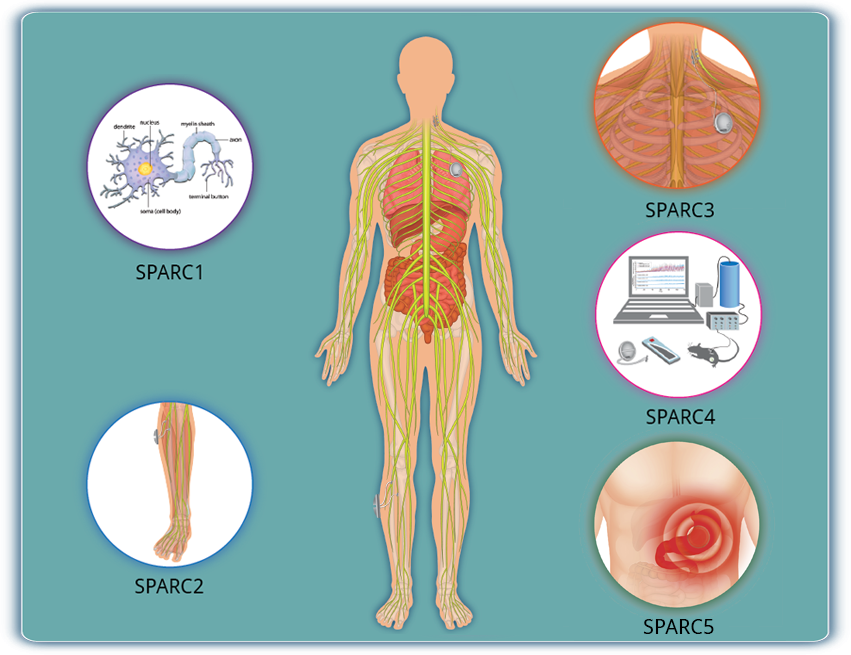
The first stage of the SPARC program supported five key components:
Image
SPARC1 (SP1)
Anatomical and Functional Mapping of the Innervation of Major Internal Organs
SPARC1 supports studies in animal models and humans, including cadaveric tissue, that create new anatomical and physiological data sets to generate and address hypotheses in the following areas:
Image
coursing and branching of nerves and the distribution of axon terminals;
the structure of nerve-organ synapses;
the cross-sectional organization of nerves;
the effect of firing patterns on organ function;
the functional relationships between neural signals and end-organ responses;
the variability in expression/anatomical representation of the neural cell-types at each potential point of implantation of neuromodulation interfaces;
differences in PNS neuroanatomy and control of organ activity between animal models and humans;
translating animal data to human applications;
the variance in effects and side effects between individuals (e.g., inter-individual variability in anatomy and response).
Anatomical and Functional Mapping of the Innervation of Major Internal Organs
SPARC1 supports studies in animal models and humans, including cadaveric tissue, that create new anatomical and physiological data sets to generate and address hypotheses in the following areas:
Image
coursing and branching of nerves and the distribution of axon terminals;
the structure of nerve-organ synapses;
the cross-sectional organization of nerves;
the effect of firing patterns on organ function;
the functional relationships between neural signals and end-organ responses;
the variability in expression/anatomical representation of the neural cell-types at each potential point of implantation of neuromodulation interfaces;
differences in PNS neuroanatomy and control of organ activity between animal models and humans;
translating animal data to human applications;
the variance in effects and side effects between individuals (e.g., inter-individual variability in anatomy and response).
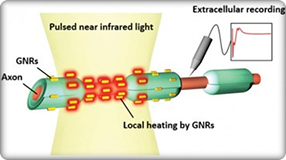
SPARC2 supports the development of tools and technologies to facilitate the progress of other SPARC components, particularly SPARC1. The scope encompasses a wide range of capabilities, spanning the fields of photonics, systems engineering, virology and genomics, device design and manufacture, surface chemistry, tissue engineering, neural interfacing, biomarker sensing, and more.
Image
It is expected that SPARC2 teams will make promising next-generation mapping technologies freely available and that other SPARC teams will adopt these technologies into their research plans. Moreover, documentation, data, and training pertaining to these technologies will be available through the efforts of SPARC4. Ultimately, the knowledge produced by the SPARC program – the comprehensive maps and new insights into translation from animal models to human patients – is expected to inform the next generation of neuromodulation therapies.
SPARC2 supports the development of tools and technologies to facilitate the progress of other SPARC components, particularly SPARC1. The scope encompasses a wide range of capabilities, spanning the fields of photonics, systems engineering, virology and genomics, device design and manufacture, surface chemistry, tissue engineering, neural interfacing, biomarker sensing, and more.
Image
It is expected that SPARC2 teams will make promising next-generation mapping technologies freely available and that other SPARC teams will adopt these technologies into their research plans. Moreover, documentation, data, and training pertaining to these technologies will be available through the efforts of SPARC4. Ultimately, the knowledge produced by the SPARC program – the comprehensive maps and new insights into translation from animal models to human patients – is expected to inform the next generation of neuromodulation therapies.
Translational Partnerships for Human Functional Mapping and New Indications
SPARC3 supports translational partnerships between industry and SPARC investigators to produce proofs of concept for new nerve stimulation indications and to study functional neuromodulation in the context of human clinical studies.
SPARC 3 facilitates these partnerships, through template agreements and leveraging NIH Common Fund support. Moreover, data from these studies may be helpful when integrated with information generated by the Anatomical and Functional Mapping component and the Next Generation Tools and Technologies component.
Translational Partnerships for Human Functional Mapping and New Indications
SPARC3 supports translational partnerships between industry and SPARC investigators to produce proofs of concept for new nerve stimulation indications and to study functional neuromodulation in the context of human clinical studies.
SPARC 3 facilitates these partnerships, through template agreements and leveraging NIH Common Fund support. Moreover, data from these studies may be helpful when integrated with information generated by the Anatomical and Functional Mapping component and the Next Generation Tools and Technologies component.
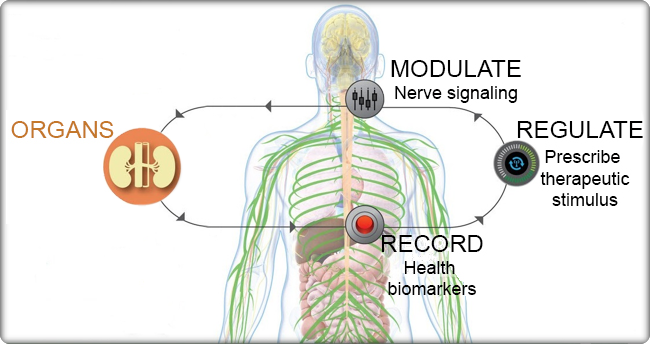
SPARC4 supports the creation of a multifunctional online hub facilitating coordination, synthesis, and prediction via three Core functionalities:
Data Coordination Core [DAT-CORE] – Store, organize, manage, and track access to data and resources generated by SPARC.
Map Synthesis Core [MAP-CORE] – Build interactive, modular, continually updated visualizations of nerve-organ anatomy and function.
Modeling and Simulation Core [SIM-CORE] – Develop an online framework capable of hosting and connecting simulations to create predictive, multiscale, multiphysics models spanning from modulation sources acting from feasible access points to organ functional responses.
The Data and Resource Center (DRC) will host an interactive atlas of human and selected animal peripheral nervous systems, spanning from the end organs under study in SPARC to potential neuromodulation intervention points. Atlas users will be able to design and place nerve stimuli and observe predictions of their end effects at multiple organs, while accounting for user-defined anatomical and physiological parameters. The system will be able to offer a readout of which input uncertainties drive the output uncertainty, providing guidance for where repeated measurements and new experiments are needed.
Image
Funded investigators closely coordinate with the DRC to achieve the following:
Integrate data to generate detailed, predictive, functional and anatomical neural circuit maps for major organs and their functionally-associated structures;
Develop techniques and evidence-based approaches that will allow the research community to interactively access these maps;
Develop therapeutic approaches for disease conditions.
Other activities will include but are not limited to: development of informatics tools, development of ontology and provenance tools, development of standards, curation of data, development or adaptation of common data elements, maintenance of documentation and protocols regarding tools and technologies developed by or brought into the SPARC program, promoting and facilitating data upload and release, and providing a mechanism to protect patient rights and data.
SPARC4 supports the creation of a multifunctional online hub facilitating coordination, synthesis, and prediction via three Core functionalities:
Data Coordination Core [DAT-CORE] – Store, organize, manage, and track access to data and resources generated by SPARC.
Map Synthesis Core [MAP-CORE] – Build interactive, modular, continually updated visualizations of nerve-organ anatomy and function.
Modeling and Simulation Core [SIM-CORE] – Develop an online framework capable of hosting and connecting simulations to create predictive, multiscale, multiphysics models spanning from modulation sources acting from feasible access points to organ functional responses.
The Data and Resource Center (DRC) will host an interactive atlas of human and selected animal peripheral nervous systems, spanning from the end organs under study in SPARC to potential neuromodulation intervention points. Atlas users will be able to design and place nerve stimuli and observe predictions of their end effects at multiple organs, while accounting for user-defined anatomical and physiological parameters. The system will be able to offer a readout of which input uncertainties drive the output uncertainty, providing guidance for where repeated measurements and new experiments are needed.
Image
Funded investigators closely coordinate with the DRC to achieve the following:
Integrate data to generate detailed, predictive, functional and anatomical neural circuit maps for major organs and their functionally-associated structures;
Develop techniques and evidence-based approaches that will allow the research community to interactively access these maps;
Develop therapeutic approaches for disease conditions.
Other activities will include but are not limited to: development of informatics tools, development of ontology and provenance tools, development of standards, curation of data, development or adaptation of common data elements, maintenance of documentation and protocols regarding tools and technologies developed by or brought into the SPARC program, promoting and facilitating data upload and release, and providing a mechanism to protect patient rights and data.
SPARC5 supports detailed anatomical and functional mapping of neural circuitry mediating visceral organ pain. This Common Fund-supported initiative enhances the objectives of the HEAL (Helping to End Addiction Long-termSM) Initiative , an aggressive, trans-agency effort to speed scientific solutions to stem the national opioid public health crisis. Specifically, SPARC5 is a participant in Translational Devices to Treat Pain (TDTP), a joint effort with NINDS and NIBIB to develop device-based approaches for safe, effective, and non-addictive treatment of pain. SPARC5 delivers scientific discoveries and other SPARC resources into the TDTP pipeline, bridging device design and targeting to clinical study. SPARC5 is funded by the NIH Common Fund, and not the NIH HEAL InitiativeSM, and represents an additional commitment by the NIH to address the opioid public health crisis.
It is expected that SPARC5 teams will leverage ongoing mapping activities in SPARC, employ new technologies developed by the BRAIN initiative , and deliver novel therapeutic targets to other TDTP Initiatives. Applicants are encouraged to use devices made available through the SPARC program and the BRAIN initiative , along with template partnership documents developed to assist applicants for these NIH programs when establishing industry collaborations and use of collaborators’ existing medical technology in proposed studies. Ultimately, it is hoped that the translation of these discoveries into effective stimulation devices for non-addictive pain treatment will improve patient outcomes and decrease or eliminate the need to prescribe opioids.
SPARC5 supports detailed anatomical and functional mapping of neural circuitry mediating visceral organ pain. This Common Fund-supported initiative enhances the objectives of the HEAL (Helping to End Addiction Long-termSM) Initiative , an aggressive, trans-agency effort to speed scientific solutions to stem the national opioid public health crisis. Specifically, SPARC5 is a participant in Translational Devices to Treat Pain (TDTP), a joint effort with NINDS and NIBIB to develop device-based approaches for safe, effective, and non-addictive treatment of pain. SPARC5 delivers scientific discoveries and other SPARC resources into the TDTP pipeline, bridging device design and targeting to clinical study. SPARC5 is funded by the NIH Common Fund, and not the NIH HEAL InitiativeSM, and represents an additional commitment by the NIH to address the opioid public health crisis.
It is expected that SPARC5 teams will leverage ongoing mapping activities in SPARC, employ new technologies developed by the BRAIN initiative , and deliver novel therapeutic targets to other TDTP Initiatives. Applicants are encouraged to use devices made available through the SPARC program and the BRAIN initiative , along with template partnership documents developed to assist applicants for these NIH programs when establishing industry collaborations and use of collaborators’ existing medical technology in proposed studies. Ultimately, it is hoped that the translation of these discoveries into effective stimulation devices for non-addictive pain treatment will improve patient outcomes and decrease or eliminate the need to prescribe opioids.
 An official website of the United States government