 An official website of the United States government




Event Details
Description of Event
2022 NIH Freezer Challenge
Eighteen labs and one IC, shown in the table below, participated in the 2022 NIH Freezer Challenge to improve freezer management, increase freezer reliability, and reduce energy consumption.
The challenge was held from January 1 to May 15 of 2022. Challenge initiatives ranged from maintenance options, such as defrosting freezers, to laboratory best-management practices, such as changing the temperature setting of Ultra-Low Temperature (ULT) freezers from -80°C to -70°C. Changing the temperature setting of an ULT freezer from -80°C to -70°C reduces the amount of work that the compressor does, which increases freezer reliability and reduces energy consumption by about 30%.
In total, the 2022 NIH Freezer Challenge resulted in annual savings of 288,258 kWh/year, $28,662/year and 211.84 MTCO2e greenhouse gas emissions/year. These savings are from only from nineteen participants. These results show the power each lab has to increase freezer reliability while also protecting the environment. Imagine what we could do if the entire NIH joined in! Participate in this year's Freezer Challenge to help out!
My Green Lab and the International Institute for Sustainable Laboratories (I2SL) hosts an annual International Freezer Challenge where thousands of labs from private companies, universities and government organizations compete to see who can reduce the most energy consumed by the freezers in their labs. The NIH Freezer Challenge Results were submitted to the International Freezer Challenge.
The table below shows the 2022 NIH freezer challenge participants.
| 2022 NIH Freezer Challenge Participants | |||
|---|---|---|---|
| IC | LAB | PI | Freezer Challenge POC |
| NCI | Laboratory of Cell Biology | Michael M. Gottesman, M.D. | Barbara Murphy, M.S., M.T. |
| NCI | Laboraotry of Human Carcinogenesis | Curtis Harris, M.D. | Adriana Zingone, M.D., Ph.D. |
| NCI | Molecular Oncology and Gene Transfer Section | Dennis Hickstein, M.D. | Thomas Bauer, Ph.D. |
| NEI | Laboratory of Immunology, Molecular immunology Section | Charles Egwuagu, Ph.D. | Cheng-Rong Yu, M.D., Ph.D. |
| NHGRI | Bell Lab | Daphne W. Bell, Ph.D. | Ariana Umana Torres, Ph.D. |
| NHGRI | Childhood Complex Disease Genomics Section | Neil Hanchard, M.B.B.S, Ph.D. | Aparna Haldipur |
| NIAID | Arbovirus Vaccine Research Section | Stephen Whitehead,. Ph.D. | Elaine Lamirande |
| NIAID | Immunobiology and Molecular Virology Unit | Andrea Marzi, Ph.D. | Joseph Rhoderick |
| NIAID | Molecular Pathogenesis Unit | Emmie de Wit, Ph.D. | Brandi Williamson, MPH |
| NIAID | Viral Epidemiology and Immunity Unit | Leah Katzelnick, Ph.D., MPH | Ana Coello Escoto |
| NICHD | Section on Molecular Transport | Sergey Bezrukov, D.Sc, Ph.D. | Megha Rajendran, Ph.D. |
| NIDCD | Section on Human Genetics | Thomas B. Friedman,Ph.D. | Barbara P. Zwiesler |
| NIDDK | Laboratory of Cellular and Developmental Biology | Jurrien Dean, M.D. | Minoo Shakoury-Elizeh, M.S. |
| NIEHS | Comparative Medicine Branch, Quality Assurance Lab | David Kurtz, D.V.M, Ph.D. | Tanya Whiteside |
| NIEHS | Genomic Integrity & Structural Biology Laboratory | Lars Pedersen, Ph.D. | Lars Pedersen, Ph.D. |
| NIEHS | In Vivo Neurobiology | Guohong Cui, M.D., Ph.D. | Amy Papaneri, M.S. |
| NIEHS | RTP Campus Freezer Replacement Initiative | Kerri Hartung/Paul Johnson | |
| NIEHS | Viral Vector Core | Negin Martin, Ph.D. | Negin Martin, Ph.D. |
| NINDS | Translational Neuroradiology Section | Daniel S. Reich, M.D., Ph.D. | Amanda Lee |
A summary of the energy savings, costs savings, and greenhouse gas reductions are shown in the table below. Visit the freezer challenge Power BI report for additional freezer challenge data.
https://nems.nih.gov/sustain/Pages/Freezer-Challenge-Power-BI.aspx
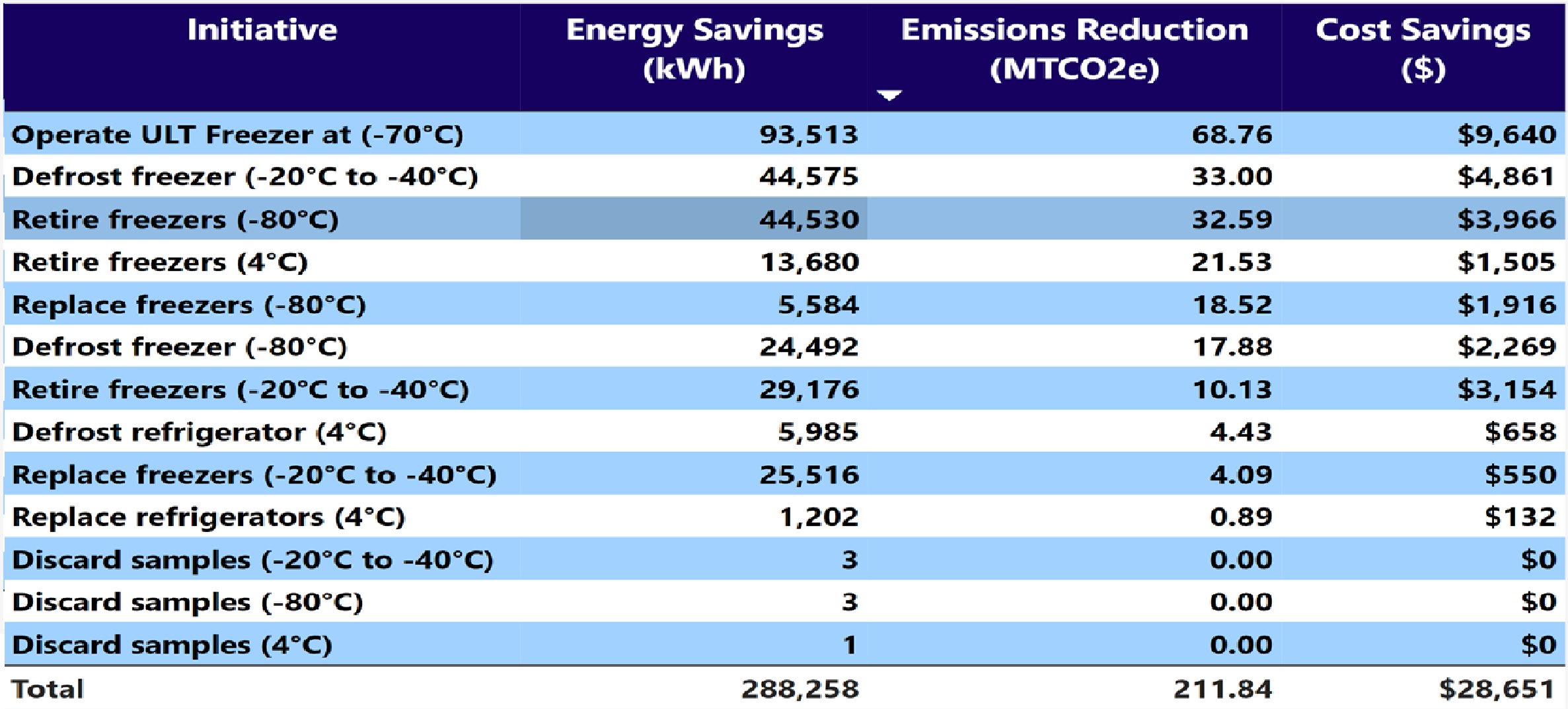
A summary of the initiatives completed as part of the 2022 NIH Freezer Challenge are shown in the table below.
| 2022 Freezer Challenge Initiatives | |
|---|---|
| Challenge Initiatives | Total |
| Change the ULT freezer temperature to (-70°C) | 35 freezers |
| Conduct a complete freezer defrost | 82 freezers and refrigerators |
| Replace old freezers/refrigerators with an energy efficient model | 17 freezers and refrigerators |
| Discard samples that are no longer needed | 19,280 samples |
| Retire unnecessary freezers (-86°C) | 5 freezers |
| Retire unnecessary freezers (-20°C to -40°C) | 9 freezers |
| Retire unnecessary refrigerators (4°C) | 8 refrigerators |
| Maintain an electronic sample inventory | 214 freezers and refrigerators |