 An official website of the United States government




Searching for causes of Buruli ulcers in Ghana
Focus on water
- Water poses complex issues for global health scientists
- An international research collaboration develops clay water filters to reduce diarrheal disease
- Uruguay herbicide test spurs regional interest
- Identifying leptospirosis and saving patients
By Cathy Kristiansen
Buruli ulcers scar, maim and bring misery to thousands of victims each year, but the culprit mycobacterium remains frustratingly difficult to understand. With Fogarty support, scientists have made inroads into understanding this clandestine disease, which crops up near swamps, wetlands, rivers and lakes, and seems tied to human-produced changes to the aquatic environment. The infection occurs mainly in rural parts of sub-Saharan Africa and takes its name from Uganda's Buruli County, where the disease was prevalent in the 1960s.
"They call it the mysterious disease because nobody knows how it's transmitted," said Fogarty grantee Dr. Richard W. Merritt, of Michigan State University. "If you ask, what do you think causes it, you get a variety of answers. It's a tough one."
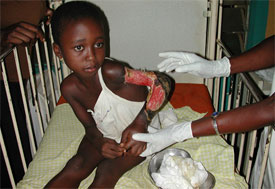
Photo courtesy of Dr. Richard Merritt
Buruli ulcers create devastating sores that can
result in amputation.
Nonetheless, since 2001, Merritt has used his Fogarty Ecology and Evolution of Infectious Diseases grants and other funding to investigate this strange ailment where it is most common, in Ghana. The country records about a thousand new cases annually, mostly in children. Without antibiotic treatment, patients develop extensive ulcers on their limbs and can eventually face amputation.
Pinning it down is difficult for several reasons. "The pathogen is outcompeted by so many other bacteria," Merritt said. "It's very slow growing and requires low oxygen, so it's not easy to culture in the lab." It can be identified using Polymerase Chain Reaction (PCR), a technology used for amplifying DNA sequences, he said, but results risk being contaminated by other microbes.
Although Merritt and his team confirmed the pathogen lurks in the biofilm floating on water and in detritus at the bottom, they're still investigating how humans become infected. "My thought is it may be present in the environment and maybe when the right nutrients are prolific enough - for instance nitrates and/or phosphates from farming - they cause it to multiply to a certain critical level, then it may be transmissible," Merritt said. Suggested vectors include biting aquatic insects, adult mosquitoes, other biting arthropods. In some countries, amphibians and possums have tested positive as reservoirs.
More Information
- Learn more about Dr. Richart Merritt's work on the project Ecological Relationships of Mycobacterium infection , supported by Fogarty's Ecology and Evolution of Infectious Diseases Initiative .
- Access details on the publication of Ecology and transmission of Buruli ulcer disease: a systematic review in PLOS Neglected Tropical Diseases from PubMed.
- Learn more about Buruli ulcers from the World Health Organization (WHO) .
- Learn more about 2013 as the United Nations International Year of Water Cooperation and World Water Day (held annually on March 22).
- Learn more about Water Sanitation Health from the World Health Organization (WHO) .
To view Adobe PDF files, download current, free accessible plug-ins from Adobe's website .