 An official website of the United States government





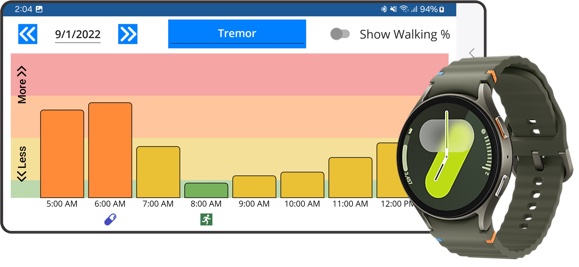
Parkinson’s disease (PD) is complex for clinicians to manage with the tools currently available. Patients make sporadic clinical visits that provide limited information about their daily experience. And therapy optimization can mean years of repeated office visits to get dosing just right: This process has to be repeated as PD advances and therapies adjust. Patients, clinicians, and care providers benefit from a reliable remote patient monitoring system (RPM) that provides real-time monitoring, motor assessment, and automated therapy adjustment.
The global PD treatment market is expected to reach $12.1 billion by 2030. Clinical trials have shown that GLNT’s patented technology can help clinicians adjust medication remotely, personalize medication schedules, improve therapy compliance, identify candidates for advanced therapies (such as deep brain stimulation and drug pumps), and increase referrals to specific therapies. Integrating KinesiaU into existing therapy systems can improve the clinician experience and workflow. It can also create differentiation for a therapy partner by providing a system that identifies when a patient could benefit from a therapy adjustment.
KinesiaU is reimbursable as part of remote patient monitoring, which creates a new revenue stream for clinicians and further increases clinician preference for GLNT therapy partners’ products. Adding KinesiaU as a companion device to an existing therapy may also allow therapy manufacturers with off-patent products (or generics) to extend their proprietary position with a novel delivery/dosing method.
Company Milestones
Scientific and Clinical
- 2014: Kinesia ONE motor-assessment system app released for task-based assessment in research studies.
- 2015: Kinesia 360 motor-assessment system app released for continuous passive monitoring in research studies.
Business
- 2010: GLNT founded as a spinoff from Cleveland Medical Devices Inc. GLNT brought with it the FDA-cleared and CE-marked Kinesia motor-assessment system technology platform.
- 2012: GLNT awarded its first U.S. patent for quantitative assessment of motor symptoms associated with movement disorders.
- 2018: Kinesia StimPoint motor-assessment system released to help with deep brain stimulation programming.
- 2019: First FDA-cleared KinesiaU motor-assessment system released for Android smartwatches that included task-based motor assessment.
- 2022: KinesiaU motor-assessment system released for iPhone and Apple Watch with the addition of continuous passive monitoring.
- 2022: KinesiaU motor-assessment system received United Kingdom (U.K.) Conformity Assessed mark.
- 2023: KinesiaU motor-assessment system recommended by National Institute for Health and Care Excellence (NICE) in the U.K. for remote monitoring of PD.
- 2023: KinesiaU motor-assessment system received CE-mark and cleared for sale in the EU, the United States (, the U.K., Canada, and Australia.
- 2024: Continuous passive monitoring added to the Android version of KinesiaU.
- 2025 (expected): GLNT begins fundraising and enters the remote patient monitoring market.
Financial Overview
The Kinesia technology has been developed and proven in the research market by using more than $40 million in non-dilutive funds from NIH Small Business Innovation Research (SBIR) grants, commercial sales, and internal funding. GLNT now seeks $6 million to grow its sales and marketing staff; expand in the U.S., U.K., and European Union (EU); and develop and stress-test the clinical market over the next 3 years.
Intellectual Property (IP)
GLNT holds more than 50 U.S. and international patents for Kinesia technology, which cover real-time monitoring and data transfers, artificial intelligence (AI) for quantifying symptom severities, adjusting medications, drug pumps, neuromodulation therapy based on motor assessments, and automated therapy adjustments.
Product Development and Regulatory Strategy
GLNT’s Kinesia technology has been cleared by the FDA, marked by the CE marked, and used by more than 20 pharmaceutical companies in clinical trials. KinesiaU is now ready to go beyond the research market and enter the patient care market as part of remote patient monitoring.
Commercialization Strategy
Company Details
Great Lakes NeuroTechnologies, Inc.
Cleveland, Ohio
Industry: Remote patient monitoring for movement disorders
Management Team:
- Dustin Heldman, Ph.D., President and Chief Operating Officer
- Robert N. Schmidt, J.D., Chairman and Chief Executive Officer
- Brian M. Kolkowski, Ph.D., J.D., Executive Vice President and General Counsel
Point of Contact:
Dustin Heldman
dheldman@glneurotech.com
216-361-5410