 An official website of the United States government




BSR AD/ADRD Research Areas
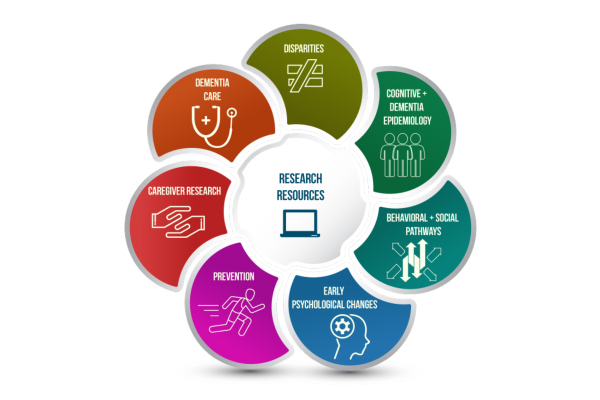
BSR supports social and behavioral research on Alzheimer’s disease and Alzheimer’s disease-related dementias (AD/ADRD) in eight broad categories described below.
Cognitive & Dementia Epidemiology
The cognitive and dementia epidemiology portfolio includes studies of the social, behavioral, economic, environmental, and regional factors that drive national prevalence and incidence of AD/ADRD, as well as national estimates of costs associated with dementia and dementia care.
Topics of interest include:
- Links between environmental exposures, behavioral and social processes, biological (including genetic) risk, and later life cognitive impairment
- Life-course longitudinal studies of age-related change
- Cognitive and dementia measures and biomarker collection in existing BSR-supported longitudinal cohort studies
- International population-based studies that permit cross-national comparisons of cognitive decline
- Dementia prevalence, incidence, and risk or protective factors and related disparities
- Disparities in trajectories of cognitive aging and decline
- Association of dementia with common comorbidities (e.g. diabetes, cardiovascular disease)
- Statistical modeling to estimate impacts of new interventions on population health and health care utilization and costs
Behavioral and Social Pathways
BSR supports research to identify behavioral, social, and biobehavioral risk and protective factors on the pathways to cognitive decline and AD/ADRD.
Topics of interest include:
- The exploration of social and behavioral factors linked with AD/ADRD such as educational attainment, work/occupation, personality, social engagement, smoking, obesity, sleep, physical activity, diet, adverse childhood experiences, socioeconomic status and environmental exposures
- Basic behavioral and social research that elucidates causal mechanisms and processes linking risk and protective factors with cognitive outcomes in later life
- Multidisciplinary longitudinal studies
- Experimental studies that test the malleability of behavioral and social intervention targets that may be linked to cognitive decline and AD/ADRD
- The development of measures of social, psychological, and environmental exposures and constructs for inclusion in future larger scale observational and interventional studies of dementia risk and resilience
Measurement of Psychological and Functional Changes
Alzheimer’s disease and related dementias cause changes in cognition, emotion, social behavior, or changes in everyday functions, like financial decision making, driving, and medication management. BSR is invested in developing sensitive tools for detection of these psychological and functional changes.
Topics of interest include:
- The development and application of new approaches for early and/or passive detection or preclinical change in cognition, affective function, motivation, social function, decision-making and other behaviors
- The development of measures and biomarkers of psychological and functional changes that could serve as intermediate outcome measures for AD/ADRD prevention trials
- Observational studies that document psychological and functional changes and relate them to their neurobiological, genetic, and physiological underpinnings
- Studies that develop new assessment tools to capture psychological and functional changes in AD/ADRD and adapt them for research or clinical purposes
- Studies that elucidate when in the life course and along which dimensions AD/ADRD-related changes in psychological processes or everyday functions diverge from changes observed in normal aging and how these processes and functions change over the course of the disease
AD/ADRD Prevention
BSR supports the development of early, midlife, and later life non-pharmacological interventions to prevent, delay, or remediate age-related cognitive decline and AD/ADRD. BSR encourages behavioral intervention development aligned with the NIH Stage Model. The NIH Stage Model is a framework guiding research that helps to understand the principles and reasons why an intervention works and to ensure resources are developed to support the use of the intervention in real-world settings. A 2024 NIH-commissioned report from the National Academies of Science, Engineering, and Medicine identified research opportunities related to AD/ADRD prevention: Research Priorities for Preventing and Treating Alzheimer’s Disease and Related Dementias .
Topics of interest include:
- Interventions that address affective, social, or cognitive changes associated with AD/ADRD, including interventions focused on health behavior change (sleep, exercise, smoking, diet), cognitive training and cognitive engagement, meditation and other mind-body approaches, or social engagement
- Interventions targeting malleable psychological, behavioral, social, or environmental factors related to cognitive decline and cognitive resilience across the life course
- Interventions to enhance cognitive reserve
- Interventions to reverse or compensate for liability for premature cognitive decline and dementia linked to adverse exposures in early life (e.g., neglect, deprivation, threat/abuse, malnutrition).
Care Partner/Caregiver Research
BSR supports a broad range of research on the health, wellbeing, and empowerment of care partners or caregivers of persons living with dementia. Research is encouraged that focuses on the unique needs and experiences of care partners from all populations affected by AD/ADRD as well as the special challenges associated with caregiving for individuals in vulnerable groups, including those at risk of elder mistreatment and those living alone with dementia in the community.
Topics of interest include:
- The demography of caregiving
- Economic impacts of caregiving
- Promoting health and wellbeing in care partners
- Behavioral intervention development focused on the care partner or the care partner and the person living with dementia together
- Care partner management of communication, decision making, and care planning
- Care partner identification within clinical settings and in population-based studies
Dementia Care
BSR supports a wide range of research on how healthcare and other types of care provided (including long term services and supports and home and community-based services) impact the health and wellbeing of persons living with dementia, their families, and society.
Topics of interest include:
- The development, testing, implementation, and dissemination of dementia care models or interventions
- Studies of the design, organization, and financing of dementia care across a variety of settings and their impact on health, healthcare utilization, and well-being of persons living with dementia
- Research on how institutional and economic factors influence incentives, access, quality, and health outcomes for persons living with dementia
- Trends and differences in care expenditures and other burdens across settings and racial/ethnic groups
- Assessing the level of unmet needs for long-term services and supports (LTSS)
- Characteristics and training needs of the paid dementia care workforce
- Economic impact of dementia care on individuals, families, and society
- The impact of dementia diagnosis
- The lived experience of persons living with dementia, including those living alone or without caregivers
- Technologies for aging in place
- Elder mistreatment
- Access to and quality of dementia care and care transitions
Health Disparities
BSR supports research on social and behavioral determinants of health to identify causal drivers of individual and population variation in dementia-related outcomes.
Topics of interest in this portfolio include:
- Understanding the social, behavioral, and environmental sources of AD/ADRD health disparities
- Tools to assess early changes in cognition and other functions in different contexts in population subgroups
- Behavioral interventions for prevention of cognitive decline and dementia that include consideration of factors including social determinants of health, race/ethnicity, sex, geographic region, and socioeconomic status
- Disparities in quality, access, and outcomes of dementia care and caregiver support interventions
The inclusion of study participants from relevant population subgroups in sufficient numbers to conduct health disparities investigations is a BSR and NIA priority.
Research Resources
BSR supports resources to support AD/ADRD research and training in all our research areas. Research resources include AD/ADRD focused Centers and Networks, Training and Career Development Awards, Conferences and Short Courses, and publicly available data repositories, infrastructure, bioinformatics and methods, and trial design innovations. BSR has long made it a priority to invest in establishing, maintaining, linking, and leveraging publicly available data infrastructure that enables a wide range of aging- and AD/ADRD-related research.
- Centers on Demography and Economics of Aging and AD/ADRD
- Roybal Centers for Translational Research in the Behavioral and Social Sciences of Aging and AD/ADRD
- NIA Imbedded Pragmatic AD/ADRD Clinical Trials (IMPACT) Collaboratory
- Artificial Intelligence and Technology Collaboratories (AITC) for Aging Research
- BSR Research Networks
- BSR Data Resources
AD/ADRD Research Program Contacts
Visit our About BSR page to learn more about BSR branches and offices and how to contact them. You may also reach out to BSR’s Office of AD/ADRD Strategic Coordination (OASC) and they can put you in contact with the correct staff member.
AD/ADRD Funding Opportunities in AD/ADRD Research
Investigators may submit their AD/ADRD applications to any Parent Notice of Funding Opportunity (NOFO) in which NIA participates.
A list of active funding opportunities for behavioral and social research on AD/ADRD can be found here .
NIA and the National Plan to Address Alzheimer's Disease
In January 2011, the National Alzheimer’s Project Act was signed into law, calling for a coordinated national plan to accelerate research on AD/ADRD and to provide better clinical care for persons living with dementia and their care partners.
The Advisory Council on Alzheimer’s Research, Care, and Services established the National Plan to Address Alzheimer’s Disease , which set six ambitious goals to both prevent future cases of AD/ADRD and better meet the needs of persons living with dementia and their families. Learn more about NIA’s commitment to the National Plan to Address AD/ADRD .
AD+ADRD Research Implementation Milestones
Informed by the National Plan and engagement with the research community and public through the AD/ADRD Research Summits, NIA developed the AD+ADRD Research Implementation Milestones . These milestones span basic, translational, clinical, and health services research.
In 2024, NIA announced 8 new AD/ADRD Care Research Implementation Milestones. Details can be found on the 2023 Dementia Care Summit website .
International Alzheimer's and Related Dementias Research Portfolio
The International Alzheimer’s and Related Dementias Research Portfolio (IADRP) is a database that captures AD/ADRD research projects by public and private funders both in the United States and throughout the world. IADRP allows for coordination of research, leverage resources, avoid duplication, and identify new research opportunities. Each project is categorized using Common Alzheimer’s and Related Dementias Research Ontology (CADRO) to organize and compare research projects using common terminology.
Triennial AD/ADRD Research Summits, including the Dementia Care and Caregiving Research Summit
NIH hosts three annual research summits that respond to the National Plan to Address Alzheimer’s Disease: The Alzheimer’s Research Summit , the Alzheimer’s Disease-Related Dementia Summit , and the Dementia Care and Caregiving Research Summit. Each summit provides an opportunity for individuals to share perspective on critical scientific gaps and opportunities in AD/ADRD research. The summits can inform updates to the NIH AD+ADRD Research Implementation Milestones that address the National Plan.
The 2023 Dementia Care and Caregiving Research Summit built on progress of the previous Summits to review research progress, highlight innovative and promising research, and identify remaining unmet research needs with input from the research community, persons living with dementia (PLWD) and their care partners, those who provide healthcare or services and supports to persons living with dementia, and other stakeholders. Lived Experience and Stakeholders panels were convened to solicit feedback both from persons living with dementia and their care partners/caregivers, as well as from a variety of formal dementia care and caregiving stakeholders, including direct care workers, health services providers, patient advocates, payer representatives, and researchers.
Visit the 2023 Dementia Care and Caregiving Research Summit webpage to see the agenda, watch the meeting recordings, view the gaps & opportunities, and see the newly developed Research Implementation Milestones.
Read the Summit report
AD/ADRD Clinical Trials
NIA encourages investigators to consult the following resources when considering the development of interventions focused on individual or institutional/organizational behavior change for AD/ADRD prevention, treatment, and care:
- NIH Stage Model for Behavioral Intervention Development
- Resources developed by the NIH Science of Behavior Change
- The Stage Model training video
- Clinical Research Operations and Management System (CROMS)
Visit the website for more information and guidance on BSR Clinical Trials.
DBSR