 An official website of the United States government




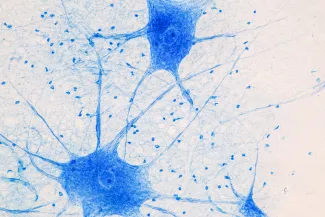
Motor neurons (blue) degenerate and die in conditions such as ALS.
Several brain and nerve cell diseases, including amyotrophic lateral sclerosis (ALS), frontotemporal dementia (FTD), and some cases of Alzheimer’s disease, are linked to problems with a protein called TDP-43. TDP-43 is a protein in the cell nucleus that helps cells process RNA correctly. This ensures that genes produce the proper instructions needed for normal cell function. When TDP-43 forms clumps called aggregates outside the nucleus, it leads to neuron death and symptoms such as muscle weakness and memory loss.
Past research has shown that when certain RNAs interact with TDP-43, they can reverse or prevent its aggregation. This makes them an intriguing therapeutic option for diseases linked to TDP-43 aggregation. Short RNAs have the advantage of being easily delivered to neurons. However, it remained unclear how these RNAs prevent TDP-43 from aggregating.
An NIH-funded research team, led by Dr. James Shorter of the University of Pennsylvania’s Perelman School of Medicine, set out to investigate. Their study was published in Science on May 7, 2026.
The scientists had previously found that a short RNA with a particular sequence, called Clip34, can stop TDP-43 from forming aggregates. In the new study, they discovered that Clip34 stabilizes two RNA-binding sections of TDP-43 to make the protein less prone to aggregate.
In a test tube, Clip34 prevented aggregation of normal TDP-43 and multiple mutated forms of the protein. The researchers also altered Clip34’s sequence to improve its ability to prevent aggregation of another abnormal form of TDP-43.
The team identified several other short RNAs that could prevent aggregation of multiple forms of TDP-43. The most effective was an RNA they call Malat1_start. This RNA restored isolated TDP-43 to its normal form even after the protein had already formed aggregates. Malat1_start also reduced TDP-43 aggregation that was induced in cells by the researchers. Importantly, Malat1_start did not interfere with TDP-43’s normal function.
Malat1_start and Clip34 restored TDP-43 to its normal location in the nucleus of motor neurons grown from patients with ALS. In addition, Malat1_start restored TDP-43 function that was impaired by cellular damage in stressed motor neurons. Finally, in mice with TDP-43 aggregates in motor neurons, Malat1_start partially reversed TDP-43 aggregation, restored TDP-43 function, and reduced neuron death.
The results provide support for continued testing of short RNAs that target TDP-43. If further studies yield promising results, those RNAs might eventually be developed into therapeutic strategies to help treat multiple neurological diseases linked to TDP-43.
“We have shown that this RNA-chaperone approach also works for FUS protein in ALS/FTD, and we suspect it can be extended to other RNA-binding proteins that are getting into trouble, such as tau in Alzheimer’s diseases cases,” Shorter says.
— by Brandon Levy
NIH’s National Institute of Neurological Disorders and Stroke (NINDS), National Institute on Aging (NIA), National Center for Advancing Translational Sciences (NCATS), and National Institute of General Medical Sciences (NIGMS); Office of the Assistant Secretary of Defense for Health Affairs; National Science Foundation; ALS Association; Alzheimer’s Association; Mildred Cohn Distinguished Postdoctoral Award; Massachusetts General Hospital; ALS Finding a Cure; FightMND; American Heart Association; AstraZeneca; Johnson Foundation; Motor Neurone Disease Association; UK Dementia Research Institute; UK Medical Research Council; Francis Crick Institute; Cancer Research UK; UK Medical Research Council; Wellcome Trust; University of Pennsylvania Department of Biochemistry and Biophysics; LiveLikeLou Center for ALS Research at the University of Pittsburgh; Farber Family Foundation; Family Strong 4 ALS; Association for Frontotemporal Degeneration; Amyotrophic Lateral Sclerosis Association; Institute for Translational Medicine and Therapeutics; Kissick Family Foundation; Milken Institute Science Philanthropy Accelerator for Research and Collaboration.
Short RNA chaperones promote aggregation-resistant TDP-43 conformers to mitigate neurodegeneration. Copley KE, Mauna JC, Danielson HL, Chen Q, Ozguney B, Ngo M, Xie L, Smirnov A, Davis M, Mayne L, Linsenmeier M, Rubien JD, Bergmann CA, Portz B, Lee BL, Odeh HM, Lai L, Chang YW, Hallegger M, Ule J, Pasinelli P, Poon Y, Mittal J, Fawzi NL, Black BE, Donnelly CJ, Jensen BK, Shorter J. Science. 2026 May 7;392(6798):eadv3301. doi: 10.1126/science.adv3301. Epub 2026 May 7. PMID: 42096556.