 An official website of the United States government




What is the Consortium of Universities for Global Health (CUGH)?
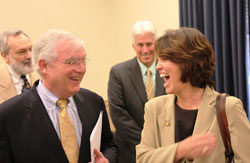
Rep. Betty McCollum, D-Minn., greets Duke
University’s Dr. Michael Merson at a Capitol
Hill briefing she hosted as co-chair of the
Congressional Global Health Caucus. Also
pictured are Boston University’s Dr. Gerald
Keusch and Dr. Donald Thea.
Related News
- Universities meet to consider global health challenges at CUGH 2014 annual meeting
May / Jun 2014 Global Health Matters - Partnerships, capacity building needed to strengthen universities in developing nations
Mar / Apr 2013 Global Health Matters
Focus on Global Health on Campus
- Stars are aligned for global health programs at universities
- Global Health on campus gains enthusiasm
- Collaborations spur biomedical innovations
- USC tries video games as teaching tool
The Consortium of Universities for Global Health (CUGH) sprang from an idea conceived by former Fogarty Director Dr. Gerald Keusch. Last year, it held its first organizing meeting among 20 members at the University of California, San Francisco.
There are 58 members now, and the four criteria for membership are:
- A well-established global health program
- An interdisciplinary program nearly always involving more than one school
- Activities encompassing education and training, research and service
- A well-established and functioning international partnership
Dr. Haile T. Debas of the University of California, San Francisco, chairman of the founding board of directors, outlines some of the Consortium's first priorities:
- Defining what is meant by global health education in terms of curricula and competencies
- Collaborating among members in research, training and service
- Developing a common "platform" for members to facilitate their work overseas
- Developing policy and advocacy in support of global health
- Creating international partnerships for human and institutional capacity building
"I am hopeful that the Consortium will ensure that we catch the crest of the wave of excitement and idealism in our students and faculty to make universities a transforming force in global health," Debas says.
To view Adobe PDF files, download current, free accessible plug-ins from Adobe's website .