 An official website of the United States government




Water poses complex issues for global health scientists
Focus on water
- An international research collaboration develops clay water filters to reduce diarrheal disease
- Searching for causes of Buruli ulcers in Ghana
- Uruguay herbicide test spurs regional interest
- Identifying leptospirosis and saving patients
By Cathy Kristiansen
Water is essential to human life. Yet in many parts of the world it carries deadly toxins, parasites or bacteria that cause disease.
Water also plays a vital role in the environment, socio-economic development and poverty reduction. For these reasons, 2013 has been named International Year of Water Cooperation , to raise awareness of the issues surrounding water and encourage increased global collaboration to solve them. In many regions, clean water is becoming increasingly scarce due to population growth, urbanization, pollution and climate change.
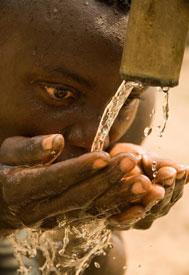
Photo by Scott Harrison/
Photoshare
Fogarty supports crosscutting
efforts to tackle health threats
related to contaminated water,
disease-bearing insects and
climate change.
Fogarty's crosscutting programs are combating these problems in a number of ways. Some grantees are tracking the impact of rising temperatures on waterborne pathogens, devising economical field tests to detect chemical contamination from farming and helping develop new tools to purify drinking water.
Others are investigating how deforestation is affecting populations of malarial mosquitoes and the spread of disease, studying how to prevent mining from polluting groundwater and and finding ways to treat people with arsenic poisoning from contaminated water.
Fogarty grants are also cultivating multidisciplinary, innovative approaches to water health issues, including developing expertise in topics that range from engineering, to chemistry, to forestry. An award to the University of North Carolina is helping to build an overarching system for managing water and sanitation research that is intended to spur policy change.
Did you know?
- 783 million people still rely on unimproved drinking water sources
- 2.5 billion people still lack access to improved sanitation facilities
- 1.1 billion people practice open defecation
WHO data from 2010
Across the NIH, grants have been awarded to scientists studying how to eliminate intestinal worms spread through water, as well as insect-borne diseases such as dengue and river blindness, that flourish during rainy seasons. Additional projects study ways to prevent and treat cholera and other diarrheal diseases.
Meanwhile, a team of Fogarty's in-house epidemiologists are collaborating with Pakistan's Aga Khan University, to investigate the interplay between water and sanitation conditions with diarrheal and other diseases among children, in addition to training local scientists and health care workers.
Although some water-related health issues can be solved merely by finding a way to supply clean drinking water, others are more complex and pose thorny research questions that remain to be answered.
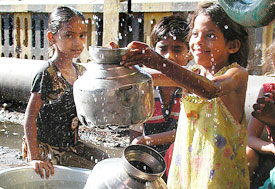
Photo by Rajendra Malviya/Photoshare
More Information
- Learn more about 2013 as the United Nations International Year of Water Cooperation and World Water Day (held annually on March 22).
- Learn more about Water Sanitation Health from the World Health Organization (WHO) .
Other Water Resources
To view Adobe PDF files, download current, free accessible plug-ins from Adobe's website .