 An official website of the United States government




Uruguay herbicide test spurs regional interest
Focus on water
- Water poses complex issues for global health scientists
- An international research collaboration develops clay water filters to reduce diarrheal disease
- Searching for causes of Buruli ulcers in Ghana
- Identifying leptospirosis and saving patients
By Cathy Kristiansen
What started as an initiative to protect Uruguayan drinking water from an herbicide commonly used by rice farmers has blossomed into an international network of budding researchers focused on solving water problems in Latin America. With Fogarty support, researchers and trainees are teaching others how to develop and use molecular-based tests to measure water purity.
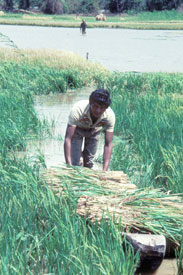
Photo by Yosef Hadar/World Bank
Researchers in Uruguay devised
a simple test to measure herbicide
levels in water.
The project began in 2001, when Dr. Jerold A. Last of the University of California (UC), Davis, received his first International Training and Research in Environmental and Occupational Health grant. This Fogarty program aims to nurture trainees from a variety of disciplines to help developing countries and emerging democracies develop capacity in both environmental and occupational health.
Last's group wanted to find a low-cost way to detect the herbicide clomazone in water. Uruguayan farmers use clomazone extensively to kill weeds and raise crop yields, but at harvest time when they need to drain their watery fields, residue chemicals can end up in the groundwater and community drinking water, posing a risk to human and environmental health. Clomazone can cause liver disease in animals, and potentially humans, and disrupt fish reproductive hormones.
To devise and test a tool farmers could use to measure clomazone concentrations, UC Davis collaborated with Uruguay's Universidad de la Republica to teach students skills in molecular techniques, laboratory work and epidemiology. The initiative focused on adapting so-called ELISA technology - enzyme-linked immunosorbent assays - to measure clomazone concentrations. ELISA tests are rapid and cost-effective.
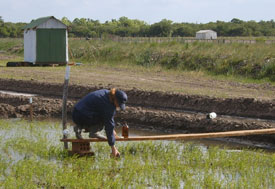
Photo by Guillermina Cantou
With Fogarty support, researchers and trainees are
teaching others how to develop and use molecular-
based tests to measure water purity.
Efforts in Uruguay were just the beginning. The scientists reached out to their colleagues elsewhere in Latin America to present workshops, host trainees and offer online curricula.
"Experts in Uruguay have adapted a short course held in Guatemala, Peru, Chile, Paraguay and Brazil and essentially not only exported the technology, but made assay kits and gave them away, so those other countries could be self-sufficient in doing tests for a large variety of environmentally relevant chemicals," Last said. "Countries in that part of the world are not used to collaborating across borders, but we are beginning to see this change."
More Information
- Read the article A Clomazone Immunoassay To Study the Environmental Fate of the Herbicide in Rice (Oryza sativa) Agriculture from the March 19, 2010 issue of the Journal of Agricultural and Food Chemistry.
- Learn more about Dr. Last's work on the project International Training Program in Environmental Toxicology and Public Health , supported by Fogarty's International Training and Research in Environmental and Occupational Health program.
- Learn more about 2013 as the United Nations International Year of Water Cooperation and World Water Day (held annually on March 22).
- Learn more about Water Sanitation Health from the World Health Organization (WHO) .
To view Adobe PDF files, download current, free accessible plug-ins from Adobe's website .