 An official website of the United States government




Research targets new diagnostics, drugs and vaccines for TB
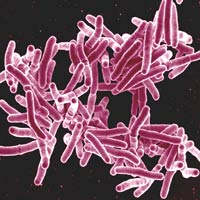
Mycobacterium tuberculosis (Mtb)

Focus on NIAID
- About NIAID
- HIV/AIDS: 30 years of hard-won victories
- Q & A with Tony Fauci
- NTDs and the skewed burden of disease
- NIAID-funded centers seek to enhance malaria control
- Basis for key parasite function in malaria found
- ICER program fosters research collaborations in developing countries
- Centers expand global reach of influenza research
- Funding and training for foreign scientists
- Giant steps in the battle against HIV/AIDS: opinion by Fogarty Director Dr. Roger I. Glass
The tuberculosis research program at the National Institute of Allergy and Infectious Diseases (NIAID) includes domestic and international efforts to develop new tools and strategies to help control TB. In 2009, an estimated 9.4 million new cases of TB were reported worldwide and an estimated 1.7 million people died of the disease. NIAID is leading and sponsoring research activities to create a foundation of knowledge for the discovery of new diagnostics, drugs and vaccines for drug-resistant and drug-sensitive TB. Many of these programs are providing critical information to advance the scientific understanding of TB.
Caused by the bacterium Mycobacterium tuberculosis (Mtb), TB remains one of the major causes of disability and death worldwide. The BCG vaccine, the only TB vaccine approved for human use, provides limited protection against immediate TB illness but does not prevent reactivation of latent infection, in which Mtb persists in human cells for years and may later develop into active disease.
In 2010, a test designed to easily diagnose TB and detect a drug-resistant form of the bacterium was shown to provide much more specific, sensitive and rapid results than currently available TB diagnostics. Known as the Xpert MTB/RIF test, when evaluated in a large clinical trial, it successfully identified 98 percent of all confirmed TB cases and 98 percent of patients with rifampin-resistant bacteria in less than two hours.
A recent study supported by NIAID and Fogarty has added compelling evidence that new, simpler and shorter treatment regimens using antibiotic drugs could dramatically help prevent tens of millions of people worldwide already infected with Mtb, and especially those co-infected with HIV, from developing full-blown TB.
The study, published in the New England Journal of Medicine by an international team of scientists, found the most streamlined combination - a high-dose pairing of 900 milligrams each of the newer antibiotic rifapentine and traditional isoniazid once weekly for three months - worked just as well or even better than 300 milligrams of isoniazid taken daily for six months or longer and widely considered the gold standard of care.
In another study, a team of European and U.S. researchers has found that a new vaccine strategy tested in mice provides better protection from TB infection than the BCG vaccine. Their findings were published recently in the journal Nature Medicine.
More Information
- Visit the NIAID Tuberculosis Web portal .
- View or download the full article New Regimens to Prevent Tuberculosis in Adults with HIV Infection from the New England Journal of Medicine.
This article was adapted from the NIAID January 25, 2011 News Release Collaboration Fuels Promising New Approach to a TB Vaccine.
-
ghmjul-aug2011.pdf (2.18 MB)
To view Adobe PDF files, download current, free accessible plug-ins from Adobe's website .