 An official website of the United States government




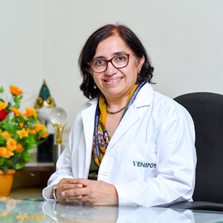
Vina Vaswani, MD: Integrating ethics into technology from the start
On December 3, 1984, more than 40 tons of methyl isocyanate gas leaked from the Union Carbide India Limited pesticide plant in Bhopal, India. The plume immediately killed at least 3,800 people and a total of 10,000 people died over the first few days, according to a 2005 paper published in Environmental Health. Up to 20,000 premature deaths occurred in the subsequent two decades.
“At that time I was in year two of my medical degree,” says Vina Vaswani, MD, a forensic medicine specialist at Yenepoya University. Two people showed up at the medical college hospital, nearly 350 kilometers from Bhopal. After boarding a train, they’d lost consciousness, so strangers brought them to the hospital. Years later, Vaswani was traveling with victims of this tragedy who received treatment as participants in a clinical trial. “When I asked, ‘Do you know this is part of research?’ They said, ‘No.’”
This was typical of Indian research at that time, she says. “Doctors who were conducting research would say, ‘If it works out, it will be for their benefit, so you don't have to tell patients it’s research.’” Also at that time, forensic professionals taught ethics because they were part of the jurisprudence system. A forensic doctor herself, Vaswani taught the code of ethics, which essentially meant training doctors to avoid negligence charges. “I said, surely this can't be ethics, because who is at the center of activity? A doctor, not the patient.”
Wanting to learn more, Vaswani looked to Europe. She came across the Erasmus Mundus program, an EU initiative to foster international collaboration, which offered a year-long ethics program at three European universities. A few years after Vaswani completed the program, her medical college became a full university (Yenepoya) and established the Centre for Ethics. The flagship program was the Post Graduate Diploma in Bioethics and Medical Ethics, which was the first In India bioethics diploma program. (The Centre for Ethics, 15 years old now, has more than 350 alumni.) Along with performing autopsies, she began to teach bioethics.
The Ethical Use of AI Tools in Global Health Research
- The Ethical Use of AI Tools in Global Health Research
- Rosamond Rhodes, PhD: Medical ethics from a constructivist perspective
- Cheryl Macpherson, PhD: Bilingual ethics training in the Caribbean
- Henry Silverman, MD: Brainstorming with AI to generate knowledge
“We began a collaboration with Johann Gutenberg University in Germany in 2011, and started a postgraduate diploma program in clinical ethics,” Vaswani explains. In 2014, she and her colleagues wrote an NIH grant application. “We were quite naïve, but somehow we made it happen.” The Yenepoya University-Fogarty International Center Research Ethics Master's Program taught students foundational bioethics as well as cutting edge research ethics, relevant to the global and local context, while answering basic questions about respect, human dignity, and autonomy of patients. It ran from 2018 through 2023 and trained 33 master’s students, who are meaningfully employed or pursuing PhDs today.
Vulnerability is the focus of Vaswani’s ethics. “Educating a patient or a study participant is one of the most important duties of a doctor or a researcher. And if you're on an ethics committee, you are the last bastion, so you must make sure that there's justice and no exploitation of study subjects.”
Today, biomedical research ethic standards in India are good, still “AI is a black elephant in a black room with five blind men feeling it with their hands and each explaining a part but thinking it’s the whole.” Ethics should be integrated into technology development and evolve alongside it, “otherwise people will not trust the technology, and they will no longer trust the doctors using it.”
More information
- Dr. Vina Vaswani's bio via Centre for Ethics
- The Bhopal disaster and its aftermath: a review , Environmental Health, May 10, 2005
- Human and artificial intelligence: a review of competencies, collaboration, and ethical implications , Palgo Journal of Education Research, 2025
- Related Fogarty grant: Yenepoya University-Fogarty International Center Research Ethics Master's Program for India
Updated April 17, 2026
To view Adobe PDF files, download current, free accessible plug-ins from Adobe's website .