 An official website of the United States government




Viral outbreaks escalating as animal-human contact rises
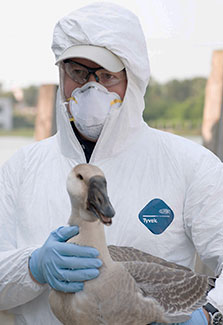
Photo courtesy of EcoHealth Alliance
NIH Grantee Dr. Peter Daszak has extensively
studied animal-human contact in China.
By January W. Payne
Researchers may never discover exactly how the current novel coronavirus outbreak began. Nonetheless they agree that as humans have changed the way they interact with animals and the environment, emerging infectious diseases are rapidly growing in frequency. Accelerating rates of deforestation, global trade and travel, and livestock production are thought to be the underlying drivers of so-called “spillover” events, when diseases jump from animals to humans. Bats are the suspected source of the virus that causes COVID-19, as was the case with the Ebola outbreak that began in 2014, MERS in 2012, SARS in 2002, and others.
“It’s important to try and find out what happened because we need to decide how best to prevent future outbreaks,” noted Dr. Peter Daszak, an NIH grantee who has extensively studied colonies of bats carrying coronavirus in rural China. In the case of COVID-19, one possibility is the virus may have been transmitted from bats to farmed wildlife or livestock, and then to humans.
Daszak, who is president of the nonprofit EcoHealth Alliance, recently published a study of zoonotic risk factors among rural communities in southern China , partly funded by the NIH’s National Institute of Allergy and Infectious Diseases (NIAID) . Through extensive interviews, he and his team documented the participants’ close human-animal interactions that increase the likelihood of zoonotic disease emergence. The researchers suggested education, conservation and other measures could lessen the risk.
Study participants were questioned about their knowledge and attitudes regarding contact with animals. One expressed the belief that consuming bats can prevent cancer, and another said the meat provides vitality. These firmly held opinions are why Daszak doesn’t believe an outright ban on China’s wildlife trade is the answer. “A better strategy might be to identify some wildlife that are farmed that could be managed more safely,” he said. Then the younger generation could be encouraged to influence their relatives to consider those less risky meat options.
Even as current mitigation strategies aim to contain the spread of COVID-19, it is just as important to track the virus over time. This allows researchers to estimate the scale and speed of outbreaks, to identify potential at-risk groups of people, and to monitor the possible emergence of new strains, vaccine or drug-resistant strains, or more pathogenic viral variants, said Dr. Michael Letko, an NIAID virologist.
“Scientists do not really know which animal coronaviruses are able to infect humans just by looking at the viral sequence,” Letko explained. “Understanding how viruses mutate to cross the species barrier better helps us understand the ever-growing genomic data we currently have on all the different circulating animal viruses,” he said.
NIH’s zoonotic research is based at Rocky Mountain Laboratories in Montana. Part of NIAID, it’s a state-of-the-art biomedical facility designed for studies of highly pathogenic viruses. Most of the scientists there are researching animal models, vaccines or other topics related to SARS-CoV-2, the virus that causes COVID-19. Letko said he is investigating several new animal viruses related to SARS-CoV-2 that have been discovered since the outbreak started, as well as determining if the virus has a unique mechanism that facilitates transmission.
Fogarty supports studies of emerging global threats through its Ecology and Evolution of Infectious Diseases (EEID) program. Daszak received his first U.S. government grant through the initiative , which he used to explore the dynamics and origins of Nipah and Hendra viruses in Malaysia and Australia. Calling the EEID program “visionary, ground-breaking and high-reward,” Daszak said the initiative is one of the few to support projects that test hypotheses on how environmental changes drive emerging diseases, or how socioeconomic systems alter transmission dynamics of pathogens across wildlife-livestock-human interfaces. “This is exactly how COVID-19 emerged—and these complex dynamics will never be understood simply by sequencing, lab virology or a single-discipline approach,” he said.
As outbreaks of emerging infectious diseases increase in frequency and impact, Daszak said it’s important to increase global preparedness. “I believe that funding programs to do spillover research, to build public health capacity, strengthen lab networks and train our colleagues in these regions will help prevent pandemics, and give an incredible return on investment.”
More Information
- Related grant: Understanding the risk of bat coronavirus emergence , supported by NIH's National Institute of Allergy and Infectious Diseases (NIAID)
- Related publication: A qualitative study of zoonotic risk factors among rural communities in southern China
International Health via PubMed, February 10, 2020 - Related publication: Perspective: Escaping Pandora's box - Another novel coronavirus
The New England Journal of Medicine via PubMed, February 26, 2020 - Related grant: The ecology, emergence and pandemic potential of Nipah virus in Bangladesh , supported by the NIH-NSF Ecology and Evolution of Infectious Diseases (EEID) Initiative
- Bio: Dr. Peter Daszak , President, EcoHealth Alliance
- Genomic epidemiology of novel coronavirus - Global subsampling
Nextstrain, a real-time tracking of pathogen evolution - NIAID's Rocky Mountain Laboratories
- NIAID coronaviruses overview and information for researchers
- Coronavirus news, funding and resources for global health researchers from Fogarty
To view Adobe PDF files, download current, free accessible plug-ins from Adobe's website .