 An official website of the United States government




New handheld device transforms microscopy
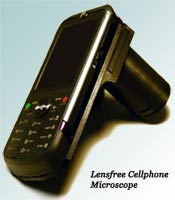
Photo courtesy of Aydogan Ozcan
Recovery Act funding will allow
the University of California, Los
Angeles to train post-docs to
develop and test tools for use
in resource-poor settings, such
this microscope attached to a
hand-held device.
Focus on Mobile Health
- Mobile health innovations advance research
- Cell phones help Turkish smokers quit
- Dengue monitored with cell phones
- Text4baby educates new mothers
- Guest Opinion: Approaching mhealth with humility
A recent breakthrough in mobile health is a compact, lens-free microscope that uses digital holography to capture images. Developed by a team at University of California, Los Angeles, the device installs easily on mobile phones and provides researchers a cost-effective means of gathering and analyzing blood samples in the field. Additionally, it can perform cell counts - or cytometry - with data transfer to a computer in mere seconds.
It can also be used by unskilled personnel for testing of urine, blood, sputum, saliva or water by searching for unique holographic signatures of organisms. The signatures captured by the cell phones allow for reconstruction of the microscopic images through rapid digital processing. "It can literally convert our existing phones to microscopes," said Dr. Aydogan Ozcan, who created the device. "The microscope captures images of the shadows of cells, instead of the cells themselves."
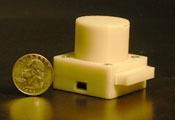
Photo courtesy of Aydogan Ozcan
Lens-free microscopes can be
attached to cell phones and
used in low-resource settings
to monitor pathogens.
Dr. Karin Nielsen, Ozcan's colleague, will soon put the device to use in several low-resource settings. Supported by a grant under Fogarty’s Framework Programs for Global Health Signature Innovations Initiative , Nielsen and teams of researchers will use the microscope and other telemedicine technologies to conduct disease surveillance for a study at sites in Brazil, Malawi and Mozambique. The rapid diagnosis capability offered by the microscope will be particularly helpful to researchers and health workers combating malaria, tuberculosis and other diseases in these countries.
More Information
- More on Dr. Ozcan's research: Smartphone Microscope Detects Nanoparticles and Viruses - NIH Research Matters, September 30, 2013
- Watch a video about Dr. Ozcan's work Turning Smartphones Into Go-Anywhere Medical Devices at the University of California, Los Angeles [Video] from the Science Coalition YouTube channel - July 2012.
- Learn more about Dr. Nielsen's work on the project Point-of-care telemedicine units for surveillance of infectious diseases , supported by Fogarty's Framework Programs for Global Health Signature Innovations Initiative .
- View a list of Mobile Health Resources
To view Adobe PDF files, download current, free accessible plug-ins from Adobe's website .