 An official website of the United States government




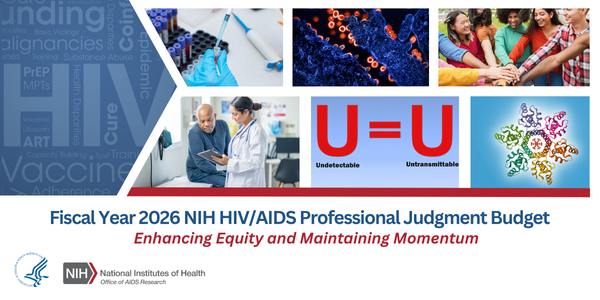
On July 17, 2024, the NIH Office of AIDS Research (OAR) released the
The research opportunities highlighted in the
FY26 NIH HIV/AIDS Professional Judgment Budget
The NIH Revitalization Act of 1993 requires that every year OAR “estimate the amounts necessary for the agencies of the National Institutes of Health to carry out all AIDS activities determined by the Director of the Office to be appropriate, without regard to the probability that such amounts will be appropriated.”
Over the last four decades, sustained investment in HIV research at NIH has enabled progressive scientific advances that have transformed HIV infection—once a fatal diagnosis—into a chronic condition. Antiretroviral therapy (ART) has evolved from limited, complicated, and poorly tolerated regimens to once-daily fixed-dose combination drugs that suppress HIV to undetectable levels. This not only improves the health of the person with HIV but also prevents them from transmitting HIV to their sexual partners, an effect known as U=U (undetectable=untransmittable). Long-acting antiretroviral drugs for prevention and treatment are newly available, and ART for the prevention of perinatal HIV transmission has been widely adopted, substantially reducing the number of infants born with HIV.
Despite global decreases in HIV acquisition and AIDS-related deaths over the past two decades, HIV remains a serious public health challenge. An estimated 39 million people were living with HIV across the world in 20221, including 1.2 million people in the United States2. Gaps in diagnosis and treatment are particularly concerning, with disparities that are compounded by social determinants of health.
The
The FY 2026 NIH HIV/AIDS Professional Judgment Budget highlights key scientific investment opportunities across four areas:
Fundamental research to promote discovery and advance HIV science
- Advance the understanding of HIV pathobiology, immunology, and virology to address HIV and its complications.
- Spur discovery of new therapeutic targets and development of innovative products and delivery systems for prevention and treatment of HIV and HIV-associated comorbidities.
- Develop innovative methods to detect, target, and destroy viral reservoirs in pursuit of a cure for HIV.
Development and assessment of novel interventions for the prevention and treatment of HIV and co-occurring conditions within the context of intersectional social and structural factors
- Accelerate translation of promising vaccine and antibody-mediated protection strategies into clinical trials.
- Accelerate the development of novel drug combinations, formulations, dosing regimens, and delivery methods for treatment, prevention, and cure modalities.
- Develop and evaluate treatment strategies and integrated care models for management of HIV and co-occurring conditions.
- Advance multidisciplinary research to develop interventions to effectively prevent and treat HIV and address co-occurring conditions of long-term HIV and its treatment across the life span.
- Accelerate behavioral and social sciences research to investigate how social determinants of health contribute to HIV outcomes.
Dissemination and implementation of HIV research discoveries to optimize public health impact
- Expand implementation research to enhance the uptake of evidence-based, person-centered, and sustainable HIV interventions and delivery approaches.
- Support research on effective, person-centered, and community-driven models of HIV-related science and public health communications that address intersectional stigma and discrimination.
Workforce development and infrastructure to enhance capacity and increase diversity
- Develop and retain a skilled and diverse HIV research workforce.
- Increase investment in facilities and resources to enhance research capacity in diverse settings and in institutions with historically limited resources.
- Strengthen data infrastructure to enable effective data management, accessibility, and analysis.
Download the