 An official website of the United States government




ONETOX | Neural Exposome and Toxicology Programs
NINDS Neural Exposome:
- Supports research on exogenous, endogenous, and behavioral factors and performs basic, translational, and clinical neuroscience research through grants-in-aid, contracts, and scientific meetings.
- Funds and conducts research training and career development programs to increase basic, translational and clinical neuroscience expertise and ensure a vibrant, talented, and diverse work force.
- Promotes the timely dissemination of scientific discoveries and their implications for neurological health to the public, health professionals, researchers, and policy-makers.
It is widely acknowledged that most diseases and disorders cannot be attributed to genetic factors alone. Coined by Chris Paul Wild in 2005 (Wild, C.P. 2005 Cancer Epidemiol Biomarkers Prev. 14(8):1847-50) , the term “exposome” describes the totality of internal and external exposures across the lifespan that affect human health. The “Neural Exposome” are those exposures that have an impact on neurological disease and disorders, and overall nervous system health. The exposures described in the exposome not only include environmental chemical and biological toxins, but also psychosocial factors and internal factors such as diet and the microbiome, and these exposures may occur anytime from in utero to late in life. A better understanding of how these exposomic factors interact with genes will lead to identifying more precise and effective intervention strategies, especially because many of the exposures are potentially modifiable.
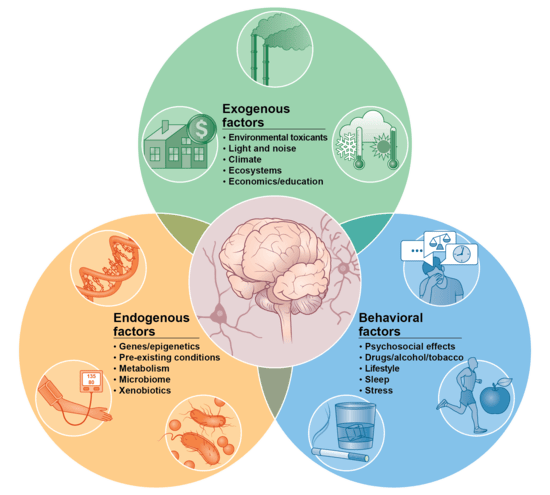
The overall goal of ONETOX is to enhance basic, translational, and clinical NIH research on the effect of the neural exposome on nervous system diseases and disorders by fostering more collaborative research within the neuroscience research community. ONETOX provides information and tools to help break down barriers to research between different scientific disciplines which can be used to establish productive team science for targeted funding opportunities. Because of the large number and different kinds of exposures within the Neural Exposome that occur across the lifespan, ONETOX collaborates with many different Institutes and Centers across the NIH to obtain a full understanding of how these exposomic factors affect brain and nervous system health.
Tamiz AP, Koroshetz WJ, Dhruv NT, Jett DA (2022)
A focus on the neural exposome.
Neuron, 110:1286-1289. PubMed ID: 35349785
The Neural Exposome Strategic Priorities Recommendations
To guide near- and medium-term efforts to cultivate neural exposome research, NINDS charged a Working Group of the National Advisory Neurological Disorders and Stroke (NANDS) Council comprised of external experts to identify research priorities.
The Neural Exposome Top Priorities Working Group delivered their report to NANDS Council on September 4, 2024.
Resources and Tools
Contacts
David A. Jett, Ph.D. | Director, ONETOX
jettd@ninds.nih.gov
Shardell Spriggs, Ph.D. | Program Director
shardell.spriggs@nih.gov
Neel Dhruv, Ph.D. | Program Director
neel.dhruv@nih.gov
Sara Sameni, Ph.D. | Health Program Specialist
sara.sameni@nih.gov
Claudia Figueroa-Romero, Ph.D. | Health Program Specialist
claudia.figueroa-romero@nih.gov
Scarlette Cella | Operations Coordinator
scarlette.cella@nih.gov
Funding Opportunities
News & Events
Tamiz AP, Koroshetz WJ, Dhruv NT, Jett DA. 2022. A focus on the neural exposome . Neuron. PMID: 35349785 .
Webinar: NINDS Neural Exposome Top Priorities (NEXT) Working Group Strategic Planning Open Session
July 15, 2024 | 2PM ET
Virtual Workshop: The Right Tools and Resources for Neural Exposome Research
April 19, 2024 | 1PM ET
Virtual Workshop: Team Science to Advance Neural Exposome Research
February 29, 2024 | 1PM EST
Related Topics
Databases:
Comparative Toxicogenomic Database (CTD)
The Comparative Toxicogenomic Database (CTD) launched in 2004 is a well-known publicly available resource for curated data on the linkage between human exposures and how they influence genes, biology, and human health.
NeurotoxKB
NeurotoxKB provides information on potential neurotoxicants that is compiled and manually curated along with supporting evidence from published scientific studies.
Environmental Neuroscience Reports:
The National Academies of Sciences Engineering Medicine Environmental Neuroscience: Advancing the Understanding of How Chemical Exposures Impact Brain Health and Disease: Proceedings of a Workshop
Integrating the Science of Aging and Environmental Health Research: Proceedings of a Workshop