 An official website of the United States government




The Research Methods Resources website provides investigators with important research methods resources to help them design their studies using the best available methods. The material is relevant to both randomized and non-randomized trials, human and animal studies, and basic and applied research.
The information provided here represents current thinking among biostatisticians and other methodologists at NIH regarding best practices for these issues. Investigators are encouraged to consider whether it is applicable to the studies they are considering and to make use of it where appropriate. This information is not part of the instructions for any application for research support from NIH and investigators are not required to use it. Those who wish to apply for research support should always refer to the general application guidelines for NIH funding and to the specific application instructions in the funding opportunity announcement to which they are applying.
Methods at a Glance
Broadly Applicable Methods
This section provides information and examples of methodological issues to be aware of when working with different study designs. Virtually all studies face methodological issues regarding the selection of the primary outcome(s), sample size estimation, missing outcomes, and multiple comparisons. Randomized studies face additional challenges related to the method for randomization. Other studies face specific challenges associated with their study design such as those that arise in effectiveness-implementation research; multiphase optimization strategy (MOST) studies; sequential, multiple assignment, randomized trials (SMART); crossover designs; non-inferiority trials; regression discontinuity designs; and paired availability designs. Some studies face issues involving exact tests, adherence to behavioral interventions, noncompliance in encouragement designs, evaluation of risk prediction models, or evaluation of surrogate endpoints.
Learn more about broadly applicable methods
In choosing a design, the investigator should carefully consider the research question, the context of the research, and the nature of the intervention. This figure presents three key questions to guide the selection process among four major design categories: randomized controlled trial (RCT), individually randomized group-treatment (IRGT) trial, parallel group- or cluster-randomized trial (GRT), and stepped-wedge group- or cluster-randomized trial (SW-GRT).
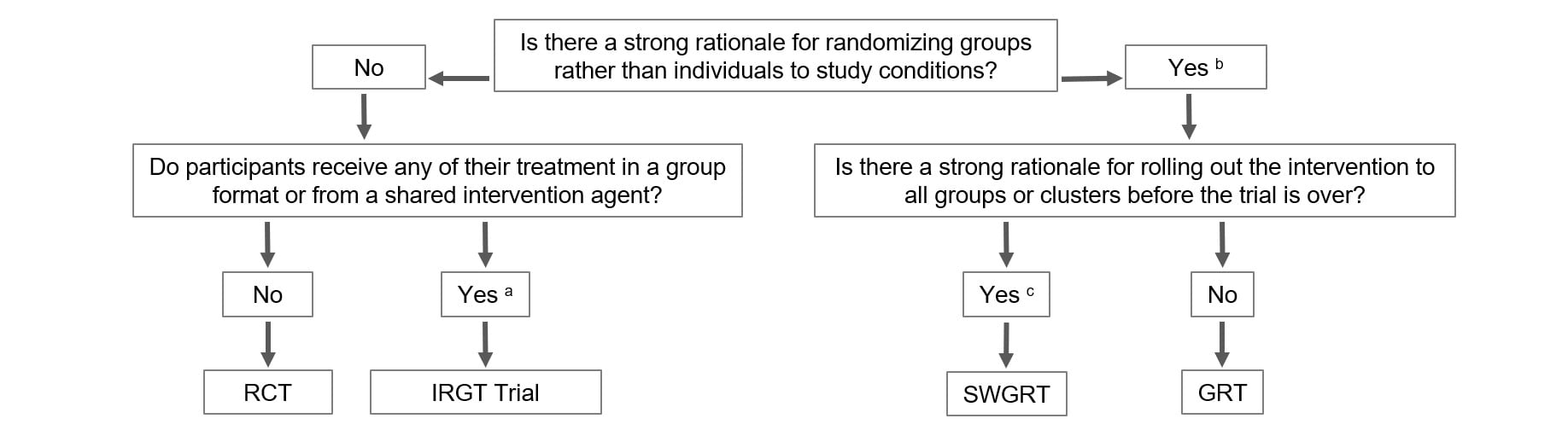
a If any of the intervention is delivered through physical or virtual groups, or through shared intervention agents who each work with multiple participants, positive intraclass correlation can develop over the course of the trial.
b There may be logistical reasons to randomize groups or clusters or it may not be possible to deliver the intervention to individuals without substantial risk of contamination.
c There may be political or logistical reasons to roll out the intervention to all groups or clusters before the trial is over.
Adapted from Murray DM, Taljaard M, Turner EL, George SM. Essential Ingredients and Innovations in the Design and Analysis of Group-Randomized Trials. Annual Review of Public Health. 2020;41:1-19. PMID31869281.
Learn more about choosing the design
Experiments, including clinical trials, differ considerably in the methods used to assign participants to study conditions (or study arms) and to deliver interventions to those participants.
This section provides information related to the design and analysis of experiments in which
- participants are assigned in groups (or clusters) and individual observations are analyzed to evaluate the effect of the intervention,
- participants are assigned individually but receive at least some of their intervention with other participants or through an intervention agent shared with other participants,
- participants are assigned in groups (or clusters) but groups cross over to the intervention condition at pre-determined time points in sequential, staggered fashion until all groups receive the intervention, and
- participants are assigned in groups, which are assigned to receive the intervention based on a cutoff value of some score value, and individual observations are used to evaluate the effect of the intervention.
This material is relevant for both human and animal studies as well as basic and applied research. And while it is important for investigators to become familiar with the issues presented on this website, it is even more important that they collaborate with a methodologist who is familiar with these issues.
In a parallel group-randomized trial (GRT), groups or clusters are randomized to study conditions, and observations are taken on the members of those groups with no crossover to a different condition during the trial.
In an individually randomized group-treatment (IRGT) trial, individuals are randomized to study conditions but receive at least some of their intervention with other participants or through an intervention agent shared with other participants.
In a stepped wedge group- or cluster-randomized trial (SWGRT), groups or clusters are randomized to sequences that cross over to the intervention condition at predetermined time points in a staggered fashion until all groups receive the intervention.
In a group or cluster regression discontinuity design (GRDD), groups or clusters are assigned to study conditions if a group-level summary crosses a cut-off defined by an assignment score. Observations are taken on members of the groups.
NIH Clinical Trial Requirements
The NIH launched a series of initiatives to enhance the accountability and transparency of clinical research. These initiatives target key points along the entire clinical trial lifecycle, from concept to reporting the results.
Check out the Frequently Asked Questions section or send us a message.
Disclaimer: Substantial effort has been made to provide accurate and complete information on this website. However, we cannot guarantee that there will be no errors. Neither the U.S. Government nor the National Institutes of Health (NIH) assumes any legal liability for the accuracy, completeness, or usefulness of any information, products, or processes disclosed herein, or represents that use of such information, products, or processes would not infringe on privately owned rights. The NIH does not endorse or recommend any commercial products, processes, or services. The views and opinions of authors expressed on NIH websites do not necessarily state or reflect those of the U.S. Government, and they may not be used for advertising or product endorsement purposes.
Please send all questions, comments, and feedback to ResearchMethodsResources@nih.gov.