 An official website of the United States government




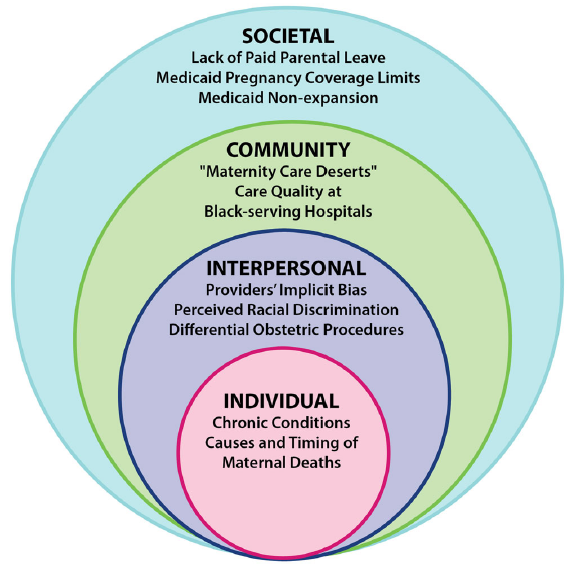
Research indicates that on the individual level, Black women are more likely to have poorer preconception health but less likely to be insured and to have access to prenatal, perinatal, and postpartum care. Research also shows that on an interpersonal level, the implicit, often unconscious racial biases of health care providers may contribute to poor patient–provider communication, overuse of “mental shortcuts” by medical staff, and high rates of cesarean deliveries. Previous studies show that community-level influences include “maternity care deserts” (i.e., areas with limited obstetrical services) and the trend of Black women delivering at hospitals with high rates of severe maternal morbidity. Research also indicates that limited paternal leave and access to Medicaid benefits contribute to MMM racial disparities on the societal level.
Dr. Noursi and colleagues also use ecological systems theory to identify interventions that might mitigate MMM racial disparities. The authors recommend several societal interventions, such as gathering data through maternal mortality review committees and the Maternal Mortality Review Information Application system of the Centers for Disease Control and Prevention ( CDC ), following the safety protocols and evidence-based best practices recommended by the Alliance for Innovation on Maternal Health , and expanding Medicaid coverage. The article also describes interpersonal solutions, such as addressing implicit bias among health care workers as well as increasing utilization of midwives and doulas.
Reference
Noursi et al. 2020. J. Racial Ethn. Health Disparities PMID: 32720294.