 An official website of the United States government




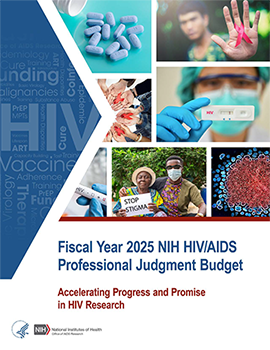
The research opportunities highlighted in the FY 2025 NIH HIV/AIDS Professional Judgment Budget align with the NIH HIV research priorities , as defined in the FY 2021–2025 NIH Strategic Plan for HIV and HIV-Related Research , and are informed by OAR’s work with all NIH offices that fund HIV research. The NIH Revitalization Act of 1993 legislatively mandates that OAR submit this budget document every year.
FY 2025 NIH HIV/AIDS Professional Judgment Budget
Over the past 35 years, incredible progress in HIV research has led to public health breakthroughs that now halt HIV disease progression, prevent perinatal HIV transmission, protect sexual partners from HIV transmission, and, ultimately, improve the lives of people with HIV. Despite these advances, HIV remains a serious public health challenge. Approximately 1.2 million people in the United States have HIV. Data indicate that diagnosis and treatment gaps persist, with disparities that are compounded by social determinants of health.1
The
OAR proposes additional funding for the NIH HIV research program to support four key areas:
Basic research to promote discovery and advance HIV science
- Advance HIV discoveries in pathobiology, immunology, and virology to address HIV and its complications, including new therapeutic and prevention product pipelines, as well as immune-mediated approaches for HIV prevention.
- Accelerate development of novel drug combinations; dosing regimens; and delivery methods for treatment and cure modalities, including those that target the viral reservoir.
- Develop innovative methods to detect, target, and destroy viral reservoirs in pursuit of a cure for HIV.
- Investigate social determinants of health, including their interactive properties, that contribute to HIV health disparities.
Development and assessment of novel interventions
- Accelerate translation of promising vaccine and antibody-mediated protection strategies into clinical trials.
- Advance multidisciplinary research to develop clinical, behavioral, and social interventions to effectively prevent and treat HIV and address comorbidities, coinfections, and complications of long-term HIV and its treatment across the lifespan.
- Develop and evaluate the efficacy of integrated care models for management of HIV and co-occurring conditions.
Translation, implementation, and dissemination of HIV research discoveries to optimize public health impact
- Support implementation research to promote the systematic uptake of evidence-based HIV interventions and delivery approaches.
- Improve community engagement and community-driven HIV research.
- Support research on effective models of HIV-related science and public health communications that reflect community input and are culturally appropriate.
Infrastructure and workforce development to enhance capacity and increase diversity
- Develop and retain a skilled and diverse HIV research workforce.
- Increase investment in facilities and resources to enhance research capacity in diverse settings and in institutions with limited resources.
- Strengthen data infrastructure to enable effective data management, accessibility, and analysis.
Download the
Additional Resources
1 -Centers for Disease Control and Prevention. Monitoring selected national HIV prevention and care objectives by using HIV surveillance data—United States and 6 dependent areas, 2019. HIV Surveillance Supplemental Report. 2021;26(No. 2). May 2021. Accessed April 14, 2023. www.cdc.gov/hiv/pdf/library/reports/surveillance/cdc-hiv-surveillance-report-vol-26-no-2.pdf