 An official website of the United States government




Rotavirus vaccine could save lives in poor countries
Related News
- WHO grants prequalification to Bharat Biotech's rotavirus vaccine, ROTAVAC(r)
Bharat Biotech news courtesy of Business Wire, January 24, 2018
More on rotavirus
Read more about the rotavirus vaccine in the full text of the articles from The Lancet.
- Rotavirus: realising the potential of a promising vaccine
- Efficacy of pentavalent rotavirus vaccine against severe rotavirus gastroenteritis in infants in developing countries in Asia: a randomised, double-blind, placebo-controlled trial
- Efficacy of pentavalent rotavirus vaccine against severe rotavirus gastroenteritis in infants in developing countries in sub-Saharan Africa: a randomised, double-blind, placebo-controlled trial
Rotavirus vaccines are effective in the developing world and introducing vaccines in these settings could substantially decrease childhood mortality from diarrheal diseases, according to a Lancet commentary co-authored by Fogarty’s director. About 500,000 children die from rotavirus every year, with 85 percent of those occurring in low-income countries.
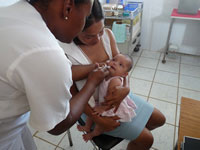
Photo courtesy of WHO
Introducing rotavirus vaccines in the
developing world could reduce the
number of deaths by 25 percent,
according to articles published in
the Lancet.
Vaccines could reduce deaths by as much as 25 percent, according to Dr. Roger I. Glass and his co-author, Dr. E. Anthony S. Nelson of the Chinese University of Hong Kong. Introducing these vaccines in some low-income settings now would allow researchers to assess their full impact to reduce diarrheal deaths and hospitalizations and improve child survival, they suggest.
The commentary, titled " Rotavirus: realizing the potential of a promising vaccine ," accompanies two studies in The Lancet, which provide new data on the efficacy of rotavirus vaccines.
"Reassuring governments in low-income countries they will be able to purchase vaccines at a reasonable price when support from the GAVI Alliance ends will be the quickest way to encourage their introduction and to establish whether these vaccines will stand alongside smallpox, measles and poliomyelitis vaccines in their public health benefits," according to Glass and Nelson. Further study could identify ways of improving vaccine effectiveness, they conclude.
More Information
- Related news: WHO grants prequalification to Bharat Biotech's rotavirus vaccine, ROTAVAC(r)
Bharat Biotech news courtesy of Business Wire, January 24, 2018 - Related news: Newly published study indicates lifesaving potential for new rotavirus vaccine
PATH announcement, March 12, 2014- Related publication: Team science and the creation of a novel rotavirus vaccine in India: a new framework for vaccine development
The Lancet, March 12, 2014
- Related publication: Team science and the creation of a novel rotavirus vaccine in India: a new framework for vaccine development
- Related news: New rotavirus vaccines seem safer, studies find
Associated Press via Yahoo! News, January 14, 2014- Related publication: Rotavirus Vaccines - Balancing Intussusception Risks and Health Benefits
New England Journal of Medicine, January 14, 2014
- Related publication: Rotavirus Vaccines - Balancing Intussusception Risks and Health Benefits
- Related news: New Indian rotavirus vaccine provides hope: opinion by Fogarty Director Dr Roger I Glass
May / Jun 2013 Global Health Matters
-
ghmjul-aug2010.pdf (4.61 MB)
To view Adobe PDF files, download current, free accessible plug-ins from Adobe's website .