 An official website of the United States government




Research must validate cleaner cookstoves
Related News
- NIH request for information (RFI): Global cookstove distribution programs and projects for evaluation of health benefits
Comments due: June 30, 2014
A baby snuggled against his mother's back while she cooks the family dinner over an open fire may be destined for an early death. The WHO estimates nearly 2 million people die prematurely each year from health problems such as lung cancer, pneumonia and obstructed airways because of toxic smoke from indoor cooking and heating fires, which almost half the world uses.
Global health policymakers are increasingly aware of the need to reduce indoor air pollution and many programs have been launched to design and introduce new cookstoves, fuel and ventilation systems. But there are many research questions that should be studied before programs are implemented. This was the topic of a workshop to discuss the health risks of indoor air pollution and identify the research gaps, summarized in a recent PLOS Medicine article Household Air Pollution in Low- and Middle-Income Countries: Health Risks and Research Priorities .
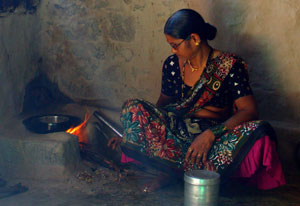
Photo by Leesha Manju/Photoshare
Research is essential to inform clean cookstoves
programs, according to a recent study.
"The imminent scale-up of stove and fuel improvement programs offers a great opportunity for health researchers to work with program implementers. Failure to do so risks introducing new cooking technologies to millions of homes without understanding whether the intended health benefits are realized - or worse, whether there are unintended adverse consequences," noted first author Dr. William J. Martin, of NIH's National Institute of Child Health and Human Development, and his colleagues.
The paper laid out the key priority areas where research is needed to implement clean cooking solutions. Scientists should examine how indoor air pollution is linked to health outcomes such as child survival and development, the impact of exposure during pregnancy, respiratory disease, eye disorders, cancer and other conditions. They should also consider crosscutting issues including exposure and biomarker assessments, women's empowerment, behavioral approaches and program evaluation.
"Quickly demonstrating the beneficial health impacts of clean stoves in multiple settings could ensure the successful scale-up and funding of this critical health program," the authors concluded.
More Information
- Presentations from the NIH 2012 Household Air Pollution Research Training Institute on clean cookstove research, use, testing and adoption
- Household Air Pollution in Low- and Middle-Income Countries: Health Risks and Research Priorities
PLOS Medicine, June 4, 2013 - Podcast: Experts describe research needed to reduce air pollution from stoves in developing world [podcast] with guest host Fogarty Director Dr. Roger Glass
National Institute of Child Health and Human Development (NICHD), June 2013 - Household air pollution and cookstove resources for global health researchers
To view Adobe PDF files, download current, free accessible plug-ins from Adobe's website .