 An official website of the United States government




Profile: Fogarty fellow Dr Mark Brady’s tuberculosis training in Peru useful in combatting COVID-19
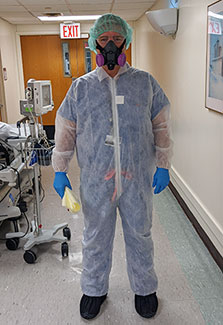
Image courtesy of Mark Brady
Mark Brady, MD, MPH
- Fogarty Fellow:
2007 - U.S. institution:
Warren Alpert Medical School at Brown University - Foreign institution:
University of Cayetano Heredia, Lima, Peru - Research topic:
Diagnosis and detection of tuberculosis - Global Health Program for Fellows and Scholars
- Profiles of Fogarty Fellows and Scholars
Focus on the Fogarty community's response to COVID-19
- COVID-19 creates new syndemic on US-Mexico border
- Researcher collaborates to solve pandemic inequities at home and abroad
- Scientists study intersection of COVID-19 and HIV
- Fogarty fellow captures 'lived experiences' of frontline health care workers, COVID-19 patients in South Africa
- Former Fogarty HIV trainee helps lead Dominican Republic's COVID response
Q and A with Dr William Duke - Profile: Fogarty fellow Dr Mark Brady’s tuberculosis training in Peru useful in combatting COVID-19
By January W. Payne
When COVID-19 reached the U.S., former Fogarty Fellow Dr. Mark Brady was called up by the Navy reserve to help with the pandemic response at the now-infamous Elmhurst hospital in New York. His Fogarty experience studying tuberculosis (TB) in a biosafety level-3 lab in Peru had given him a foundation in infectious disease research and how to teach others safety procedures to avoid infection.
“The fellowship was excellent preparation for my career. I can't think of anything better,” said Brady. He investigated a liquid-based culture for TB diagnosis as a participant in Fogarty’s Fellows and Scholars program , which provides a year-long mentored clinical research training experience in a low-resource setting. It gave him the opportunity to conduct a variety of research projects with numerous collaborators, gaining field experience, learning project management and going through the publication process.
While working at Lima’s Cayetano Heredia University (UPCH), Brady watched residents perform manual ventilation on patients when ventilators were in short supply. More recently, he has been studying the effectiveness of a simple, inexpensive device to help regulate correct airflow during manual ventilation, which could be helpful in the U.S. or wherever ventilators are in short supply or unavailable. “It costs next to nothing, has a stable shelf life for years and helps fill a critical need when there aren’t enough mechanical ventilators,” he said. Brady previously helped test an electricity-free incubator with a team from MIT during his fellowship. “I like helping people and I like solving problems - that’s just how I’m wired,” he observed.
His early work in the developing world gave him valuable exposure to pathogens encountered in his later military experience. “If you’re in a mass casualty situation, you can make something out of plastic and silicone. It costs next to nothing, has a stable shelf life for years and helps fill a critical need.” Brady’s infectious disease expertise was also called on during his previous military deployments when he was confronted with cholera in Iraq and a vaccine-derived polio outbreak in Syria.
His fellowship training has made him “kind of the de facto content expert on airborne disease transmission,” he explained.
It’s no surprise then that Brady was selected as the chief operating officer for a 400-bed COVID-19 field hospital in Memphis, where he helped start the region’s first emergency medicine (EM) residency program and is EM research director at the University of Tennessee. “I just happened to have the right training at the right time,” he said. “During an airborne pandemic, being able to say, we've got a physician who did a research fellowship on an airborne infectious disease” makes him a good asset in Memphis.
As everywhere, the pandemic has forced hard choices on Brady. His ability to squeeze every cent and every bit of efficiency from the available resources is grounded in his Fogarty experience. “When you have novel situations, what you need most are problem solvers,” Brady suggested. “That’s something that Fogarty really shines in, with a focus on translational research.”
All of these experiences have allowed Brady to continue doing what led him to do a Fogarty fellowship years ago: his desire to help underserved populations at home and abroad. “That's ultimately how I ended up in emergency medicine. I thought about infectious diseases, but I just like the very, very fast pace in the emergency department where you see very, very sick people,” he said. “You see really underserved populations in the emergency department, especially when you're in an urban area.”
For Brady, the Fogarty fellowship is what started his path toward being ready to take a leadership role in addressing the pandemic in both Memphis and New York. “I'm just grateful for the experience,” he said. “The fellowship punches above its weight class in terms of impact.”
More Information
- safeBVM
- Related news: Medical Maverick: An emergency medicine doc traces the evolution of the specialty
Medicine@Brown, Spring 2015 - Related publication: MODS for tuberculosis screening prior to isoniazid preventive therapy in HIV-infected persons
Clinical Infectious Diseases, April 1, 2011 - Related publication: The MIT D-lab electricity-free PortaTherm™ incubator for remote testing with the QuantiFERON®-TB Gold In-Tube assay
International Journal of Tuberculosis and Lung Disease via PubMed, November 2010 - Related publication: Microscopic observation drug susceptibility assay for tuberculosis screening before isoniazid preventive therapy in HIV-infected persons
Clinical Infectious Diseases, April 1, 2010 - Related publication: Reducing the string test intra-gastric downtime for detection of Mycobacterium tuberculosis
Ingenta, December 2008 - Related publication: The MODS method for diagnosis of tuberculosis and multidrug resistant tuberculosis
JoVE Journal, August 11, 2008
To view Adobe PDF files, download current, free accessible plug-ins from Adobe's website .