 An official website of the United States government




Profile: Fogarty Fellow Dr Leah Katzelnick investigates Zika and dengue viruses in South America
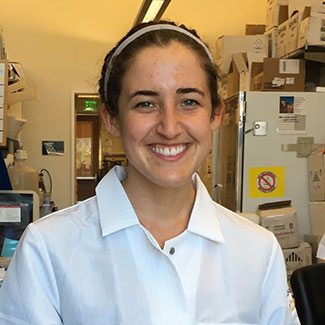
Leah Katzelnick, Ph.D., M.P.H.
- Fogarty Fellow:
2018-2019 - U.S. institution:
University of California, Berkeley - Foreign institutions:
Universidad San Francisco de Quito, Ecuador
National Virology Laboratory, Managua, Nicaragua - Research topic:
Connection between Zika and dengue infections - Global Health Program for Fellows and Scholars
- Profiles of Fogarty Fellows and Scholars
By Susan Scutti
In 2015, an outbreak of Zika fever swept South America and the Caribbean. Although infection typically caused only mild symptoms in adults, thousands of pregnant women who became infected suffered miscarriages and more than 3,700 delivered babies with microcephaly or other congenital abnormalities. Zika virus is a relative of the region’s endemic dengue virus - both are mosquito-borne flaviviruses - so the epidemic raised questions about whether a prior infection with one of dengue’s four serotypes might alter a person’s risk of Zika disease, or vice versa. Fogarty Fellow Dr. Leah Katzelnick’s project answered this by showing a previous Zika infection increases the risk of dengue disease severity.
Dengue itself sparks a complex immune response, explained Katzelnick, now chief of the NIH’s National Institute of Allergy and Infectious Diseases (NIAID) Viral Epidemiology and Immunity Unit. A first-time infection with dengue generally causes no symptoms, or only mild ones. However, a previously infected person has an increased risk of severe disease if re-infected. “My original Fogarty project was proposing to look at the dynamics of the dengue antibody response over time in relation to immunity,” said Katzelnick. “So, after your first infection, do your antibodies wane? Do only certain kinds of antibodies wane?”
Katzelnick, who was then a Berkeley-based collaborator working with a team in Nicaragua, arrived in South America in mid-2019 - during the first post-Zika dengue epidemic. Witnessing “skyrocketing” cases, the team hypothesized that prior Zika infections might be causing “a more explosive dengue wave than we’d ever seen,” said Katzelnick. She quickly pivoted her research to study how Zika immunity modified dengue disease.
Surprisingly, this wasn’t the first time she’d changed course while a Fogarty Fellow. A political crisis in Nicaragua had prevented her planned arrival in early 2019, so she’d spent the first six months of her fellowship in Ecuador studying the dengue vaccine. Disheartened at first, Katzelnick soon embraced the “amazing opportunity to see how you set up one of these huge cohort studies before joining my Nicaraguan colleagues.”
Each project revealed dengue’s insidious power in addition to different aspects of global health research. In Nicaragua, she tracked a powerful epidemic as it progressed, while in Ecuador, she developed a companion test for the dengue vaccine. “The vaccine can actually increase your future risk of severe dengue disease if you’ve never had an infection. So, we were looking for a test that would say ‘yes’ or ‘no.’ Are you positive for dengue or not?” Direct contact with primary investigators on each project proved invaluable. “While I knew the data really well, I didn’t know how you actually do all this - coordinate a major cohort with thousands of people and bring experts in various areas together in a well-integrated system.” Along with project management skills, she learned about the patient consenting process and helped to build capacity. “I taught different classes in both countries on new statistical methods for analyzing clinical data and on the use of open source programs and tools.”
Today, she’s confident that both projects are relevant beyond the borders where her research took place. “We were invited to present to a CDC advisory board and a Zika task force, both of which included policymakers who will decide on recommendations for the dengue vaccine and a future Zika vaccine,” said Katzelnick. And her investigation of antibody kinetics and resulting immunity in relation to disease severity is applicable to any community worldwide where flaviviruses circulate.
When her fellowship concluded at the end of 2019, Katzelnick transitioned to her current position at NIAID, where she continues to explore immune interactions between flaviviruses. “My Fogarty experience is the model for setting up our NIAID viral epidemiology and immunity lab,” she said. “The fellowship taught me how to connect with new researchers on a project, find shared goals and reciprocally share and transfer knowledge.” For Katzelnick, her Fogarty experience was “completely essential for feeling like a real researcher in global health.”
More Information
- Zika virus infection enhances future risk of severe dengue disease
Science via PubMed, August 28, 2020 - Protective and enhancing interactions among dengue viruses 1-4 and Zika virus
Current Opinion in Virology via PubMed, September 24, 2020 - Dr Leah Katzelnick's publication history via National Library of Medicine's PubMed
- Profile: Dr Leah Katzelnick via the NIAID Laboratory of Infectious Diseases
- Dengue fever from the National Institute of Allergy and Infectious Diseases (NIAID)
- Zika virus from the National Institute of Allergy and Infectious Diseases (NIAID)
- Zika virus news, resources and funding for global health researchers from Fogarty
To view Adobe PDF files, download current, free accessible plug-ins from Adobe's website .