 An official website of the United States government




Opinion: Now is the time to catalyze data science and health innovation in Africa
Image by iStock
Focus: NIH hosts virtual conference on data science in Africa
- Data science potential for Africa examined during NIH virtual symposium
- Applicants urged to find diverse partners for new NIH DS-I Africa program
- Research hubs will harness innovation to advance African data science discoveries
- Unique methods needed to train African data scientists
- Conducting ethical data science research in Africa
- Leveraging data ecosystems to foster African research networks
- Developing biomedical technology to support global health research
Q and A with Dr Bruce Tromberg
Opinion by Fogarty Director Dr Roger I Glass
Data driven science, discovery, and care are the health currencies of the future. They have enormous potential to revolutionize science, speed health discoveries and strengthen the health care system in Africa. To ensure African scientists are prepared to lead the coming surge of big data research, NIH is investing $58 million over five years in the Harnessing Data Science for Health Discovery and Innovation in Africa (DS-I Africa) program . It will leverage data and technologies to help African scientists develop knowledge and craft solutions for the continent’s most pressing clinical and public health problems. The first awards will be made in 2021.
The continent stands at an inflection point. Expansion of R&D, manufacturing, and connectivity have positioned Africa for explosive growth in health innovation. Its population is rapidly expanding, with the number of people under the age of 25 predicted to almost double by 2050, rising from 230 million to 450 million. High-speed internet connectivity is improving and sub-Saharan Africa is expected to have over 600 million unique mobile phone subscribers by 2025.

Read recent opinion pieces
from Fogarty Director
Dr. Roger I. Glass .
Some African leaders are eager to embrace innovation and transition to knowledge-based economies, recognizing the opportunity to “leapfrog” the adoption of health innovations and implement new approaches unburdened by legacy systems. With novel technologies designed to improve health promotion, diagnosis and disease treatment, these leaders believe they can improve efficiency, cost effectiveness and quality of care while leveraging automation to mitigate health workforce shortages.
With DS-I Africa, NIH will be building an innovation and data science consortium that seeks to disrupt the status quo and spur new mechanisms to utilize data in ways that can transform how countries work. We envision a robust, African-led network of public and private partners that fosters a culture of innovation and entrepreneurship, accelerating scientific discoveries, devising new software solutions and technologies, generating start-ups and spinoff companies, and collaborating with governments and businesses to reach scale and improve health.
We aim to attract collaborators from multiple sectors, uniting data specialists, computer scientists and engineers with biomedical researchers, clinicians and other health experts in interdisciplinary teams. We invite African governments, industry and other research funders to join our efforts to synergistically increase their reach and impact.
We plan to fund an open data science platform and coordinating center, support the development of robust research hubs, train a cadre of skilled data scientists, and advance understanding of the ethical, legal and social implications (ELSI) of data science approaches in an African context. Discoveries made possible by data science advances in Africa have the potential to benefit the entire world, since we are all from Africa - the cradle of humanity - and share a common inheritance.
NIH has much relevant expertise to contribute to DS-I Africa, which leverages the substantial investments NIH has already made across the continent. DS-I Africa is a program of the NIH Common Fund that supports innovative endeavors with the potential for extraordinary impact. DS-I Africa is guided by a working group led by Common Fund staff in the Office of the Director, Fogarty, the National Institute of Mental Health (NIMH) , the National Institute of Biomedical Imaging and Bioengineering (NIBIB), and the National Library of Medicine (NLM).
To encourage networking across disciplines, sectors and geographies and to foster collaborations for DS-I Africa applications, NIH is hosting a virtual symposium platform with networking tools and online events scheduled through November.
We hope others who share our vision for advancing data science to transform health in Africa will join our effort to empower and bolster African partnerships. It is only right that all the world’s people - especially those who have the fewest resources and the greatest disease burden - benefit from the power of big data.
DS-I Africa Sub-initiatives
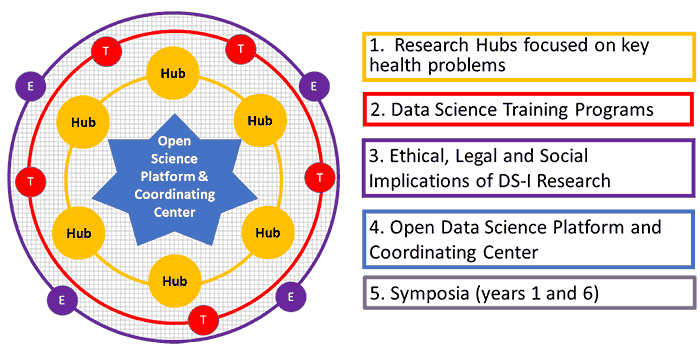
Description of DS-I Africa Sub-initiatives illustration: Shows DSI Africa initiatives in concentric circles:
- Open Data Science Platform and Coordination Center at center in blue
- Research Hubs focused on key health problems in the next circle in yellow
- Data Science Training Programs in the next circle in red
- Ethical, Legal and Social Implications of DS-I Research in the outer circle in purple
- Symposia (years 1 and 6) not pictured
More Information
- NIH to invest $58M to catalyze data science and health research innovation in Africa
NIH Common Fund news, July 27, 2020 - Harnessing Data Science for Health Discovery and Innovation in Africa (DS-I Africa)
- NIH Strategic Plan for Data Science
NIH Office of Data Science Strategy - Report: The Mobile Economy: Sub-Saharan Africa
GSMA - Human Heredity and Health in Africa (H3Africa)
- Program: Medical Education Partnership Initiative (MEPI)
- Program: He alth-Professional Education Partnership Initiative (HEPI)
- Recent opinion pieces from Fogarty Director Dr. Roger I. Glass
To view Adobe PDF files, download current, free accessible plug-ins from Adobe's website .