 An official website of the United States government




NIH aims to increase collaboration on chronic diseases
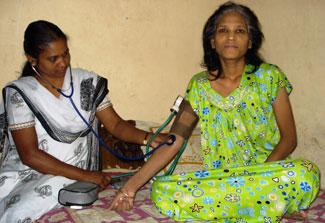
© 2007 Divya Pal Singh, courtesy of Photoshare
A home-care nurse measures the blood pressure of a terminal
cancer patient in Uttam Nagar, New Delhi.
Noncommunicable diseases kill 38 million people a year, most of them in low- and middle-income countries (LMICs), according to the WHO. These chronic conditions - which include cancer, cardiovascular and respiratory diseases, and diabetes - threaten health as well as social and economic development. To address the growing global burden, representatives from multiple U.S. government organizations recently gathered at the NIH.
"How can we work together on global noncommunicable disease research?" asked Dr. Ted Trimble, director of the National Cancer Institute's Center for Global Health , as he opened a two-day conference. The Center convened officials involved in research, prevention and control, capacity building and development to help synergize the government's NCD initiatives.
The global health landscape is changing, noted Ambassador Jimmy Kolker, HHS Assistant Secretary for Global Affairs, in his keynote address. U.S. global health collaborations historically have focused on controlling infectious diseases, improving maternal and child health, and bolstering health systems. Now, there's the challenge of chronic diseases. "The global recognition of the rising problems of NCDs, and opportunities to prevent the risk factors such as tobacco use, hypertension and obesity is a changing paradigm in global health," Kolker said. "It's not just about external threats that infectious diseases pose, but a global view that we live in this networked, commercialized world with health challenges that affect all of us."
In 2011, the U.N. launched a campaign to stem the epidemic and included NCDs in the recently announced Sustainable Development Goals . Kolker said the U.S. could learn from, and share information with, other countries working to reduce NCD deaths and facing similar dilemmas regarding risk factors as well as access, cost and quality of care.
Kolker pointed out another global health shift, calling the donor-recipient relationship "very last century." Countries are looking to the U.S. for technical partnerships to build the capacity of their scientists and service providers, he observed. "Even in the poorest countries, the question is, ‘How do you do this in the United States?'"
The incidence of NCDs is rising faster, occurring at a younger age, and having worse outcomes in LMICs than in wealthier nations. They take an enormous economic toll. A recent Council on Foreign Relations (CFR) report named it "the emerging global health crisis." Meanwhile, a study by the World Economic Forum and Harvard University put a dollar figure on the problem - estimating NCDs will cost developing countries about $21.3 trillion over the next two decades.
"If you can make an economic case for investing in global health, you probably should start with NCDs in low- and middle-income countries because the overwhelming proportion of burden falls between the most productive years of life," explained Thomas Bollyky, a CFR senior fellow, who presented highlights from the Council's report. "Given the scale at which this is happening," he added, "it reverberates through households, health systems and national governments, and it starts to have global effects."
While health spending in LMICs has tripled over the last two decades, it's still low, Bollyky said. The governments of all LMICs together, representing about 5.7 billion people, spend as much or less on health than the governments of Canada, the United Kingdom, France and Germany combined, which only serve about 300 million citizens. In LMICs, people are poorer and can't afford to buy health care out of pocket and governments aren't providing the preventive and chronic care higher income countries do. That, Bollyky explained, is a key driver of the problem.
Related NIH funding
Given that lifestyle choices, such as a diet and exercise, are modifiable risk factors, both Bollyky and Kolker suggested engaging the private sector to find solutions. On the research front, Trimble drew attention to a new funding opportunity to develop regional centers of research excellence focusing on noncommunicable diseases in low- and middle-income countries.
More Information
- Chronic, noncommunicable diseases information and resources from Fogarty
- UN 2011 High-level Meeting on Prevention and Control of Noncommunicable Diseases
- UN report by the Secretary-General on the prevention and control of noncommunicable diseases (A/66/83) , May 2011
- World Health Organization (WHO) resources:
- WHO noncommunicable diseases and their risk factors
- WHO noncommunicable diseases fact sheet , updated January 2015
- The emerging global health crisis: Noncommunicable diseases in low- and middle-income countries
Council on Foreign Relations, December 2014 - The Global Economic Burden of Noncommunicable Diseases
A report by the World Economic Forum and the Harvard School of Public Health, September 2011
To view Adobe PDF files, download current, free accessible plug-ins from Adobe's website .