 An official website of the United States government




The National Institute of Nursing Research (NINR): Nursing research and training spur global health gains
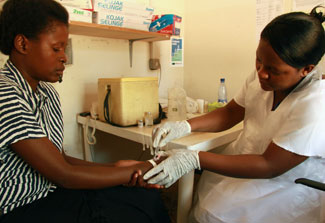
Photo by Victoria A. Smith, courtesy of Photoshare
Nurse scientists play a vital role in improving clinical care,
especially in developing countries.
Focus on nursing research
- Sari cloth can filter cholera from water, research shows
- Lab-on-a-chip provides speedy disease diagnoses
- Research aims to curb mental, emotional pain of HIV
- Study finds mothers can help reduce daughters' risk of HIV infection in Jamaica
- The role of nursing research in global health: Q and A with NINR Director Dr Patricia A Grady
- Profile: Fogarty nursing fellow Faith Beulah oversees HIV trials in India
by Cathy Kristiansen
No profession is more integral and essential within every level of global health care than nursing. Because of their close relationship with patients, nurses are ideally positioned to design and drive scientific discoveries that can be implemented directly into clinical practice. Since 1986, the NIH's National Institute of Nursing Research (NINR) has been supporting critical investigations to advance disease prevention, patient self-management, end-of-life care and treatment innovations, as well as funding training for nurse scientists.
The results of nursing research help build the knowledge base and provide the evidence to guide interventions by nurses and other health care workers. From studying approaches to prevent HIV/AIDS in Jamaican girls, to assessing water filters that could reduce cholera outbreaks in Bangladesh, or identifying how to lessen depression caused by HIV/AIDS, NINR-funded nurse investigators are producing scientific evidence that improves health around the globe.
These advances are particularly important for developing countries, where doctors are scarce and there are many hard-to-reach and underserved populations. Nurses and nurse scientists help fill the gaps, including training essential health care workers. Developing expertise in low-resource settings has never been more critical, since diseases such as Ebola can quickly move from a child in a West African jungle to a nurse in Texas.
"In an increasingly interconnected and mobile world, global health threats such as tuberculosis, SARS, Ebola and influenza, among others, can spread at the speed of a jet plane," NINR Director, Dr. Patricia A. Grady, commented. "Nursing science is at the forefront of designing programs that promote wellness, prevention and, not coincidentally, lower health care costs."
Rapid advances in technology and genomic science, as well as significant changes in demographics and health care policies and practice, have placed new demands and created opportunities for nursing to find fresh approaches and interventions to improve health. With the increasing prevalence of mobile phones in even the poorest countries, there are new avenues to develop technological tools, such as the lab-on-a-chip (see the related article Lab-on-a-chip provides speedy disease diagnoses ), and find innovative ways to communicate health information.
NINR has supported studies in more than a dozen developing countries over the past decade in such critical areas as reducing maternal and infant deaths related to childbirth, studying text messaging to improve patient drug adherence to combat tuberculosis, and finding more effective methods to limit the spread of HIV/AIDS. More recently, NINR has begun to address the rising tide of noncommunicable diseases by supporting the development of the research expertise needed among nurses in Thailand and elsewhere.
NINR also invests in global health research training for early-career nurse investigators, in collaboration with Fogarty. For instance, the agency has supported participants in Fogarty's Global Health Program for Fellows and Scholars, which has provided mentored training in HIV/AIDS, tuberculosis and tropical disease research for nurses working in countries such as Argentina, Thailand, Malaysia and India. (See the related article Fogarty nursing fellow oversees HIV trials in India .)
The seeds of NINR-funded global research are spreading as researchers share discoveries and other developing countries recognize the value of these more effective and economical interventions. For instance, in a South-South collaboration, researchers in Chile are building on an NINR-supported model developed in Botswana and Malawi to mobilize health care workers to drive HIV/AIDS prevention patient education.
In these and similar projects around the world, NINR is working to identify areas in need of research, disseminate scientific findings and form global partnerships to improve the health and well-being of all the world's citizens.
Global Nursing Research and Training Resources
Access resources and background information from the National Institute of Nursing Research (NINR) at NIH:
- NINR Director's Page: Dr. Patricia A. Grady
- Overview of NINR Global Health Research
- NINR Strategic Plan
- History of NINR: 25 Years of NINR: Bringing Science to Life
Related resources and publications:
- Resources and publications related to this article:
- Edmonds JK et al. Determinants of place of birth decisions in uncomplicated childbirth in Bangladesh: an empirical study . Midwifery, October 2012
- Iribarren SJ et al. mHealth intervention development to support patients with active tuberculosis (Argentina) . Journal of Mobile Technology in Medicine, July 2014
- Chimango JL et al. Impact of a peer-group intervention on occupation-related behaviors for urban hospital workers in Malawi . Journal of the Association of Nurses in AIDS Care, July 2009
- Resources and publications related to Study shows sari cloth can filter cholera from water :
- About the NINR-supported project Simple Water Filtration for Cholera Intervention .
- Huq A et al. Simple sari cloth filtration of water is sustainable and continues to protect villagers from cholera in Matlab, Bangladesh . mBio, May 2010
- Colwell RR et al. Reduction of cholera in Bangladeshi villages by simple filtration . Proceedings of the National Academy of Sciences, February 2003
- Resources and publications related to Lab-on-a-chip provides speedy disease diagnoses :
- About the NINR-supported project A Low-cost Point-of-care Diagnostic Test for Simultaneous HIV-1 and STIs .
- Related publications:
- Sia SK et al. A smartphone dongle for diagnosis of infectious diseases at the point of care . Science Translational Medicine, February 4, 2015
- Chin CD et al. Mobile device for disease diagnosis and data tracking in resource-limited settings . Clinical Chemistry, April 2013
- A low-cost, point-of-care diagnostic test for HIV-1 and other sexually transmitted diseases [Video] . Nature Video, Uploaded July 29, 2011
- Chin CD et al. Microfluidics-based diagnostics of infectious diseases in the developing world . Nature Medicine, July 2011
- Addae-Mensah KU et al. Actuation of elastomeric microvalves in point-of-care settings using handheld, battery-powered instrumentation . Lab Chip, October 2010
- Parsa H et al. Effect of volume- and time-based constraints on capture of analytes in microfluidic heterogeneous immunoassays . Lab Chip, August 2008
- Resources and publications related to Study finds mothers can help avert daughters' HIV infection in Jamaica :
- About the NINR-supported project Developmental and Testing of a Jamaican Mother-daughter HIV Risk-reduced Program .
- Kang SY et al. Characteristics related to sexual experience and condom use among Jamaican female adolescents . Journal of health care for the poor and underserved, February 2013
- Hutchinson MK et al. Validation of the Jamaican maternal sexual role modeling questionnaire . West Indian Medical Journal, December 2012
- Hutchinson MK et al. Jamaican mothers' influences of adolescent girls' sexual beliefs and behaviors .
Journal of Nursing Scholarship, March 2012 - Wood EB et al. Jamaican adolescent girls with older male sexual partners . Journal of Nursing Scholarship, December 2011
- Wood EB. HIV-related sexual risk behaviours among late-adolescent Jamaican girls with older male partners . The West Indian Medical Journal, July 2010
- Resources and publications related to Research aims to curb mental, emotional pain of HIV :
- About related NINR-supported projects:
- In Thailand: Family-to-family: Psychoeducation to Improve Children's Outcomes in HIV+ Families
- In China: Culture, Behavioral Change and HIV-Risk Reduction Among Young Migrants in China
- In South Africa: Improving Care for Dying Children and their Families
- In India: Vulnerable Populations/Health Disparities Research
- In Zimbabwe: Psychosocial Support to HIV/AIDS Affected Children in Zimbabwe
- Related resources and publications:
- Family to Family Intervention Manual (designed for use in Thailand)
UCLA Center for HIV Identification, Prevention and Treatment Services (CHIPTS) - Chi P et al. Vicious Circle of perceived stigma, enacted stigma and depressive symptoms among children affected by HIV/AIDS in China . AIDS and behavior, June 2014
- Chi P et al. Do children orphaned by AIDS experience distress over time? A latent growth curve analysis of depressive symptoms . Psychology, health and medicine, April 2014
- Lee SJ et al. Disclosure challenges among people living with HIV in Thailand . International journal of nursing practice, August 2013
- Li L et al. Efficacy of an intervention for families living with HIV in Thailand: a randomized controlled trial . AIDS and Behavior, July 2012
- Hong Y et al. Care arrangements of AIDS orphans and their relationship with children's psychological well-being in rural China . Health policy and planning, March 2011
- Li L et al. Stigma, social support, and depression among people living with HIV in Thailand . AIDS Care, August 2009
- Family to Family Intervention Manual (designed for use in Thailand)
- About related NINR-supported projects:
To view Adobe PDF files, download current, free accessible plug-ins from Adobe's website .