 An official website of the United States government




Focus on One Health research: a holistic approach to improving the health of people, animals and the environment
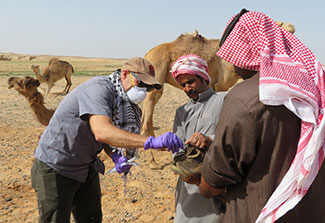
Photo courtesy of NIAID
Spillover events, where diseases jump from animals to
humans, are increasing in frequency. Humans have acquired
MERS coronavirus through close contact with camels.
Focus on One Health research
- Prawn farming reduces disease, provides food source in Senegal
- Scientists in Tanzania show bacterial zoonoses, not malaria, often the cause of febrile diseases
- Research improves health among Mongolian livestock herders
Researchers may never discover exactly how the current novel coronavirus outbreak began, but they agree that as humans have changed the way they interact with animals and the environment, emerging infectious diseases are rapidly growing in frequency. Accelerating rates of deforestation, human settlements encroaching on forests, global trade and travel, and livestock production are thought to be the underlying drivers of so-called “spillover” events, when diseases jump from animals to humans. For example, bats are one of the species suspected to be the source of the virus that causes COVID-19, while viruses in bats and other animals spurred the Ebola outbreak that began in 2014, MERS in 2012 and SARS in 2002, and others. Constant mutations jeopardize existing vaccines and treatments.
With 70% of emerging infectious diseases originating in animals, there is increasing urgency to prioritize the study of zoonotic diseases. “To anticipate threats for humans, we’ve got to partner with people in other disciplines including animal and environmental health,” said Dr. Gregory Gray, a Fogarty grantee and epidemiologist at Duke University.
The One Health movement aims to integrate the efforts of multiple disciplines to improve health for people, animals and the environment. It has become a global effort, including annual conferences that bring scientists and policymakers together to consider how to control existing and emerging infectious diseases. Since the majority of diseases that occur in humans also affect animals, it's important that the biomedical research workforce includes multidisciplinary practitioners with a broad understanding of subjects such as animal anatomy, physiology, pharmacology, epidemiology, behavior science and infectious diseases. Communication strategies and public outreach are also critical to develop interventions such as educational programs for workers to improve hygiene and increase use of personal protective equipment, development of rapid diagnostics and vaccines, and improved food safety measures.
NIH’s zoonotic research is based at Rocky Mountain Laboratories in Montana. Part of the National Institute of Allergy and Infectious Diseases, it’s a state-of-the-art biomedical facility designed for investigations of highly pathogenic viruses. Fogarty supports studies of emerging global threats through its Ecology and Evolution of Infectious Diseases program, a partnership with the National Science Foundation. The initiative supports efforts to understand the underlying ecological and biological mechanisms that govern relationships between environmental changes and the emergence and transmission of infectious diseases. Funded researchers explore how environmental events such as habitat alteration, biological invasion and pollution alter the risks of disease outbreaks in both animals and humans.
As outbreaks of emerging infectious diseases - such as the current COVID-19 pandemic - increase in frequency and impact, scientists and policymakers are calling for an increased emphasis on global preparedness.
More Information
- NIH One Health resources:
- Other U.S. Government One Health resources:
- U.S. Centers for Disease Control and Prevention (CDC): One Health
- U.S. Food and Drug Administration (FDA):
- U.S. Department of Agriculture (USDA): One Health
- One Health resources from others:
Resources and publications related to the article Prawn farming reduces disease, provides food source in Senegal :
- Fact sheet: Schistosomiasis , WHO
- About Schistosomiasis , CDC
- Profile: Dr. Susanne Sokolow
via Stanford University Woods Institute for the Environment - Grant: Effects of agricultural expansion and intensification on infections via NIH RePORTER
- Related program: Ecology and Evolution of Infectious Diseases Initiative (EEID)
- Grant: Emergence and biological control of schistosomiasis via NIH RePORTER
- Related publications featuring the results of the intervention:
- How to identify win-win interventions that benefit human health and conservation
Nature Sustainability, November 16, 2020 - Precision mapping of snail habitat provides a powerful indicator of human schistosomiasis transmission
Proceedings of the National Academy of Sciences, November 12, 2019 - Agrochemicals increase risk of human schistosomiasis by supporting higher densities of intermediate hosts
Nature Communications, February 26, 2018 - Reduced transmission of human schistosomiasis after restoration of a native river prawn that preys on the snail intermediate host
Proceedings of the National Academy of Sciences, August 4, 2015
- How to identify win-win interventions that benefit human health and conservation
Resources and publications related to the article Scientists in Tanzania show bacterial zoonoses, not malaria, often the cause of febrile diseases :
- Profile: Dr. John Crump
via University of Otago - NIAID/NIH grant: Investigating Febrile Deaths in Tanzania (INDITe) via NIH RePORTER
- NIAID/NIH grant: Acute HIV-1 Infections Network Core via NIH RePORTER
- Fogarty/NIH grant: The Impact and Society Ecology of Bacterial Zoonoses in Northern Tanzania: Under via NIH RePORTER
- Related Fogarty program: Ecology and Evolution of Infectious Diseases Initiative (EEID)
- Related publication: Fever, bacterial zoonoses, and One Health in sub-Saharan Africa
Clinical Medicine, September 2019 - Related publication: Mixed Methods Survey of Zoonotic Disease Awareness and Practice among Animal and Human Healthcare Providers in Moshi, Tanzania
PLOS Neglected Tropical Diseases, March 4, 2016 - Related publication: Global burden of human brucellosis: a systematic review of disease frequency
PLOS Neglected Tropical Diseases, October 25, 2012 - Campaign: Not Every Fever is Malaria (Tanzania) via Compass
Resources and publications related to the article Research improves health among Mongolian livestock herders :
- Profile: Dr. Gregory Gray
via Duke University Global Health Institute - Grant: One Health Innovation Fellowships for Zoonotic Disease Research in Mongolia , including related publications, via NIH RePORTER
- Related publication: Knowledge and practices surrounding zoonotic disease among Mongolian herding households
Pastoralism, April 20, 2020 - Related publication: Potential risk factors for zoonotic disease transmission among Mongolian herder households caring for horses and camels
Pastoralism, January 29, 2018 - Related Fogarty program: Framework Programs for Global Health Innovation
To view Adobe PDF files, download current, free accessible plug-ins from Adobe's website .