 An official website of the United States government




Focus on adolescent health research: Healthy habits in teens help reduce NCD burden
Focus on adolescent health research
- Fogarty's adolescent research key to future good health
- Teen pregnancy can impact health for a lifetime
- HIV/AIDS a key battleground for teen health researchers
By Karin Zeitvogel
When teens see their movie idols light up on the big screen, they're more likely to try tobacco themselves, Fogarty-supported studies indicate. This matters because tobacco use is the single biggest risk factor for developing an NCD later in life, and it's a behavior often adopted during adolescence.
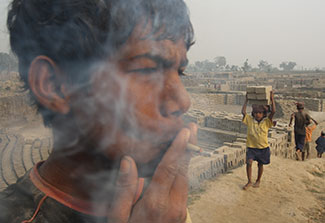
© 2010 Suchetadas, courtesy of Photoshare
Santu, a 15-year-old child laborer, smokes a bidi (leaf-rolled
tobacco cigar) while working in a brick factory at
Ghanashyampur village in Murshidabad, 350 km north of
Kolkata, India. Santu also works in a bidi factory.
Among the Fogarty-supported studies to look into teen smoking, one, led by grantee Dr. Monika Arora, found a clear association between exposure to tobacco use in India's popular Bollywood movies and teens taking up the habit. India is not only the country with the largest population of adolescents in the world, but also one of four countries with China, Russia and the U.S., in which more than half of global tobacco-related deaths occur. Even after adjusting for demographic, social and family differences between the nearly 4,000 Indian teens who took part in the study, Arora found that the odds of using tobacco were more than double among teens who saw a lot of smoking in Bollywood films than those with low exposure to tobacco use in movies.
Those findings are not restricted to India. A study conducted in Argentina, with support from Fogarty and NIH's National Cancer Institute, found that the more adolescents saw actors smoke in U.S. and Argentinian films, the more likely they were to start using tobacco themselves. Researchers in India and Argentina have called for policy action on ‘film smoking,' calling it an important, independent risk factor for smoking initiation.
Early use of tobacco is of concern because it predicts greater likelihood of addiction, longer lifetime use, and higher rates of lung cancer, said Arora. "Ensuring good health in adolescents brings economic and lifestyle benefits at the individual and national level and is vital to improving the health of future generations," she said.
"We are seeing the global burden of disease shifting to NCDs, so we need to focus on health promotion and prevention, particularly among adolescents who are less risk-averse than young children or adults. If we don't, the kind of budget required for managing NCDs among adults will be way beyond the means of any government, especially in low- and middle-income countries."
More Information
- Related NIH-supported project: Assessment of causality between exposure to tobacco use in Bollywood movies and tobacco use
- Related NIH-supported project: Visual media influences on adolescent smoking behavior
- Related Fogarty article: Bollywood, like Hollywood, raises risk of teen smoking
Sep/Oct 2012 Global Health Matters - Related Fogarty article: NIDA, Fogarty work to reduce smoking in Argentina
Jul/Aug 2015 Global Health Matters - Related publications:
- Tobacco use in Bollywood movies, tobacco promotional activities and their association with tobacco use among Indian adolescents
Tobacco Control, September 2012 - Differences in tobacco use among young people in urban India by sex, socioeconomic status, age, and school grade: assessment of baseline survey data
The Lancet, February 2006 - Smoking in Movies and Adolescent Smoking Initiation: A Longitudinal Study among Argentinian Adolescents
The Journal of Pediatrics, January 2017 - Multiple tobacco product use among US adolescents and young adults
Tobacco Control, March 2016
- Tobacco use in Bollywood movies, tobacco promotional activities and their association with tobacco use among Indian adolescents
To view Adobe PDF files, download current, free accessible plug-ins from Adobe's website .