 An official website of the United States government




Congressional Justification FY2012
This document provides justification for the Fiscal Year 2012 activities of the Fogarty International Center, a component of the National Institutes of Health in the U.S. Department of Health and Human Services.
Fogarty is dedicated to advancing the mission of the National Institutes of Health by supporting and facilitating global health research conducted by U.S. and international investigators, building partnerships between health research institutions in the U.S. and abroad, and training the next generation of scientists to address global health needs.
To view Adobe PDF files, download current, free accessible plug-ins from the Adobe's website .
FY2012 Congressional Justitifcation (Full Text)
- Organization Chart
- Appropriation Language
- Amounts Available for Obligation
- Budget Mechanism Table
- Major Changes in Budget Request
- Summary of Changes
- Budget Graphs
- Budget Authority by Activity
- Authorizing Legislation
- Appropriations History
- Justification of Budget Request
- Budget Authority by Object Class
- Salaries and Expenses
- Details of Full-Time Equivalent Employment (FTE)
- Detail of Positions
Organization Chart

Text Description of Organization Chart
Office/DivisionNameOffice of the DirectorDirector - Roger I. Glass, M.D., Ph.DDeputy Director - Michael P. Johnson, M.D.Office of Administrative Management and International Services
(to right of Office of Director)Timothy J. Tosten, M.P.A.Division of International Relations
(below Office of Director)James E. Herrington, Ph.D.Division of International Epidemiology and Population Studies
(below Office of Director)Mark A. Miller, M.D.Division of International Science Policy, Planning and Evaluation
(below Office of Director)Karen J. Hofman, M.D.Division of International Training and Research
(below Office of Director)Kenneth Bridbord, M.D.
Appropriation Language
For carrying out the activities of the John E. Fogarty International Center (described in subpart 2 of part E of title IV of the Public Health Service Act), $71,328,000.
Amounts Available for Obligation [Note 1]
(Dollars in Thousands)
| Source of Funding | FY 2010 Actual | FY 2011 CR | FY 2012 PB |
|---|---|---|---|
| Appropriation | $70,051 | $70,051 | $71,328 |
| Type 1 Diabetes | 0 | 0 | 0 |
| Rescission | 0 | 0 | 0 |
| Supplemental | 0 | 0 | 0 |
| Subtotal, adjusted appropriation | 70,051 | 70,051 | 71,328 |
| Real transfer under Director's one-percent transfer authority (GEI) | (74) | 0 | 0 |
| Real transfer under Secretary's one-percent transfer authority | (10) | 0 | 0 |
| Comparative transfer to NLM for NCBI and Public Access | (48) | (60) | 0 |
| Comparative transfer under Director's one-percent transfer authority (GEI) | 74 | 0 | 0 |
| Subtotal, adjusted budget authority | 69,993 | 69,991 | 71,328 |
| Unobligated balance lapsing | (10) | 0 | 0 |
| Total obligations | 69,983 | 69,991 | 71,328 |
Budget Mechanism Table [Note 2]
(Dollars in Thousands)
| MECHANISM | FY 2010 Actual | FY 2011 CR | FY 2012 PB | Change vs. FY 2010 | |||||||
|---|---|---|---|---|---|---|---|---|---|---|---|
| No. | Amount | No. | Amount | No. | Amount | No. | Amount | ||||
| Research Grants: | Research Projects: | Noncompeting | 101 | $10,026 | 92 | $10,551 | 94 | $10,762 | (7) | $736 | |
| Administrative supplements | (5) | 535 | 0 | 0 | 0 | 0 | 5 | (535) | |||
| Competing: | Renewal | 0 | 0 | 0 | 0 | 0 | 0 | 0 | 0 | ||
| New | 35 | 2,549 | 35 | 2,560 | 36 | 2,609 | 1 | 60 | |||
| Supplements | 0 | 0 | 0 | 0 | 0 | 0 | 0 | 0 | |||
| Subtotal, competing | 35 | 2,549 | 35 | 2,560 | 36 | 2,609 | 1 | 60 | |||
| Subtotal, RPGs | 136 | 13,110 | 127 | 13,111 | 130 | 13,371 | (6) | 261 | |||
| SBIR/STTR | 0 | 0 | 0 | 0 | 0 | 0 | 0 | 0 | |||
| Research Project Grants | 136 | 13,110 | 127 | 13,111 | 130 | 13,371 | (6) | 261 | |||
| Research Centers: | Specialized/comprehensive | 0 | 0 | 0 | 0 | 0 | 0 | 0 | 0 | ||
| Clinical research | 0 | 0 | 0 | 0 | 0 | 0 | 0 | 0 | |||
| Biotechnology | 0 | 0 | 0 | 0 | 0 | 0 | 0 | 0 | |||
| Comparative medicine | 0 | 0 | 0 | 0 | 0 | 0 | 0 | 0 | |||
| Research Centers in Minority Institutions | 0 | 0 | 0 | 0 | 0 | 0 | 0 | 0 | |||
| Research Centers | 0 | 0 | 0 | 0 | 0 | 0 | 0 | 0 | |||
| Other Research: | Research careers | 13 | 1,248 | 11 | 1,500 | 11 | 1,500 | (2) | 252 | ||
| Cancer education | 0 | 0 | 0 | 0 | 0 | 0 | 0 | 0 | |||
| Cooperative clinical research | 0 | 0 | 0 | 0 | 0 | 0 | 0 | 0 | |||
| Biomedical research support | 0 | 0 | 0 | 0 | 0 | 0 | 0 | 0 | |||
| Minority biomedical research support | 0 | 0 | 0 | 0 | 0 | 0 | 0 | 0 | |||
| Other | 168 | 38,343 | 165 | 37,963 | 167 | 37,678 | (1) | (665) | |||
| Other Research | 181 | 39,463 | 176 | 39,463 | 178 | 39,178 | (3) | (413) | |||
| Total Research Grants | 317 | 52,701 | 303 | 52,574 | 308 | 52,549 | (9) | (512) | |||
| FTTPs | FTTPs | FTTPs | FTTPs | ||||||||
| Research Training: | Individual awards | 0 | 0 | 0 | 0 | 0 | 0 | 0 | 0 | ||
| Institutional awards | 2 | 125 | 0 | 0 | 0 | 0 | (2) | (125) | |||
| Total, Training | 2 | 125 | 0 | 0 | 0 | 0 | (2) | (125) | |||
| Research & development contracts | 0 | 3,315 | 0 | 3,330 | 0 | 4,551 | 0 | 1,236 | |||
| (SBIR/STTR) | 0 | 0 | 0 | 0 | 0 | 0 | 0 | 0 | |||
| FTEs | FTEs | FTEs | FTEs | ||||||||
| Intramural research | 0 | 0 | 0 | 0 | 0 | 0 | 0 | 0 | |||
| Research management and support | 61 | 13,852 | 61 | 14,087 | 61 | 14,228 | 0 | 376 | |||
| Construction | 0 | 0 | 0 | 0 | 0 | 0 | 0 | 0 | |||
| Buildings and Facilities | 0 | 0 | 0 | 0 | 0 | 0 | 0 | 0 | |||
| Total, FIC | 61 | 69,993 | 61 | 69,991 | 61 | 71,328 | 0 | 1,335 | |||
Major Changes in Budget Request
Major changes by budget mechanism and/or budget activity detail are briefly described below. Note that there may be overlap between budget mechanism and activity detail and these highlights will not sum to the total change for the FY 2012 budget request for FIC, which is $1.3 million more than the FY 2010 Estimate, for a total of $71.3 million.
Research Project Grants (+$0.261 million; total $13.371 million):
FIC will support a total of 130 Research Project Grant (RPG) awards in FY 2012. Noncompeting RPGs will decrease by 7 awards and decrease by $736 thousand. Competing RPGs will increase by 1 award and increase by $60 thousand. FIC will continue to support new investigators and maintain the number of competing RPGs.
Research Capacity Strengthening (+$756 thousand; total $38.4 million):
FIC will increase funding for the Bioethics program, as well as the International Clinical, Operational and Health Services Research and Training Award for non-communicable diseases and disorders, malaria, AIDS and TB. FIC is also continuing the Millennium Promise Awards: Non-Communicable Chronic Diseases Research Training Program. This program will focus on the fields related to cancer, cerebrovascular disease including stroke, lung disease including chronic obstructive pulmonary disease (COPD), environmental factors including indoor air pollution, and obesity and lifestyle factors related to these conditions.
Development of Human Resources for Global Health Research (+$63 thousand; total $4.9 million):
FIC will increase funding for this activity, building on the progress made with the FIC International Clinical Research Scholars Program, as well as the Research Career awards.
International Collaborative Research (+$140 thousand; total $13.8 million):
FIC will continue emphasis on the Brain Disorders in the Developing World: Research Across the Lifespan program, and increase funding for other areas of competing research programs.
Summary of Changes
(Dollars in Thousands)
- FY 2010 Actual: $69,993
- FY 2012 Estimate: $71,328
- Net Change: $1,335
| CHANGES | 2012 Estimate | Change from FY 2010 | |||
|---|---|---|---|---|---|
| FTEs | Budget Authority | FTEs | Budget Authority | ||
| A. Built-in | |||||
| 1. Intramural research: | |||||
| a. Annualization of January 2010 pay increase | $0 | $0 | |||
| b. January FY 2012 pay increase | 0 | 0 | |||
| c. One less day of pay (n/a for 2011) | 0 | 0 | |||
| d. Payment for centrally furnished services | 0 | 0 | |||
| e. Increased cost of laboratory supplies, materials, and other expenses | 0 | 0 | |||
| Subtotal | 0 | 0 | |||
| 2. Research management and support: | |||||
| a. Annualization of January 2010 pay increase | $8,373 | $49 | |||
| b. January FY 2012 pay increase | 8,373 | 0 | |||
| c. One less days of pay (n/a for 2011) | 8,373 | (32) | |||
| d. Payment for centrally furnished services | 844 | 8 | |||
| e. Increased cost of laboratory supplies, materials, and other expenses | 5,011 | 48 | |||
| Subtotal | 30,974 | 73 | |||
| Subtotal, Built-in | 30,974 | 73 | |||
| B. Program | |||||
| 1. Research project grants: | |||||
| a. Noncompeting | 94 | $10,762 | (7) | $201 | |
| b. Competing | 36 | 2,609 | 1 | 60 | |
| c. SBIR/STTR | 0 | 0 | 0 | 0 | |
| Total | 130 | 13,371 | (6) | 261 | |
| 2. Research centers | 0 | 0 | 0 | 0 | |
| 3. Other research | 178 | 39,178 | (3) | (413) | |
| 4. Research training | 0 | 0 | (2) | (125) | |
| 5. Research and development contracts | 0 | 4,551 | 0 | 1,236 | |
| Subtotal, extramural | 57,100 | 698 | |||
| 6. Intramural research | 0 | 0 | 0 | 0 | |
| 7. Research management and support | 61 | 14,228 | 0 | 299 | |
| Subtotal, program | 61 | 84,699 | 0 | 1,258 | |
| Total changes | 115,147 | 1,335 | |||
Budget Graphs
History of Budget Authority: Funding Levels by Fiscal Year
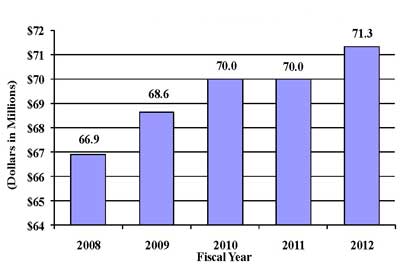
| Description of Graph: Bar Chart of Funding Levels by Fiscal Year | |
|---|---|
| Fiscal Year | Funding Level(Dollars in Millions) |
| 2008 | $ 66.9 |
| 2009 | $ 68.6 |
| 2010 | $ 70.0 |
| 2011 | $ 70.0 |
| 2012 | $ 71.3 |
History of FTEs: FTEs by Fiscal Year
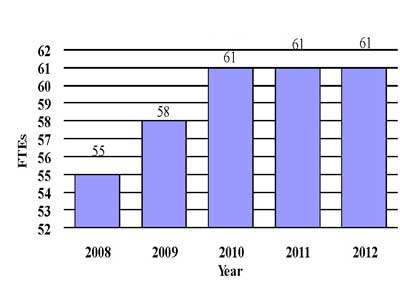
| Description of Graph: Bar Chart of FTE's by Fiscal Year | |
|---|---|
| Fiscal Year | FTEs |
| 2008 | 55 |
| 2009 | 58 |
| 2010 | 61 |
| 2011 | 61 |
| 2012 | 61 |
Distribution by Mechanism: FY 2012 Budget Mechanism
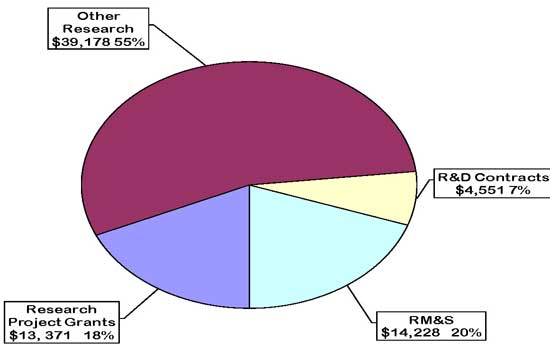
| Description of Graph:Pie Chart of FY 2012 Budget Mechanism | ||
|---|---|---|
| Category | Dollars in Thousands | Percent |
| R&D Contracts | $ 4,551 | 7% |
| RM&S | $ 14,228 | 20% |
| Research Project Grants | $ 13,371 | 18% |
| Other Research | $ 39,178 | 55% |
Change by Selected Mechanisms: FY 2012 Estimate Percent Change from FY 2010 Mechanism
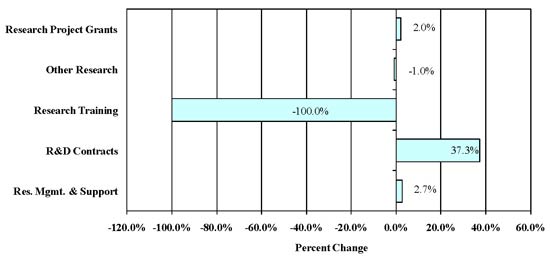
| Description of Graph: Bar Chart of FY 2012 Estimate Percent Change from FY 2010 Mechanism | |
|---|---|
| Category | Percent Change |
| Research Project Grants | 2.0% |
| Other Research | -1.0% |
| Research Training | -100.0% |
| R&D Contracts | 37.3% |
| Research Management and Support | 2.7% |
Budget Authority by Activity
(Dollars in thousands)
| FY 2010 Actual | FY 2011 CR | FY 2012 PB | Change vs. FY 2010 | ||||||
|---|---|---|---|---|---|---|---|---|---|
| FTEs | Amount | FTEs | Amount | FTEs | Amount | FTEs | Amount | ||
| Extramural ResearchDetail: | Research Capacity Strengthening | $37,630 | $37,581 | $38,386 | $756 | ||||
| Development of Human Resources for Global Health Research | 4,825 | 4,790 | 4,888 | 63 | |||||
| International Collaborative Research | 13,686 | 13,533 | 13,826 | 140 | |||||
| Subtotal, Extramural | 56,141 | 55,904 | 57,100 | 959 | |||||
| Intramural research | 0 | 0 | 0 | 0 | 0 | 0 | 0 | 0 | |
| Res. management & support | 61 | 13,852 | 61 | 14,087 | 61 | 14,228 | 0 | 376 | |
| TOTAL | 61 | 69,993 | 61 | 69,991 | 61 | 71,328 | 0 | 1,335 | |
Authorizing Legislation
| PHS Act/Other Citation | U.S. Code Citation | FY 2011 CR | FY 2010 Actual | 2012 Amount Authorized | FY 2012 PB | |
|---|---|---|---|---|---|---|
| Research and Investigation | Section 301 | 42§241 | Indefinite | $69,993,000 | Indefinite | $71,328,000 |
| International Cooperation | Section 307 | 42§242l | Indefinite | Indefinite | ||
| John E. Fogarty International Center | Section 482 | 42§287b | Indefinite | Indefinite | ||
| Total, Budget Authority | $69,993,000 | $71,328,000 |
Appropriations History
| Fiscal Year | Budget Estimate to Congress | House Allowance | Senate Allowance | Appropriation |
|---|---|---|---|---|
| 2003 | $63,088,000 | $63,088,000 | $60,880,000 | $63,880,000 |
| Rescission | ($415,000) | |||
| 2004 | 64,266,000 | 64,266,000 | 65,900,000 | 65,800,000 |
| Rescission | (418,000) | |||
| 2005 | 67,182,000 | 67,182,000 | 67,600,000 | 67,182,000 |
| Rescission | (550,000) | |||
| 2006 | 67,048,000 | 67,048,000 | 68,745,000 | 67,048,000 |
| Rescission | (670,000) | |||
| 2007 | 66,681,000 | 66,681,000 | 66,832,000 | 66,378,000 |
| Rescission | 0 | |||
| 2008 | 66,594,000 | 67,599,000 | 68,000,000 | 67,741,000 |
| Rescission | (1,183,000) | |||
| Supplemental | 354,000 | |||
| 2009 | 66,623,000 | 68,905,000 | 68,476,000 | 68,691,000 |
| Rescission | 0 | |||
| 2010 | 69,227,000 | 70,780,000 | 69,409,000 | 70,051,000 |
| Recession | 0 | |||
| 2011 | 73,027,000 | 72,914,000 | ||
| Receission | ||||
| 2012 | 71,328,000 | |||
Justification of Budget Request
John E. Fogarty International Center for Advanced Study in the Health Sciences
Authorizing Legislation: Section 301 and title IV of the Public Health Service Act, as amended.
Budget Authority (BA):
| FY 2010 Actual | FY 2011 Continuing Resolution | FY 2012 President's Budget | FY 2012 +/- FY 2010 | |
|---|---|---|---|---|
| BA | $69,993,000 | $69,991,000 | $71,328,000 | $1,335,000 |
| FTE | 61 | 61 | 61 | 61 |
Program funds are allocated as follows: Competitive Grants/Cooperative Agreements; Contracts; Direct Federal/Intramural and Other.
Director’s Overview
When it comes to global health, there is no “them” - only “us.” [Note 3] Over the past several years, the U.S. Government (USG) has recognized this reality, and has made improving health around the world a national priority. For these investments to yield the maximum benefit, we must have people in place here as well as around the globe to generate the scientific evidence that will inform how best to allocate resources. These researchers will contribute the necessary local expertise and knowledge to thwart pandemics and fight diseases that prevent societies from achieving their full potential and stymie their economic development. The Fogarty International Center plays a unique role at the National Institutes of Health (NIH) and in the USG by supporting the development of global health research expertise in the U.S. and abroad.
Reinvigorating the Biomedical Research Community.
Research advances will more likely occur when investigators study diseases onsite to develop health interventions that are responsive to local and international priorities. This requires trained, in-country scientists and robust institutions that understand local populations and collaborate with U.S. and other investigators. Fogarty responds to this need through support of long-term research and training partnerships between U.S. and low- and middle-income country (LMIC) research institutions, which has resulted in the training of more than 5,000 researchers many of whom contribute to major scientific advances. For example, the first results from a large clinical trial testing candidate microbicides that use anti-retrovirals (ARVs) found that the incorporation of an ARV into a vaginal gel was more than 50 percent protective against HIV infection when used as directed. This advance is a key step toward empowering women with a safe and effective HIV prevention tool. Notably, six of the study’s authors are current or former Fogarty-sponsored trainees. The lead scientists explicitly recognized Fogarty’s training support in making this trial possible.
Fogarty also supports the training of U.S. investigators to conduct global health research and actively engage in international scientific collaborations. These investments directly respond to the overwhelming demand for global health opportunities on university campuses across the U.S. In addition, these programs are helping to prepare early career scientists to participate in the global scientific marketplace, to build long-term relationships and to acquire skills that will help to ensure that the U.S. continues to be a global leader in health innovation.
Combating Global Disease.
In his “Focusing on Global Health” Theme, the NIH Director has highlighted infectious diseases, non-communicable diseases, and injuries. Fogarty’s Global Infectious Disease Research Training Program supports collaborations between U.S. and LMIC research institutions that are training early career investigators in infectious disease research and empowering the trainees to eventually become mentors and leaders of the next generation of scientists in their home countries. For example, Dr. Hector Garcia, a former Fogarty-supported trainee from the Universidad Peruana Cayetano Heredia (UCPH) in Peru, is now the recipient of NIH research funding to test treatments for epilepsy resulting from neurocysticercosis. Building on a twenty-year-old research and training collaboration between UCPH and the Johns Hopkins School of Public Health, Dr. Garcia is also the Principal Investigator on a Fogarty grant that is training students in infectious disease research, with an emphasis on diarrheal disease, cysticercosis, and tuberculosis. Notably, neurocysticercosis is the leading cause of epilepsy among U.S. immigrants from Central and South America. By extending the frontiers of science beyond our borders and investing in research where diseases are endemic, new interventions that are developed can help us better treat patient populations in the U.S.
Non-communicable diseases, such as heart disease, stroke, cancer, and diabetes, are the leading causes of worldwide mortality, accounting for 60 percent of all deaths. Eighty percent of this burden is in LMICs, where these diseases affect people disproportionately during their most economically productive years. Therefore, non-communicable diseases present a serious threat to economic development. Fogarty is addressing this challenge through its expanded program on Chronic, Non-Communicable Diseases and Disorders across the Lifespan, which supports training of in-country scientists to conduct research on these diseases. Given the high burden of non-communicable diseases in the U.S., knowledge gained from these research activities can inform domestic efforts to prevent and treat these diseases, particularly in low-resource settings.
Leveraging Resources through Innovative Partnerships.
It is imperative that we identify opportunities to leverage resources and expertise. Fogarty is administering a major new program called the Medical Education Partnership Initiative (MEPI) - a joint effort of the Office of the Global AIDS Coordinator, the Health Resources and Services Administration, the Department of Defense, USAID, CDC, and NIH. MEPI supports institutions in Sub-Saharan African countries and their U.S. partners to develop new models of medical education and to strengthen the ability of medical students and faculty to conduct research that responds to the health needs of their countries. As evidence of Fogarty’s successful investments in building research capacity, over half of the awardees in this highly competitive program have a history of ten or more years of Fogarty support.
Fogarty has also partnered with the Bill and Melinda Gates Foundation (Gates Foundation) and the Foundation for NIH (FNIH) on a study of Malnutrition and Enteric Diseases, which examines the relationship between malnutrition and intestinal infections and the consequences of these conditions on various aspects of child health and development. Investigators across multiple international research sites hope to facilitate the design of more targeted, cost-effective interventions that will reduce the burden of child morbidity and mortality from diarrheal diseases. Fogarty is providing scientific oversight and coordination of the research, FNIH is providing administrative and financial oversight, and the Gates Foundation is funding the study.
Deep regional expertise also enables Fogarty to facilitate scientific collaborations between countries. In the context of advancing science and health, Fogarty seeks opportunities to bridge differences between countries that might otherwise not engage and to build trust by encouraging scientists from around the world to work together to address shared health challenges. These partnerships promote goodwill, stability and peace, and effectively harness science for diplomacy. As the world continues to become more interdependent, international scientific partnerships will play a critical role in building bridges and in improving health for people worldwide. Fogarty’s unique programs will continue to enable scientists in the U.S. and abroad to work together to tackle the most pressing and complex health challenges of our time.
Overall Budget Policy:
The FY 2012 request for FIC is $71.3 million, an increase of $1.3 million, or 1.9 percent over the FY 2010 Enacted Level. FIC distributes its resources among many programs and mechanisms and is committed to funding the largest number of meritorious projects possible, while allowing the flexibility needed to support selected program priorities and to respond to emerging scientific opportunities. Funding decisions are based on the number of high-quality applications, the overall number of applications, and the availability of funds. FIC funds a large number of initiatives with collaborating funding partners that include other NIH Institutes/Centers, other government agencies, and non-government organizations. Funding decisions take into account program relevance and overall portfolio consideration.
Funds are included in R&D contracts to reflect FIC’s share of NIH-wide funding required to support several trans-NIH initiatives, such as the Therapies for Rare and Neglected Diseases program (TRND) and the Basic Behavioral and Social Sciences Opportunity Network (OppNet).
In FY 2012, FIC will support new investigators on R01 equivalent awards at success rates equivalent to those of established investigators submitting new R01 equivalent applications.
Program Descriptions and Accomplishments
Research Capacity Strengthening
The development of appropriate and effective health interventions that address local needs and priorities requires a sustainable base of research sites and scientists in the U.S. and developing countries. Strong institutions that can conduct robust health research and train scientists in a wide range of disciplines are critical to finding solutions to global public health challenges, and to building the research workforce of the future. Fogarty is strengthening U.S. and low- and middle income country (LMIC) institutions by investing in multidisciplinary research, training and curriculum development related to global health, which will lead to more innovative and sustainable research environments.
Budget Policy
The FY 2012 request for this program is $38.4 million, an increase of $756 thousand or 2 percent over the FY 2010 Enacted Level. FIC’s new Strategic Plan 2009-2013 provides the pathway toward developing sustainable global health research and training programs where they are needed most. The plan’s first goal is to mobilize the scientific community to address the growing epidemic of chronic, non-communicable diseases related to increased longevity and changing lifestyles in the developing world. To accomplish this, FIC will invest in this area, while continuing to invest in the critical infectious diseases agenda. FIC’s Millenium Promise Awards in Non-Communicable Diseases Program plans to fund $1.5 million a year to support non-communicable diseases research training, with seven awards expected annually. In addition, FIC is working with other NIH components and private partners to develop further chronic disease initiatives.
Portrait of a Program: Framework Programs for Global Health
FY 2010 Level: $1.138 million
FY 2012 Level: $1.158 million
Interest in global health - both on the part of students and faculty - has soared on U.S. university campuses over the past several years. Furthermore, solving complex global health problems will require knowledge, imagination, and cooperation from experts in a wide variety of fields. Launched in 2005, the Framework Programs for Global Health (Framework) provide competitive grants to universities in the U.S. and in low- and middle-income countries to develop multidisciplinary curricula in global health and stimulate the participation of faculty and students from a wide range of disciplines in global health education and research. This has resulted in new undergraduate and graduate programs at 36 universities and partnering institutions, and has engaged university components representing numerous disciplines, such as medicine, public health, nursing, engineering, law, agriculture, business, and social sciences. For example, with support from Framework, the Harvard Program in Refugee Trauma at the Massachusetts General Hospital partnered with the University of Rome and the Istituto Superiore di Sanita to develop a new program for policymakers and healthcare practitioners focused on mental health interventions for traumatized populations. This program has trained 200 people from 60 countries, including doctors, psychologists, lawyers, occupational therapists, and journalists.
In 2010, the program was expanded using American Recovery and Reinvestment Act funds to include a problems-based multidisciplinary pilot training program - the Framework Programs for Global Health Signature Innovations Initiative. This initiative provides one-year support to U.S. universities and their partners to explore models for training postdoctoral investigators to carry out multidisciplinary research likely to produce innovative devices, practices or policies in global health. For example, one team will further develop, validate, and field test an inexpensive lens-free microscope that can be attached to a cell phone, allowing the user to send the image of a sample collected anywhere in the world to a distant computer for automated analysis and feedback. This can provide point-of-care surveillance and diagnosis of TB, malaria, HIV/AIDS, and water-borne diseases.
Fogarty will build on these programs in FY 2012 with a solicitation for an updated program that will combine the institutional capacity building approach of the original Frameworks program with the multidisciplinary problem-based training model of the Innovations initiative. The grants will allow institutions or consortia to develop new training models to address the most pressing issues in global health, while providing more opportunities for, and strengthening interactions between researchers from diverse disciplines across campuses
Sustainable development of human resources for global health research
Breakthrough scientific advances depend on investments in the best and the brightest investigators, wherever they reside. Global health successes in particular are built upon a foundation of well-trained researchers from both high-income countries and LMICs who work together to solve major global health problems. Therefore, training talented LMIC scientists remains a high priority for Fogarty. Over the past 40 years, Fogarty programs have supported the training of over 5,000 investigators around the world. Well-trained researchers in developing countries bring an understanding of the unique biological, epidemiological, social, and cultural contexts of their communities. In addition, prominent and successful investigators in LMICs are often called upon by their Ministries of Health to help design and implement healthcare delivery programs for local populations, which provides additional opportunities to translate research findings into policies that can benefit larger populations.
Budget Policy
The FY 2012 request for this program is $4.9 million, an increase of $63 thousand or 1.3 percent over the FY 2010 Enacted Level. FIC’s impact has historically been most significant in developing the pipeline of U.S. and foreign research talent. FIC intends to expand the number of overseas research experiences available for young U.S. scientists in order to encourage them to adopt careers in global health. FIC will also continue its research training partnerships between U.S. and foreign institutions and strive to enhance research opportunities for foreign scientists when they return home.
Portrait of a Program: Collaborative Trauma and Injury Research Training Program
FY 2010 Level: $1.176 million
FY 2012 Level: $1.197 million
Unintentional injuries (e.g., resulting from traffic accidents, drowning, poisoning, falls or burns) and intentional injuries (e.g., resulting from assault, self-inflicted violence or acts of war) kill more than five million people worldwide every year, accounting for nine percent of global mortality. [Note 4] Over 90% of these deaths occur in low- and middle-income countries (LMICs). [Note 4] A large proportion of those who survive their injuries deal with temporary or permanent disabilities. Notably, the Department of State has published data demonstrating that injury is the leading cause of death from non-natural causes in U.S. citizens traveling abroad. In response to this high burden of global mortality and morbidity, Fogarty established the Collaborative Trauma and Injury Research Training Program in 2004. The program supports research training partnerships between U.S. and LMIC research institutions related to clinical, translation, and implementation research on human trauma and injury. The ultimate goal of this investment is to facilitate the development of locally relevant and effective interventions to prevent or treat injuries in low-resource settings. Program partners include the National Institute on Alcohol Abuse and Alcoholism, the National Institute of Neurological Disorders and Stroke, the U.S. Centers for Disease Control and Prevention, and the World Health Organization.
The program currently supports twelve grants that span the continents of Latin America, Eastern Europe, Asia and Africa. One grant involves a collaboration between the University of Maryland and various universities in Cairo, which is training leaders in emergency medicine with the goal of reducing traffic-related deaths in Egypt. A successful course on the assessment and management of trauma patients offered to 400 Egyptian professionals has now expanded to include Iraq. Training courses in public health preparedness and response have also been offered to the Kurdish Health Ministry to aid in the establishment of a formal medical emergency plan. Another grant is funding scientists at the University of California/Los Angeles and the University of the North in South Africa to train investigators to conduct research in trauma and injury prevention related to personal, interpersonal and community level violence and intentional injuries. Research activities specifically focus on minimizing mental health effects - specifically depression and post traumatic stress disorder. Grantees are partnering with local universities, research organizations, and traditional healers in their training activities. In an effort to build this capacity in a sustainable manner, the program will be presented to South African government officials to facilitate on-going training of researchers in universities and research centers across the country.
International Collaborative Research
Fogarty supports research partnerships between U.S. and LMIC scientists in several high-priority areas. This investment makes U.S. academic institutions more globally competitive, extends their reach, and enables U.S. scientists to participate in international teams that are developing interventions related to key global health priorities. For example, the burden of chronic, non-communicable diseases is climbing at a rapid rate in many LMICs due to dramatic gains in life expectancy, urbanization, and global economic development. This has led to a shared research agenda between high-income countries and LMICs, as well as opportunities to share knowledge and lessons learned. Therefore, international collaborative research becomes more critical to understanding how to better prevent, diagnose and treat these diseases. Many such discoveries will be relevant to U.S. populations.
Budget Policy
The FY 2012 request for this program is $13.8 million, an increase of $140 thousand or 1 percent over the FY 2010 Enacted Level. This area encourages implementation science to address the “know-do” gap, and would expand research training opportunities for U.S. and foreign scientists, foster a sustainable research environment in LMICs, and build strategic partnerships to further global health. FIC plans to expand its International Clinical, Operational and Health Services Research Training Award program for AIDS and TB and has reinforced the initiative’s support for implementation research.
Portrait of a Program: : International Tobacco and Health Research and Capacity Building Program
FY 2010 Level: $1.781 million
FY 2012 Level: $1.813 million
Tobacco use is one of the gravest public health challenges our world has ever confronted. More than five million people die of tobacco-caused illness each year, and it accounts for 10% of adult mortality globally. Tobacco use is increasing in low- and middle-income countries (LMICs), which will bear the brunt of the tobacco epidemic in the 21st century. Without a significant shift in worldwide prevalence patterns, smoking is projected to cause roughly eight million deaths annually by 2030; notably, more than 80% of these deaths will occur in LMICs. [Note 5] Because tobacco-related disease strikes people in the prime of their working lives, it also negatively impacts economic development.
Successful implementation of tobacco control strategies is informed by scientific evidence; however, there is a lack of capacity for local surveillance, research, and evaluation of interventions in LMICs. Furthermore, globalization of the tobacco epidemic requires coordinated efforts and collaboration between researchers from high-income countries and their counterparts in LMICs. The International Tobacco and Health Research and Capacity Building Program addresses the critical role of research and local research capacity in reducing the global burden of tobacco consumption and the need to generate a solid evidence base that can inform effective local tobacco control strategies and policies. The program supports epidemiological and behavioral research, as well as prevention, treatment, communications, implementation, health services and policy research. Current NIH partners for this program include the National Institute for Drug Abuse and the National Cancer Institute; Fogarty anticipates the participation of additional NIH partners when this program recompetes in FY 2012.
Grantees supported by this program are developing evidence that can be useful to tobacco control efforts globally, including here in the U.S. For example, in Delhi, India, researchers aretesting the efficacy and cost-effectiveness of a comprehensive, community-based behavioral intervention for tobacco cessation among disadvantaged youth living in low-income communities. Such studies can inform efforts to curb adolescent smoking in the U.S - particularly in resource-poor settings. Researchers in California are working with Turkish scientists to design and evaluate the effectiveness of a text messaging-based smoking intervention that harnesses mobile technologies in Turkey. Given the widespread use of mobile phones globally, evidence from such studies can inform the design of cell phone-based health interventions in the United States and abroad.
Research Management and Support (RMS)
FIC’s RMS provides administrative, budgetary, logistical, and scientific support to review, award, and monitor research grants, training awards, and contracts. It encompasses strategic planning, coordination, and evaluation of the Center’s programs; regulatory compliance; international coordination; international science policy; and liaisons with other Federal agencies, Congress, and the public. Specific functions include an in-house epidemiology section performing mathematical modeling of infectious diseases; international program officers developing partnerships between U.S. scientists and institutions and their counterparts abroad to advance scientific research and training; identification of collaborative opportunities with foreign science funding agencies; support for all NIH international travel by issuing and tracking official government passports and international visas; review and approval of Notice of Foreign Travel requests; and the creation and coordination of official travel cables to U.S. Embassies.
Budget Policy
The FY 2012 budget estimate for RMS is $14.2 million, an increase of $376 thousand or 2.6 percent over the FY 2010 estimate. This increase in RMS reflects overall NIH policy for FY 2012 and will help to strengthen program management.
Budget Authority by Object
(Dollars in thousands)
| FY 2010 Actual | FY 2012 PB | Increase or Decrease | Percent Change | ||
|---|---|---|---|---|---|
| Total compensable workyears: | |||||
| Full-time employment | 61 | 61 | 0 | 0.0% | |
| Full-time equivalent of overtime and holiday hours | 0 | 0 | 0 | 0.0 | |
| Average ES salary | $179,700 | $179,700 | $0 | 0.0 | |
| Average GM/GS grade | 11.8 | 11.8 | 0.0 | 0.0 | |
| Average GM/GS salary | $98,569 | $98,569 | 0 | 0.0 | |
| Average salary, grade established by act of July 1, 1944 (42 U.S.C. 207) | 0 | 0 | 0 | 0.0 | |
| Average salary of ungraded positions | 0 | 0 | 0 | 0.0 | |
| OBJECT CLASSES | FY 2010 Actual | FY 2012 PB | Increase or Decrease | Percent Change | |
| Personnel Compensation: | |||||
| 11.1 | Full-time permanent | $4,379 | $4,389 | $10 | 0.2% |
| 11.3 | Other than full-time permanent | 1,470 | 1,473 | 3 | 0.2 |
| 11.5 | Other personnel compensation | 153 | 153 | 0 | 0.0 |
| 11.7 | Military personnel | 278 | 288 | 10 | 3.6 |
| 11.8 | Special personnel services payments | 0 | 0 | 0 | 0 |
| Total, Personnel Compensation | 6,280 | 6,303 | 23 | 0.4 | |
| 12.0 | Personnel benefits | 1,603 | 1,607 | 4 | 0.2 |
| 12.2 | Military personnel benefits | 203 | 203 | 0 | 0.0 |
| 13.0 | Benefits for former personnel | 0 | 0 | 0 | 0.0 |
| Subtotal, Pay Costs | 8,086 | 8,113 | 27 | 0.3 | |
| 21.0 | Travel and transportation of persons | 349 | 386 | 37 | 10.6 |
| 22.0 | Transportation of things | 50 | 55 | 5 | 10.0 |
| 23.1 | Rental payments to GSA | 0 | 0 | 0 | 0.0 |
| 23.2 | Rental payments to others | 0 | 0 | 0 | 0.0 |
| 23.3 | Communications, utilities and miscellaneous charges | 112 | 124 | 12 | 10.7 |
| 24.0 | Printing and reproduction | 28 | 31 | 3 | 10.7 |
| 25.1 | Consulting services | 21 | 23 | 2 | 9.5 |
| 25.2 | Other services | 1,453 | 1,550 | 97 | 6.7 |
| 25.3 | Purchase of goods and services from government accounts | 6,529 | 7,821 | 1,292 | 19.8 |
| 25.4 | Operation and maintenance of facilities | 40 | 44 | 4 | 10.0 |
| 25.5 | Research and development contracts | 258 | 365 | 107 | 41.5 |
| 25.6 | Medical care | 0 | 0 | 0 | 0.0 |
| 25.7 | Operation and maintenance of equipment | 31 | 35 | 4 | 12.9 |
| 25.8 | Subsistence and support of persons | 0 | 0 | 0 | 0.0 |
| 25.0 | Subtotal, Other Contractual Services | 8,332 | 9,838 | 1,506 | 18.1 |
| 26.0 | Supplies and materials | 88 | 97 | 9 | 10.2 |
| 31.0 | Equipment | 122 | 135 | 13 | 10.7 |
| 32.0 | Land and structures | 0 | 0 | 0 | 0.0 |
| 33.0 | Investments and loans | 0 | 0 | 0 | 0.0 |
| 41.0 | Grants, subsidies and contributions | 52,826 | 52,549 | (277) | -0.5 |
| 42.0 | Insurance claims and indemnities | 0 | 0 | 0 | 0.0 |
| 43.0 | Interest and dividends | 0 | 0 | 0 | 0.0 |
| 44.0 | Refunds | 0 | 0 | 0 | 0.0 |
| Subtotal, Non-Pay Costs | 61,907 | 63,215 | 1,308 | 2.1 | |
| Total Budget Authority by Object | 69,993 | 71,328 | 1,335 | 1.9 | |
Salaries and Expenses
(Dollars in thousands)
| OBJECT CLASSES | FY 2010 Actual | FY 2012 PB | Increase or Decrease | Percent Change |
|---|---|---|---|---|
| Personnel Compensation: | ||||
| Full-time permanent (11.1) | $4,379 | $4,532 | $153 | 3.5% |
| Other than full-time permanent (11.3) | 1,470 | 1,521 | 51 | 3.5 |
| Other personnel compensation (11.5) | 153 | 158 | 5 | 3.3 |
| Military personnel (11.7) | 278 | 297 | 19 | 6.8 |
| Special personnel services payments (11.8) | 0 | 0 | 0 | 0.0 |
| Total Personnel Compensation (11.9) | 6,280 | 6,508 | 228 | 3.6 |
| Civilian personnel benefits (12.1) | 1,603 | 1,659 | 56 | 3.5 |
| Military personnel benefits (12.2) | 203 | 210 | 7 | 3.4 |
| Benefits to former personnel (13.0) | 0 | 0 | 0 | 0.0 |
| Subtotal, Pay Costs | 8,086 | 8,377 | 291 | 3.6 |
| Travel (21.0) | 349 | 358 | 9 | 2.6 |
| Transportation of things (22.0) | 50 | 51 | 1 | 2.0 |
| Rental payments to others (23.2) | 0 | 0 | 0 | 0.0 |
| Communications, utilities and miscellaneous charges (23.3) | 112 | 115 | 3 | 2.7 |
| Printing and reproduction (24.0) | 28 | 28 | 0 | 0.0 |
| Other Contractual Services: | ||||
| Advisory and assistance services (25.1) | 21 | 21 | 0 | 0.0 |
| Other services (25.2) | 1,453 | 1,436 | (17) | -1.2 |
| Purchases from government accounts (25.3) | 4,756 | 5,375 | 619 | 13.0 |
| Operation and maintenance of facilities (25.4) | 40 | 41 | 1 | 2.5 |
| Operation and maintenance of equipment (25.7) | 31 | 32 | 1 | 3.2 |
| Subsistence and support of persons (25.8) | 0 | 0 | 0 | 0.0 |
| Subtotal Other Contractual Services | 6,301 | 6,905 | 604 | 9.6 |
| Supplies and materials (26.0) | 88 | 90 | 2 | 2.3 |
| Subtotal, Non-Pay Costs | 6,928 | 7,547 | 619 | 8.9 |
| Total, Administrative Costs | 15,014 | 15,924 | 910 | 6.1 |
Details of Full-Time Equivalent Employment (FTEs)
| OFFICE/DIVISION | FY 2010 Actual | FY 2011 CR | FY 2012 PB | ||||||
|---|---|---|---|---|---|---|---|---|---|
| Civilian | Military | Total | Civilian | Military | Total | Civilian | Military | Total | |
| Office of the Director | 16 | 0 | 16 | 16 | 0 | 16 | 16 | 0 | 16 |
| Office of Administrative Management and International Services | 12 | 0 | 12 | 12 | 0 | 12 | 12 | 0 | 12 |
| Division of International Training and Research | 11 | 0 | 11 | 11 | 0 | 11 | 11 | 0 | 11 |
| Division of International Relations | 11 | 2 | 13 | 11 | 2 | 13 | 11 | 2 | 13 |
| Division of International Science Policy, Planning and Evaluation | 6 | 0 | 6 | 6 | 0 | 6 | 6 | 0 | 6 |
| Division of International Epidemiology and Population Studies | 2 | 1 | 3 | 2 | 1 | 3 | 2 | 1 | 3 |
| TOTAL | 58 | 3 | 61 | 58 | 3 | 61 | 58 | 3 | 61 |
Includes FTEs which are reimbursed from the NIH Roadmap for Medical Research
| FISCAL YEAR | Average GS Grade |
|---|---|
| 2010 | 11.8 |
| 2011 | 11.8 |
| 2012 | 11.8 |
Detail of Positions
| GRADE | FY 2010 Actual | FY 2011 CR | FY 2012 PB |
|---|---|---|---|
| Total, ES Positions | 1 | 1 | 1 |
| Total, ES Salary | 179,700 | 179,700 | 179,700 |
| GM/GS-15 | 6 | 6 | 6 |
| GM/GS-14 | 17 | 17 | 17 |
| GM/GS-13 | 2 | 2 | 2 |
| GS-12 | 8 | 8 | 8 |
| GS-11 | 6 | 6 | 6 |
| GS-10 | 0 | 0 | 0 |
| GS-9 | 3 | 3 | 3 |
| GS-8 | 1 | 1 | 1 |
| GS-7 | 3 | 3 | 3 |
| GS-6 | 0 | 0 | 0 |
| GS-5 | 0 | 0 | 0 |
| GS-4 | 1 | 1 | 1 |
| GS-3 | 0 | 0 | 0 |
| GS-2 | 1 | 1 | 1 |
| GS-1 | 1 | 1 | 1 |
| Subtotal | 49 | 49 | 49 |
| Grades established by Act of July 1, 1944 (42 U.S.C. 207): | |||
| Assistant Surgeon General | 0 | 0 | 0 |
| Director Grade | 2 | 2 | 2 |
| Senior Grade | 1 | 1 | 1 |
| Full Grade | 0 | 0 | 0 |
| Senior Assistant Grade | 0 | 0 | 0 |
| Assistant Grade | 0 | 0 | 0 |
| Subtotal | 3 | 3 | 3 |
| Ungraded | 16 | 14 | 14 |
| Total permanent positions | 52 | 52 | 52 |
| Total positions, end of year | 69 | 69 | 69 |
| Total full-time equivalent (FTE) employment, end of year | 61 | 61 | 61 |
| Average ES salary | 179,700 | 179,700 | 179,700 |
| Average GM/GS grade | 11.8 | 11.8 | 11.8 |
| Average GM/GS salary | 98,569 | 98,569 | 98,569 |
Notes
Note 1: Excludes the following amounts for reimbursable activities carried out by this account:
FY 2010 - $6,593
FY 2011 - $6,726
FY 2012 - $6,790Note 2: All items in italics are "non-adds"; items in parenthesis are subtractions.
Note 3: Global Health Council, Washington, D.C.
Note 4: World Health Organization, at http://www.who.int/chp/en/ .
- Note 5: World Health Organization Fact Sheet (2010) at http://www.who.int/mediacentre/factsheets/fs339/en/index.html .