 An official website of the United States government




Congressional Justification for Fiscal Year 2016
Fogarty's Congressional Justification for Fiscal Year 2016 provides justification for activities of the Fogarty International Center, a component of the National Institutes of Health in the U.S. Department of Health and Human Services.
Fogarty is dedicated to advancing the mission of the National Institutes of Health by supporting and facilitating global health research conducted by U.S. and international investigators, building partnerships between health research institutions in the U.S. and abroad, and training the next generation of scientists to address global health needs. Learn more about Fogarty's mission and vision , and global health research and research training programs .
To view Adobe PDF files, download current, free accessible plug-ins from the Adobe's website .
FY 2016 Congressional Justification (Full Text)
- Organization Chart
- Appropriation Language
- Amounts Available for Obligation
- Budget Mechanism Table
- Major Changes in Budget Request
- Summary of Changes
- Budget Graphs
- Budget Authority by Activity
- Authorizing Legislation
- Appropriations History
- Justification of Budget Request
- Budget Authority by Object Class
- Salaries and Expenses
- Detail of Full-Time Equivalent Employment (FTE)
- Detail of Positions
Organization Chart
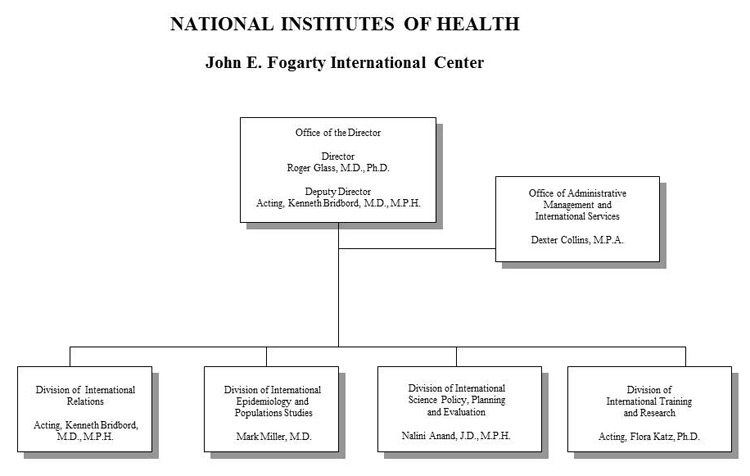
| Office/Division | Name |
|---|---|
| Office of the Director | Director: Roger Glass, M.D., Ph.D. |
| Deputy Director: Acting, Kenneth Bridbord, M.D., M.P.H. | |
| Office of Administrative Management and International Services(to right of Office of Director) | Dexter Collins, M.P.A. |
| Division of International Relations(below Office of Director) | Acting, Kenneth Bridbord, M.D., M.P.H. |
| Division of International Epidemiology and Population Studies(below Office of Director) | Mark Miller, M.D. |
| Division of International Science Policy, Planning and Evaluation(below Office of Director) | Nalini Anand, J.D., M.P.H. |
| Division of International Training and Research(below Office of Director) | Acting, Flora Katz, Ph.D. |
Appropriation Language
For carrying out the activities of the John E. Fogarty International Center (described in subpart 2 of part E of title IV of the PHS Act), [$67,786,000] $69,505,000.
Amounts Available for Obligation [Note 1]
(Dollars in Thousands)
| Source of Funding | FY 2014 Actual | FY 2015 Enacted | FY 2016 President's Budget |
|---|---|---|---|
| Appropriation | $67,577 | $67,786 | $69,505 |
| Type 1 Diabetes | 0 | 0 | 0 |
| Rescission | 0 | 0 | 0 |
| Sequestration | 0 | 0 | 0 |
| FY 2014 First Secretary's Transfer | -169 | 0 | 0 |
| FY 2014 Second Secretary's Transfer | -13 | 0 | 0 |
| Subtotal, adjusted appropriation | $67,395 | $67,786 | $69,505 |
| OAR HIV/AIDS Transfers | 0 | -152 | 0 |
| National Children's Study Transfers | 222 | 0 | 0 |
| Subtotal, adjusted budget authority | $67,617 | $67,634 | $69,505 |
| Unobligated balance, start of year | 0 | 0 | 0 |
| Unobligated balance, end of year | 0 | 0 | 0 |
| Subtotal, adjusted budget authority | $67,617 | $67,634 | $69,505 |
| Unobligated balance lapsing | -43 | 0 | 0 |
| Total obligations | $67,575 | $67,634 | $69,505 |
Budget Mechanism Table [Note 2]
(Dollars in Thousands)
| Mechanism | FY 2014 Actual | FY 2015 Enacted | FY 2016 President's Budget | FY 2016 +/- FY 2015 | ||||||
|---|---|---|---|---|---|---|---|---|---|---|
| No. | Amount | No. | Amount | No. | Amount | No. | Amount | |||
| Research Projects: | Noncompeting | 40 | $4,693 | 38 | $6,081 | 26 | $5,541 | -12 | -$540 | |
| Administrative supplements | (0) | 434 | (0) | 0 | (0) | 0 | (0) | 0 | ||
| Competing: | Renewal | 2 | 1,089 | 0 | 0 | 0 | 0 | 0 | 0 | |
| New | 13 | 2,499 | 12 | 2,415 | 33 | 5,873 | 21 | 3,458 | ||
| Supplements | 0 | 0 | 0 | 0 | 0 | 0 | 0 | 0 | ||
| Subtotal, competing | 15 | $3,588 | 12 | $2,415 | 33 | $5,873 | 21 | $3,458 | ||
| Subtotal, RPGs | 55 | $8,715 | 50 | $8,497 | 59 | $11,414 | 9 | $2,917 | ||
| SBIR/STTR | 0 | 0 | 0 | 0 | 0 | 0 | 0 | 0 | ||
| Research Project Grants | 55 | $8,715 | 50 | $8,497 | 59 | $11,414 | 9 | $2,917 | ||
| Research Centers: | Specialized/comprehensive | 0 | $486 | 0 | $471 | 0 | $150 | 0 | -$320 | |
| Clinical research | 0 | 0 | 0 | 0 | 0 | 0 | 0 | 0 | ||
| Biotechnology | 0 | 0 | 0 | 0 | 0 | 0 | 0 | 0 | ||
| Comparative medicine | 0 | 0 | 0 | 0 | 0 | 0 | 0 | 0 | ||
| Research Centers in Minority Institutions | 0 | 0 | 0 | 0 | 0 | 0 | 0 | 0 | ||
| Research Centers | 0 | $486 | 0 | $471 | 0 | $150 | 0 | -$320 | ||
| Other Research: | Research careers | 20 | $2,544 | 24 | $3,072 | 21 | $2,722 | -3 | -$350 | |
| Cancer education | 0 | 0 | 0 | 0 | 0 | 0 | 0 | 0 | ||
| Cooperative clinical research | 0 | 0 | 0 | 0 | 0 | 0 | 0 | 0 | ||
| Biomedical research support | 0 | 0 | 0 | 0 | 0 | 0 | 0 | 0 | ||
| Minority biomedical research support | 0 | 0 | 0 | 0 | 0 | 0 | 0 | 0 | ||
| Other | 164 | 37,734 | 160 | 36,911 | 157 | 36,349 | -3 | -562 | ||
| Other Research | 184 | $40,278 | 184 | $39,984 | 178 | $39,071 | -6 | -$912 | ||
| 239 | $49,479 | 234 | $48,951 | 237 | $50,636 | 3 | $1,685 | |||
| FTTPs | FTTPs | FTTPs | ||||||||
| Ruth L. Kirschstein Training Awards: | Individual | 0 | $0 | 0 | $0 | 0 | $0 | 0 | $0 | |
| Institutional | 0 | 0 | 0 | 0 | 0 | $0 | 0 | 0 | ||
| Total Research Training | 0 | $0 | 0 | $0 | 0 | $0 | 0 | $0 | ||
| Research and development contracts | 0 | $3,146 | 0 | $3,241 | 0 | $3,273 | 0 | $32 | ||
| SBIR/STTR (non-add) | (0) | (0) | (0) | (0) | (0) | (0) | (0) | (0) | ||
| Intramural research | 0 | 0 | 0 | 0 | 0 | 0 | 0 | 0 | ||
| Research Management and Support | 63 | 14,992 | 63 | 15,442 | 63 | 15,596 | 0 | 154 | ||
| Research Management and Support (SBIR Admin) (non-add) | (0) | (0) | (0) | (0) | (0) | (0) | (0) | (0) | ||
| Construction | 0 | 0 | 0 | 0 | ||||||
| Buildings and Facilities | 0 | 0 | 0 | 0 | ||||||
| Total, FIC | 63 | $67,617 | 63 | $67,634 | 63 | $69,505 | 0 | $1,871 | ||
Major Changes in the Fiscal Year 2016 President's Budget Request
Major change for the FY 2016 President's Budget for FIC is an increase of $1.871 million more than the FY 2015 Enacted level, for a total of $69.505 million. FIC will support a total of 59 Research Project Grant (RPG) awards in FY 2016. Noncompeting RPGs will decrease by 12 awards and decrease by $0.540 million. Competing RPGs will increase by 21 awards and increase by $3.458 million. There is a 1.0 percent increase in Research and Development (R&D) and in Research Management Support (RMS) to support trans-NIH initiatives.
Summary of Changes
(Dollars in Thousands)
- FY 2015 Enacted: $67,634
- FY 2016 President's Budget: $69,505
- Net change: $1,871
| Changes | FY 2016 President's Budget | Change from FY 2015 | |||
|---|---|---|---|---|---|
| FTEs | Budget Authority | FTEs | Budget Authority | ||
| A. Built-in | 1. Intramural research: | ||||
| a. Annualization of January 2015 pay increase and benefits | $0 | $0 | |||
| b. January FY 2016 pay increase and benefits | 0 | 0 | |||
| c. One more day of pay (n/a for 2015) | 0 | 0 | |||
| d. Differences attributable to change in FTE | 0 | 0 | |||
| e. Payment for centrally furnished services | 0 | 0 | |||
| f. Increased cost of laboratory supplies, materials, other expenses and non-recurring costs | 0 | 0 | |||
| Subtotal | $0 | ||||
| 2. Research management and support: | |||||
| a. Annualization of January 2015 pay increase and benefits | $8,851 | $22 | |||
| b. January FY 2016 pay increase and benefits | 8,851 | 65 | |||
| c. One more day of pay (n/a for 2015) | 8,851 | 32 | |||
| d. Differences attributable to change in FTE | 8,851 | 0 | |||
| e. Payment for centrally furnished services | 452 | 11 | |||
| f. Increased cost of laboratory supplies, materials, other expenses and non-recurring costs | 6,293 | 0 | |||
| Subtotal | $129 | ||||
| Subtotal, Built-in | $129 | ||||
| No. | Amount | No. | Amount | ||
| B. Program | 1. Research project grants: | ||||
| a. Noncompeting | 26 | $5,541 | -12 | $540 | |
| b. Competing | 33 | 5,873 | 21 | 3,458 | |
| c. SBIR/STTR | 0 | 0 | 0 | 0 | |
| Subtotal, RPGs | 59 | $11,414 | 9 | $2,917 | |
| 2. Research centers | 0 | $150 | 0 | -$320 | |
| 3. Other research | 178 | 39,071 | -6 | -912 | |
| 4. Research training | 0 | 0 | 0 | 0 | |
| 5. Research and development contracts | 0 | 3,273 | 0 | 32 | |
| Subtotal, extramural | $53,909 | $1,717 | |||
| FTEs | Amount | FTEs | Amount | ||
| 6. Intramural research | 0 | $0 | 0 | $0 | |
| 7. Research management and support | 63 | 15,596 | 0 | -26 | |
| 8. Construction | 0 | 0 | |||
| 9. Buildings and facilities | 0 | 0 | |||
| Subtotal, program | 63 | $69,505 | 0 | $1,691 | |
| Total changes | $1,820 | ||||
Fiscal Year 2016 Budget Graphs
History of Budget Authority: Funding Levels by Fiscal Year
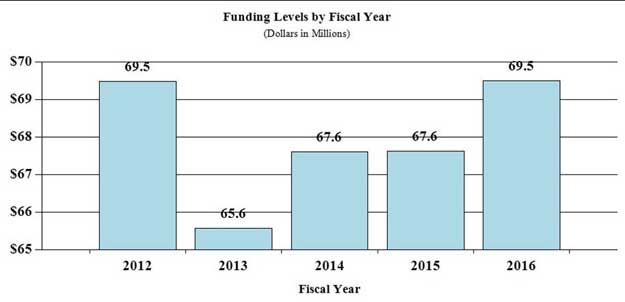
| Fiscal Year | Funding Level(Dollars in Millions) |
|---|---|
| 2012 | $ 69.5 |
| 2013 | $ 65.6 |
| 2014 | $ 67.6 |
| 2015 | $ 67.6 |
| 2016 | $ 69.5 |
History of FTEs: FTEs by Fiscal Year *
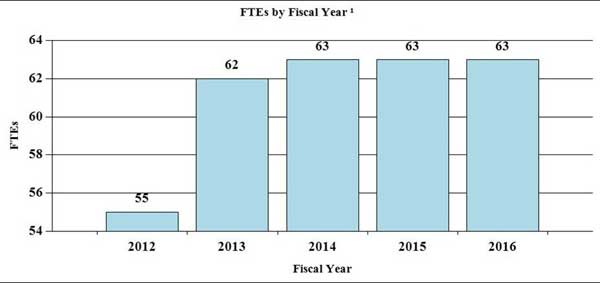
*Budget graph note 1: FY 2012 is non-comparable for DEAS transfer.
| Fiscal Year | FTEs |
|---|---|
| 2012 | 55 |
| 2013 | 62 |
| 2014 | 63 |
| 2015 | 63 |
| 2016 | 63 |
Distribution by Mechanism: FY 2016 Budget Mechanisms
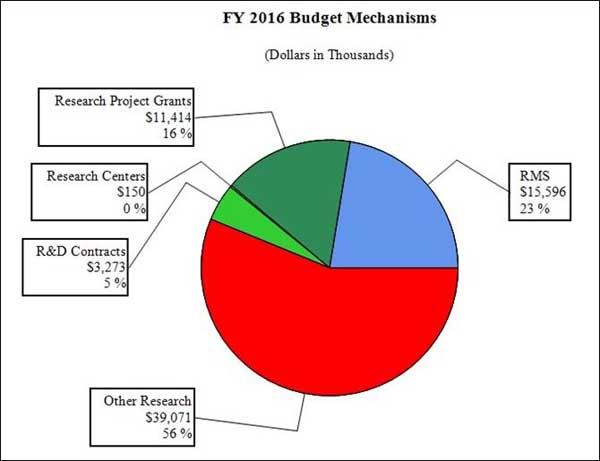
| Category | Dollars in Thousands | Percent |
|---|---|---|
| R&D Contracts | $ 3,273 | 5% |
| Research Centers | $150 | 0% |
| Research Project Grants | $ 11,414 | 16% |
| RMS | $ 15,596 | 23% |
| Other Research | $ 39,071 | 56% |
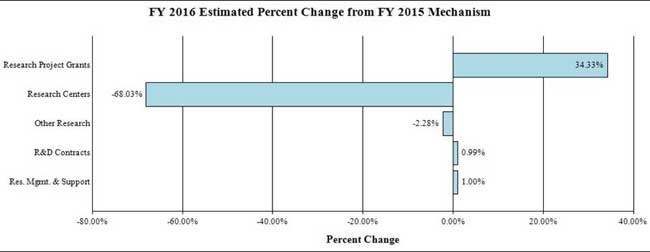
Change by Selected Mechanism: FY 2016 Estimate Percent Change from FY 2015 Mechanism
| Category | Percent Change |
|---|---|
| Research Project Grants | 34.33% |
| Research Centers | -68.03% |
| Other Research | -2.28% |
| R&D Contracts | 0.99% |
| Research Management and Support | 1.00% |
Budget Authority by Activity [Note 3]
(Dollars in thousands)
| FY 2014 Actual | FY 2015 Enacted | FY 2016 President's Budget | FY 2016 +/- FY 2015 | ||||||
|---|---|---|---|---|---|---|---|---|---|
| FTE | Amount | FTE | Amount | FTE | Amount | FTE | Amount | ||
| Extramural ResearchDetail: | Research Capacity Strengthening | $35,735 | $34,096 | $34,749 | $652 | ||||
| Development of Human Resources for Global Health Research | 7,192 | 8,913 | 9,202 | 290 | |||||
| International Collaborative Research | 9,699 | 9,183 | 9,958 | 775 | |||||
| Subtotal, Extramural | $52,625 | $52,192 | $53,909 | $1,717 | |||||
| Intramural research | 0 | $0 | 0 | $0 | 0 | $0 | 0 | $0 | |
| Research management and support | 63 | $14,992 | 63 | $15,442 | 63 | $15,596 | 0 | $154 | |
| TOTAL | 63 | $67,617 | 63 | $67,634 | 66 | $69,505 | 0 | $1,871 | |
Authorizing Legislation
| PHS Act/Other Citation | U.S. Code Citation | 2014 Amount Authorized | FY 2015 Enacted | 2016 Amount Authorized | FY 2016 PB | |
|---|---|---|---|---|---|---|
| Research and Investigation | Section 301 | 42§241 | Indefinite | $67,634,000 | Indefinite | $69,505,000 |
| International Cooperation | Section 307 | 42§242I | Indefinite | Indefinite | ||
| John E. Fogarty International Center | Section 401(a) | 42§281 | Indefinite | Indefinite | ||
| Total, Budget Authority | $67,634,000 | $69,505,000 |
Appropriations History
| Fiscal Year | Budget Estimate to Congress | House Allowance | Senate Allowance | Appropriation |
|---|---|---|---|---|
| 2006 | $67,048,000 | $67,048,000 | $68,745,000 | $67,048,000 |
| Rescission | ($670,000) | |||
| 2007 | $66,681,000 | $66,681,000 | $66,832,000 | $66,378,000 |
| Rescission | $0 | |||
| 2008 | $66,594,000 | $67,599,000 | $68,000,000 | $67,741,000 |
| Rescission | ($1,183,000) | |||
| Supplemental | $354,000 | |||
| 2009 | $66,623,000 | $68,905,000 | $68,476,000 | $68,691,000 |
| Rescission | $0 | |||
| 2010 | $69,227,000 | $70,780,000 | $69,409,000 | $70,051,000 |
| Rescission | $0 | |||
| 2011 | $73,027,000 | $72,914,000 | $70,051,000 | |
| Rescission | ($615,089) | |||
| 2012 | $71,328,000 | $71,328,000 | $68,653,000 | $69,754,000 |
| Rescission | ($131,835) | |||
| 2013 | $69,758,000 | $69,969,000 | $69,622,165 | |
| Rescission | ($139,244) | |||
| Sequestration | ($3,494,554) | |||
| 2014 | $72,864,000 | $72,380,000 | $67,577,000 | |
| Rescission | $0 | |||
| 2015 | $67,776,000 | $67,786,000 | ||
| Rescission | $0 | |||
| 2016 | $69,505,000 | |||
Justification of Budget Request
John E. Fogarty International Center for Advanced Study in the Health Sciences
Authorizing Legislation: Section 301 and title IV of the Public Health Service Act, as amended.
Budget Authority (BA):
| FY 2014 Actual | FY 2015 Enacted | FY 2016 President's Budget | FY 2016 +/- FY 2015 | |
|---|---|---|---|---|
| BA | $67,617,096 | $67,634,000 | $69,505,000 | $1,871,000 |
| FTE | 63 | 63 | 63 | 0 |
Program funds are allocated as follows: Competitive Grants/Cooperative Agreements; Contracts; Direct Federal/Intramural and Other.
Director's Overview
As a global leader in health research, the United States has been at the forefront of major scientific discoveries that have improved health at home and abroad. In an interconnected world, it is essential that NIH continue to invest in a global health research workforce that can respond to evolving challenges that affect us all. The Fogarty International Center rises to this challenge by supporting the next generation of leaders in global health research, equipping them with the necessary skills to discover solutions and collaborate with colleagues across the globe. These well-trained scientists are poised to develop locally relevant and effective new interventions and technologies to combat the rising tide of non-communicable diseases, as well as infectious diseases that continue to sap economic development in low-resource settings.
No one country or institution can effectively tackle today's global health challenges on its own. Fogarty's success is grounded in strategic partnerships that build on mutual goals and harness respective strengths. Fogarty collaborates closely with NIH ICs to catalyze new scientific directions and training in global health, other Government agencies to capitalize on complementary missions, and institutions and governments in low- and middle-income countries (LMICs) to promote sustainability and local ownership of the research agenda.
Preparing a Diverse and Talented Biomedical Research Workforce
Fogarty's unique niche at NIH has been its support of innovative research training programs to address global health challenges. These programs are built on robust partnerships between U.S. and LMIC research institutions to train the next generation of scientists. For example, over the past 25 years, Fogarty has supported multi-disciplinary biomedical, behavioral, and social science research capacity strengthening for the prevention, care, and treatment of HIV/AIDS and HIV-related conditions. Fogarty trainees have been on the front lines of ground-breaking research on critical interventions including new treatment regimens, prevention of mother-to-child transmission of HIV, circumcision to prevent HIV transmission, and treatment adherence interventions. Fogarty continues to support these efforts with the current Fogarty HIV Research Training Program, which strengthens institutional capacity in LMICs to address emerging priorities in the HIV epidemic and to disseminate evidence to decision makers, health care providers, and the media.
Since 2010, the Medical Education Partnership Initiative (MEPI), led by Fogarty and supported by the U.S. President's Emergency Plan for AIDS Relief, and NIH, has been transforming medical education and research training for medical students, faculty, and other health professionals in Sub-Saharan Africa. MEPI supports training of future scientific leaders to solve their country's most pressing health problems - from HIV/AIDS to non-communicable diseases - and bolsters institutional capacity in African universities to effectively respond to challenges in priority health areas in their countries. Through MEPI, Fogarty will continue to foster the next generation of African faculty researchers by providing research training and mentored research opportunities specifically to junior faculty in MEPI-supported institutions.
Fogarty also supports U.S. postdoctoral scientists to pursue research careers focused on global health. The International Research Scientist Development Award invites these researchers to spend up to five years working in a LMIC under the guidance of U.S.-based and LMIC-based mentors. Among others, current projects include research on cost-effective prevention methods for cardiovascular disease in South Africa and India and the economic impact of community-based integrated health care systems in rural Rwanda.
Translating Discovery into Health
Fogarty's Framework Programs for Global Health Innovation supports interdisciplinary research training programs that focus on translating discovery into effective interventions, processes and policies. To increase the translation of research findings into realized health benefits, projects include implementation considerations appropriate to LMICs, such as affordability, accessibility, ease of use, and scalability. One project based in South Africa engaged experts in microbiology, anthropology, and engineering among other disciplines to develop a sustainable clay and paper filtration system to reduce diarrheal diseases among vulnerable populations.
Through the Multinational Influenza Seasonal Mortality Study (MISMS), and in partnership with HHS, Fogarty is supporting a collaborative effort to analyze national and global disease burden data associated with influenza virus circulation and to promote training in LMICs to enhance analytical capacity and data-driven decision making. MISMS models the epidemiology and evolutionary dynamics of influenza in human, swine, and avian populations, globally. The results of this research have helped target global surveillance efforts and guided seasonal influenza vaccine selection and recommendations on immunization strategies.
Harnessing Data and Technology to Improve Health
Fogarty recognizes the potential for new technologies to revolutionize research and research training, particularly in LMICs. Fogarty's eCapacity Initiative funds innovative research education programs that provide LMIC researchers with the knowledge and skills necessary to effectively incorporate information and communication technologies into global health research and research training activities. For example, a collaboration between researchers in the United States, Argentina, and Peru is developing telediagnostic tools to relay laboratory data through smart phones in high-volume, diagnostics labs and creating an online education program to train staff in multiple locations on its use.
Fogarty is also encouraging innovation in the development and implementation of mobile health technologies to address global health problems. In partnership with other NIH Institutes and Centers, Fogarty's Mobile Health: Technology and Outcomes in Low and Middle Income Countries (mHealth) program is helping to build the evidence base for mobile technology as a tool to improve health outcomes, especially in remote regions with minimal access to quality health care. Researchers in Nigeria, for example, are developing a disposable, cell phone-friendly device to screen for malaria and sickle cell anemia. By decreasing laboratory wait times; this diagnostic tool reduces the risks associated with delayed anti-malaria treatments.
Unraveling Life's Mysteries through Basic Research
Fogarty's International Cooperative Biodiversity Groups program supports research on the discovery of novel compounds and extracts from nature with therapeutic potential. For example, with evidence showing that invasive fungal diseases kill more people annually than either tuberculosis or malaria, scientists in the United States and Brazil are studying the symbiotic bacteria on ants that have evolved to kill microbes that invade the ant's nest. The findings from this research could lead to new antibiotics for drug-resistant microbes, a goal of a recent Presidential Executive Order, as well as new drugs for parasitic diseases and cancer.
As the world becomes more interdependent, Fogarty's unique partnerships and programs will continue to enable scientists in the United States and abroad to work together to tackle the most pressing and complex health problems of our time. Fogarty will continue to invest in future research leaders, who will build on their training experiences to push the frontiers of science and provide the evidence necessary to transform global public health.
Program Descriptions and Accomplishments
Research Capacity Strengthening
Identification of priority health challenges and development of effective health interventions to address those challenges require a critical mass of U.S. and LMIC institutions that can conduct robust research and train the next generation of scientists to solve complex problems. These institutions can stimulate innovative and multidisciplinary research on locally relevant problems, generate effective and implementable solutions, and build a nimble and networked research workforce. Fogarty investments are strengthening U.S. and LMIC research institutions by supporting sustainable research environments and research infrastructure.
Budget Policy: The FY 2016 President's Budget estimate is $34.749 million, an increase of $0.652 million, or 1.9 percent above the FY 2015 Enacted level. Fogarty's Strategic Plan provides the pathway toward developing sustainable global health research and training programs where they are needed most. One goal of the plan is to mobilize the scientific community to address the growing epidemic of chronic, non-communicable diseases related to increased longevity and changing lifestyles in the developing world. To accomplish this, Fogarty continues to invest in this area, while also investing in the critical infectious diseases agenda. With the merging of several Fogarty AIDS programs into one called the HIV Research Training Program, Fogarty plans to increase funding by $1.2 million, supporting grants that focus on building or strengthening HIV-related capacity in a particular scientific or critical research infrastructure area at LMIC institutions.
Program Portrait: International Research Ethics Education and Curriculum Development Award (Bioethics)
FY 2015 Level: $4.1 million
FY 2016 Level: $4.1 million
Change: $0.0 million
If research institutions are to be sustainable platforms for cutting-edge science, they must be equipped to protect human subjects involved in research conducted by their investigators. In light of increased international collaborations and clinical trials abroad, trained individuals and institutional frameworks are needed to ensure that any research conducted is held to high ethical standards and human subjects are adequately protected. The success and credibility of clinical trials and other health research depend on strong, local ethics review boards and appropriate national regulations; therefore, building research ethics capacity in LMICs is critical.
Fogarty's International Research Ethics Education and Curriculum Development Award (Bioethics) program supports the development of culturally relevant bioethics curricula for LMIC scientists, as well as training future leaders who can advise LMIC institutions on formulating and strengthening local bioethics guidelines, building well-informed review bodies capable of evaluating research proposals, and training others in the principles of ethical research conduct. In the last decade, Fogarty has supported training for over 560 LMIC scientists, academics, and health professionals in master's level bioethics curricula.
Through the Bioethics Program, Nigerian grantee Dr. Clement Adebamowo has provided ethics training to over 1,000 West African researchers, drafted the Nigerian National Code for Research Ethics, and established a web-based research protocol tracking system for the country. Notably, the National Health Research Ethics Committee of Nigeria, chaired by Dr. Adebamowo, recently published a statement on the ethics of using innovative interventions in emergency situations, such as the drug ZMapp for victims of Ebola. The Committee concluded that it is ethical to use innovative treatments for Ebola without submitting an application to the Committee. Dr. Adebamowo subsequently published the ethical considerations behind this decision in The Lancet.
International Collaborative Research
Fogarty-supported research collaborations between U.S. and LMIC scientists help to make U.S. academic institutions more globally competitive, extend their reach, and enable U.S. scientists to lead and participate in international research teams that address key global health priorities. The burden of chronic, non-communicable diseases is climbing at a rapid rate in many LMICs due to dramatic gains in life expectancy, urbanization, and global economic development. This has led to a shared research agenda between high-income countries and LMICs, as well as opportunities to share knowledge and lessons learned. As the respective strengths and expertise of local and U.S. scientists are brought to bear on complex challenges, these partnerships also lead to more robust solutions to global health problems.
Budget Policy: The FY 2016 President's Budget estimate is $9.958 million, an increase of $0.775 million, or 7.8 percent above the FY 2015 Enacted level. This area encourages implementation science to address the "know-do" gap, and would expand research training opportunities for U.S. and foreign scientists, foster a sustainable research environment in LMICs, and build strategic partnerships to further global health.
Program Portrait: Mobile Health: Technology and Outcomes in Low and Middle Income Countries (mHealth)
FY 2015 Level: $1.8 million
FY 2016 Level: $2.0 million
Change: +$0.2 million
Fogarty seeks to stimulate innovation in the development and implementation of technologies and other locally relevant solutions to address global health problems. The use of mobile health technologies has expanded exponentially worldwide. Scientists who utilize these tools can enhance the quality of their research and better address certain research priorities. For example, mobile technologies can transform epidemiological and surveillance research and mobile devices can capture, store, analyze, manage, and present data. These devices, which can be used to help create data platforms for new diagnostics, are low-cost and real-time tools for tracking disease progression, movement, behavior, adherence to therapy, and environmental exposures.
The Mobile Health: Technology and Outcomes in Low- and Middle-Income Countries (mHealth) program supports research on the development or adaptation of mHealth technologies specifically suited for LMICs, as well as research on the health-related outcomes associated with implementation of the technology. In particular, the mHealth program encourages multidisciplinary projects that focus on tools or interventions for chronic diseases, disease diagnostics, and crosscutting applications. The program's aims are to use mHealth technologies to improve both clinical and public health outcomes from the, while also building related research capacity in LMICs.
Dr. Peter Winch, for example, leads a program that will develop virtual community health services to ensure health care equity and quality in Mali. Dr. Winch and his team will develop and study an mHealth intervention package that uses mobile phones to deliver important health and reminder messages and helps community health workers tailor their counseling to their client's particular need based on the stage of pregnancy, age of child, or even seasonality. This study builds on proven, community-based approaches that utilize community health workers to reach people in need of care in their homes and to provide the support for behavior change that may be absent in clinic-based care. The results of this research will be used to advocate for more responsive and appropriate community health communication technologies across Mali and in other countries in Sub-Saharan Africa.
Sustainable Development of Human Resources for Global Health Research
Breakthrough scientific advances in global health are built upon a foundation of well-trained researchers from both high-income countries and LMICs who collaborate to solve major global health problems. Investing in the best and brightest minds and catalyzing research and training partnerships between talented U.S. and LMIC scientists continues to be a FIC high priority. Well-trained LMIC researchers bring an understanding of the unique biological, epidemiological, social, and cultural contexts of their communities, thereby contributing this knowledge to research on locally relevant challenges that often have broader, global implications.
Budget Policy: The FY 2016 President's Budget estimate is $9.202 million, an increase of $0.290 million, or 3.1 percent above the FY 2015 Enacted level. FIC's impact has historically been most significant in developing the pipeline of U.S. and foreign research talent. FIC intends to expand the number of overseas research experiences available for young U.S. scientists in order to encourage them to adopt careers in global health. FIC will also continue its research training partnerships between U.S. and foreign institutions and strive to enhance research opportunities for foreign scientists when they return home. In further support, FIC will fund eCapacity training, focusing on the capacity building activities at LMIC institutions.
Program Portrait: Global Health Program for Fellows and Scholars
FY 2015 Level: $3.7 million
FY 2016 Level: $4.2 million
Change: +$0.5 million
Over the last decade, American university campuses have seen a soaring interest in global health among students and faculty from a wide range of fields. Since 2004, Fogarty has met this interest by providing individual support to more than 500 fellows (i.e., postdoctoral students and M.D.s) and scholars (i.e., current Ph.D.s and M.D. students) for hands-on, clinical research training experiences in LMICs. With support from mentors, Fellows and Scholars have conducted studies on a variety of topics including surgical capacity in Rwanda, mental health in Indian slums, sexually transmitted diseases in Peru, and cervical cancer in Zambia. Through these research projects, they have produced scientific discoveries and formed lasting partnerships. Participants have published more than 1,300 articles in peer-reviewed journals, presented research findings at numerous scientific meetings, and used their research training to make practical improvements and advancements in treating disease. Most importantly, many Fellows and Scholars have committed to pursuing careers in global health and have been awarded NIH research grants based on their initial study results.
Fogarty's Global Health Program for Fellows and Scholars provides a year of mentored training and research experience for young investigators at a time when they are still carving out their career plans. Fellows and Scholars come from a wide range of fields, including medicine, public health, nursing, dentistry, pharmacy, veterinary medicine, and other health sciences. With support from 17 NIH ICs and Offices, Fogarty has funded research projects at more than 80 sites in over two dozen countries. Projects initially focused on HIV and other infectious diseases, but have since included non-communicable conditions, such as trauma, mental illness, diabetes, cancer, and cardiovascular disease.
As life expectancy rises around the globe, so do chronic diseases, fueling the need for research into co-morbidities. Understanding that therapies for breast cancer can put women at risk for osteoporosis and fracture, Dr. Evelyn Hsieh chose to use her year-long Fogarty fellowship in China to examine the link between breast cancer and osteoporosis to identify risk factors for bone fractures, such as age and treatment protocols. By conducting this research in China, where women are on average diagnosed with breast cancer at 49 years old (12 years younger than in the U.S.), Dr. Hsieh was able to access a large study population of pre- and post-menopausal women. Dr Hsieh, with additional support from Cancer Institute at the Chinese Academy of Medical Sciences (CICAMS) under the mentorship of Professor You-Lin Qiao (CICAMS), also conducted a pilot study to measure vertebral fracture rates, vitamin D levels, and bone turnover markers in 200 breast cancer survivors in Beijing. The findings from both studies will go a long way towards understanding the risk factors associated with osteoporosis and fracture for women with breast cancer - an issue facing women around the world.
Research Management and Support (RMS)
RMS provides administrative, budgetary, logistical, and scientific support to review, award, and monitor research grants, training awards, and contracts. It encompasses strategic planning, coordination, and evaluation of Fogarty's programs; regulatory compliance; international coordination; international science policy; and liaisons with other Federal agencies, Congress, and the public. Specific functions include an in-house epidemiology program performing mathematical modeling of infectious diseases; international program officers developing partnerships between U.S. scientists and institutions and their counterparts abroad to advance scientific research and training; identification of collaborative opportunities with foreign science funding agencies; support for all NIH international travel by issuing and tracking official government passports and international visas; review and approval of Notice of Foreign Travel requests; and the creation and coordination of official travel cables to U.S. Embassies.
Budget Policy: The FY 2016 President's Budget estimate is $15.596 million, an increase of $0.154 million, or 1.0 percent above the FY 2015 Enacted level.
Budget Authority by Object Class [Note 4]
(Dollars in thousands)
| FY 2015 Enacted | FY 2016 President's Budget | FY 2016 +/- FY 2015 | ||
|---|---|---|---|---|
| Total compensable workyears: | ||||
| Full-time employment | 63 | 63 | 0 | |
| Full-time equivalent of overtime and holiday hours | 0 | 0 | 0 | |
| Average ES salary | $0 | $0 | $0 | |
| Average GM/GS grade | 11.9 | 11.9 | 0.0 | |
| Average GM/GS salary | $102 | $102 | $0 | |
| Average salary, grade established by act of July 1, 1944 (42 U.S.C. 207) | $94 | $94 | $0 | |
| Average salary of ungraded positions | $169 | $169 | $0 | |
| Object Classes | FY 2015 Enacted | FY 2016 President's Budget | FY 2016 +/- FY 2015 | |
| Personnel Compensation: | ||||
| 11.1 | Full-time permanent | $4,967 | $5,035 | $69 |
| 11.3 | Other than full-time permanent | 1,120 | 1,135 | 15 |
| 11.5 | Other personnel compensation | 150 | 152 | 2 |
| 11.7 | Military personnel | 207 | 210 | 3 |
| 11.8 | Special personnel services payments | 58 | 58 | 1 |
| 11.9 | Subtotal, Personnel Compensation | $6,501 | $6,591 | $90 |
| 12.1 | Civilian personnel benefits | $1,949 | $1,969 | $19 |
| 12.2 | Military personnel benefits | 287 | 291 | 4 |
| 13.0 | Benefits for former personnel | 0 | 0 | 0 |
| Subtotal Pay Costs | $8,738 | $8,851 | $113 | |
| 21.0 | Travel and transportation of persons | $237 | $241 | $4 |
| 22.0 | Transportation of things | 12 | 12 | 0 |
| 23.1 | Rental payments to GSA | 0 | 0 | 0 |
| 23.2 | Rental payments to others | 0 | 0 | 0 |
| 23.3 | Communications, utilities and miscellaneous charges | 125 | 127 | 2 |
| 24.0 | Printing and reproduction | 0 | 0 | 0 |
| 25.1 | Consulting services | 12 | 12 | 0 |
| 25.2 | Other services | 1,826 | 1,826 | 0 |
| 25.3 | Purchase of goods and services from government accounts | 7,182 | 7,245 | 63 |
| 25.4 | Operation and maintenance of facilities | 14 | 14 | 0 |
| 25.5 | Research and development contracts | 334 | 334 | 0 |
| 25.6 | Medical care | 0 | 0 | 0 |
| 25.7 | Operation and maintenance of equipment | 6 | 6 | 0 |
| 25.8 | Subsistence and support of persons | 0 | 0 | 0 |
| 25.0 | Subtotal, Other Contractual Services | $9,373 | $9,437 | $63 |
| 26.0 | Supplies and materials | $80 | $81 | $1 |
| 31.0 | Equipment | 119 | 121 | 2 |
| 32.0 | Land and structures | 0 | 0 | 0 |
| 33.0 | Investments and loans | 0 | 0 | 0 |
| 41.0 | Grants, subsidies and contributions | 48,951 | 50,636 | 1,685 |
| 42.0 | Insurance claims and indemnities | 0 | 0 | 0 |
| 43.0 | Interest and dividends | 0 | 0 | 0 |
| 44.0 | Refunds | 0 | 0 | 0 |
| Subtotal, Non-Pay Costs | $58,896 | $60,654 | $1,758 | |
| Total Budget Authority by Object Class | $67,634 | $69,505 | $1,871 | |
Salaries and Expenses
(Dollars in thousands)
| Object Class | FY 2015 Enacted | FY 2016 President's Budget | FY 2016 +/- FY 2015 |
|---|---|---|---|
| Personnel Compensation: | |||
| Full-time permanent (11.1) | $4,967 | $5,035 | $69 |
| Other than full-time permanent (11.3) | 1,120 | 1,135 | 15 |
| Other personnel compensation (11.5) | 150 | 152 | 2 |
| Military personnel (11.7) | 207 | 210 | 3 |
| Special personnel services payments (11.8) | 58 | 58 | 1 |
| Total Personnel Compensation (11.9) | $6,501 | $6,591 | $90 |
| Civilian personnel benefits (12.1) | $1,949 | $1,969 | $19 |
| Military personnel benefits (12.2) | 287 | 291 | 4 |
| Benefits to former personnel (13.0) | 0 | 0 | 0 |
| Subtotal, Pay Costs | $8,738 | $8,851 | $131 |
| Travel and transportation of persons (21.0) | $237 | $241 | $4 |
| Transportation of things (22.0) | 12 | 12 | 0 |
| Rental payments to others (23.2) | 0 | 0 | 0 |
| Communications, utilities and miscellaneous charges (23.3) | 125 | 127 | 2 |
| Printing and reproduction (24.0) | 0 | 0 | 0 |
| Other Contractual Services: | |||
| Consultant services (25.1) | 12 | 12 | 0 |
| Other services (25.2) | 1,826 | 1,826 | 0 |
| Purchases from government accounts (25.3) | 5,354 | 5,391 | 36 |
| Operation and maintenance of facilities (25.4) | 14 | 14 | 0 |
| Operation and maintenance of equipment (25.7) | 6 | 6 | 0 |
| Subsistence and support of persons (25.8) | 0 | 0 | 0 |
| Subtotal Other Contractual Services | $7,212 | $7,248 | $37 |
| Supplies and materials (26.0) | $80 | $81 | $1 |
| Subtotal, Non-Pay Costs | $7,665 | $7,709 | $44 |
| Total, Administrative Costs | $16,403 | $16,560 | $157 |
Detail of Full-Time Equivalent Employment (FTE)
| OFFICE/DIVISION | FY 2014 Actual | FY 2015 Est. | FY 2016 Est. | |||||||
|---|---|---|---|---|---|---|---|---|---|---|
| Civilian | Military | Total | Civilian | Military | Total | Civilian | Military | Total | ||
| Division of International Epidemiology and Population Studies | Direct: | 2 | 1 | 3 | 2 | 1 | 3 | 2 | 1 | 3 |
| Reimbursable: | - | - | - | - | - | - | - | - | - | |
| Total: | 2 | 1 | 3 | 2 | 1 | 3 | 2 | 1 | 3 | |
| Division of International Relations | Direct: | 10 | - | 10 | 10 | - | 10 | 10 | - | 10 |
| Reimbursable: | - | - | - | - | - | - | - | - | - | |
| Total: | 10 | - | 10 | 10 | - | 10 | 10 | - | 10 | |
| Division of International Science Policy, Planning and Evaluation | Direct: | 6 | - | 6 | 6 | - | 6 | 6 | - | 6 |
| Reimbursable: | - | - | - | - | - | - | - | - | - | |
| Total: | 6 | - | 6 | 6 | - | 6 | 6 | - | 6 | |
| Division of International Training and Research | Direct: | 13 | 1 | 14 | 13 | 1 | 14 | 13 | 1 | 14 |
| Reimbursable: | - | - | - | - | - | - | - | - | - | |
| Total: | 13 | 1 | 14 | 13 | 1 | 14 | 13 | 1 | 14 | |
| Office of Administrative Management | Direct: | 15 | - | 15 | 15 | - | 15 | 15 | - | 15 |
| Reimbursable: | - | - | - | - | - | - | - | - | - | |
| Total: | 15 | - | 15 | 15 | - | 15 | 15 | - | 15 | |
| Office of the Director | Direct: | 15 | - | 15 | 15 | - | 15 | 15 | - | 15 |
| Reimbursable: | - | - | - | - | - | - | - | - | - | |
| Total: | 15 | - | 15 | 15 | - | 15 | 15 | - | 15 | |
| TOTAL | 61 | 2 | 63 | 61 | 2 | 63 | 61 | 2 | 63 | |
| Includes FTEs whose payroll obligations are supported by the NIH Common Fund. | ||||||||||
| FTEs supported by funds from Cooperative Research and Development Agreements. | 0 | 0 | 0 | 0 | 0 | 0 | 0 | 0 | 0 | |
| Fiscal Year | Average GS Grade |
|---|---|
| 2012 | 12.1 |
| 2013 | 12.1 |
| 2014 | 11.9 |
| 2015 | 11.9 |
| 2016 | 11.9 |
Detail of Positions [Note 5]
| Grade | FY 2014 Actual | FY 2015 Enacted | FY 2016 President's Budget |
|---|---|---|---|
| Total, ES Positions | 0 | 0 | 0 |
| Total, ES Salary | 0 | 0 | 0 |
| GM/GS-15 | 8 | 8 | 8 |
| GM/GS-14 | 16 | 16 | 16 |
| GM/GS-13 | 6 | 6 | 6 |
| GS-12 | 9 | 9 | 9 |
| GS-11 | 6 | 6 | 6 |
| GS-10 | 0 | 0 | 0 |
| GS-9 | 2 | 2 | 2 |
| GS-8 | 2 | 2 | 2 |
| GS-7 | 6 | 6 | 6 |
| GS-6 | 0 | 0 | 0 |
| GS-5 | 1 | 1 | 1 |
| GS-4 | 0 | 0 | 0 |
| GS-3 | 0 | 0 | 0 |
| GS-2 | 1 | 1 | 1 |
| GS-1 | 0 | 0 | 0 |
| Subtotal | 57 | 57 | 57 |
| Grades established by Act of July 1, 1944 (42 U.S.C. 207) | |||
| Assistant Surgeon General | 0 | 0 | 0 |
| Director Grade | 1 | 1 | 1 |
| Senior Grade | 0 | 0 | 0 |
| Full Grade | 1 | 1 | 1 |
| Senior Assistant Grade | 0 | 0 | 0 |
| Assistant Grade | 0 | 0 | 0 |
| Subtotal | 2 | 2 | 2 |
| Ungraded | 12 | 12 | 12 |
| Total permanent positions | 59 | 59 | 59 |
| Total positions, end of year | 71 | 71 | 71 |
| Total full-time equivalent (FTE) employment, end of year | 63 | 63 | 63 |
| Average ES salary | 0 | 0 | 0 |
| Average GM/GS grade | 11.9 | 11.9 | 11.9 |
| Average GM/GS salary | 101,608 | 101,608 | 101,608 |
Notes
Note 1: Excludes the following amounts for reimbursable activities carried out by this account:
FY 2014 - $4,066
FY 2015 - $4,150
FY 2016 - $4,230Note 2: All items in italics and brackets are non-add entries.
Note 3: Includes FTEs whose payroll obligations are supported by the NIH Common Fund.
Note 4: Includes FTEs whose payroll obligations are supported by the NIH Common Fund.
Note 5: Includes FTEs whose payroll obligations are supported by the NIH Common Fund.