 An official website of the United States government




Program Snapshot
The NIH Common Fund’s Somatic Cell Genome Editing (SCGE) program aims to reduce the burden of diseases caused by genetic changes. Genome editing technologies present an exciting prospect for treatments and possibly even cure for these diseases. During its first 5-year phase (FY18-FY23), SCGE developed quality tools to perform and assess effective genome editing tools in non-reproductive (“somatic”) cells of the body. In its second phase (FY23-27), SCGE will accelerate the translation of genome editing therapies into the clinic.
SCGE Phase 1
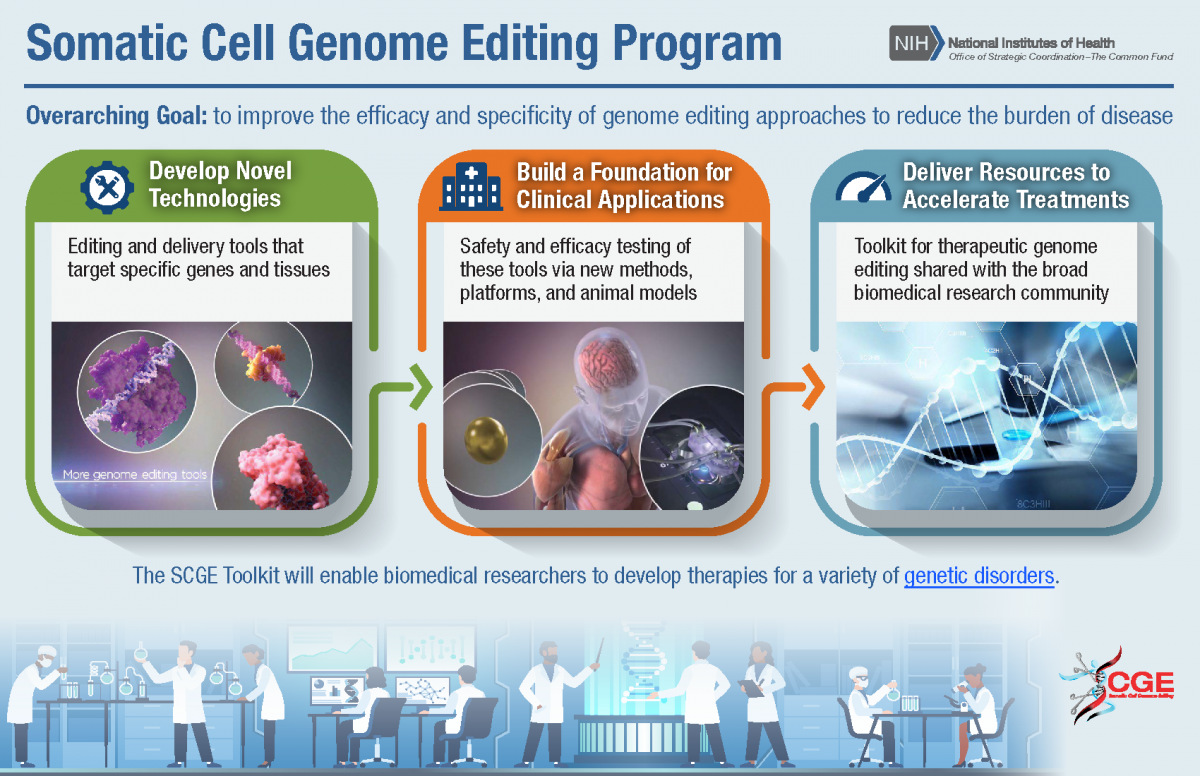
SGCE worked to improve the efficacy and specificity of genome editing approaches. The SCGE program developed new methods and improved systems that delivered genome editing machinery into various tissues with greater specificity, including tissues that present an unmet need and that are harder to reach such as the brain, ear, heart, and lung. SCGE made significant discoveries of new or optimized editors that edit target genomes with improved efficacy and novel functionality, including a prime editor that could correct up to 89% of known genetic variants associated with human diseases. The SCGE program developed new methods to assess unintended biological effects, such as high-throughput technologies that quickly identify high specific target sites and follow genome-wide activity of editors over time. Through the development of better animal models, the SCGE program has tested and validated a number of genome editing tools and delivery systems. The program has developed a genome editing toolkit that broadly disseminates program tools and learnings, opening this space to a wider range of the biomedical research community.
Learn more about the goals of SCGE Phase 1:
SCGE Phase 2
SCGE will accelerate the translation of genome editing therapies into the clinic by developing targeted delivery technologies; advancing clinical development and evaluation of novel genome editing therapeutics; establishing new regulatory pathways to lay the groundwork for clinical trials that assess the safety and efficacy of promising genome editing therapies to treat multiple diseases; and disseminating successful strategies for starting clinical trials through a publicly accessible platform.
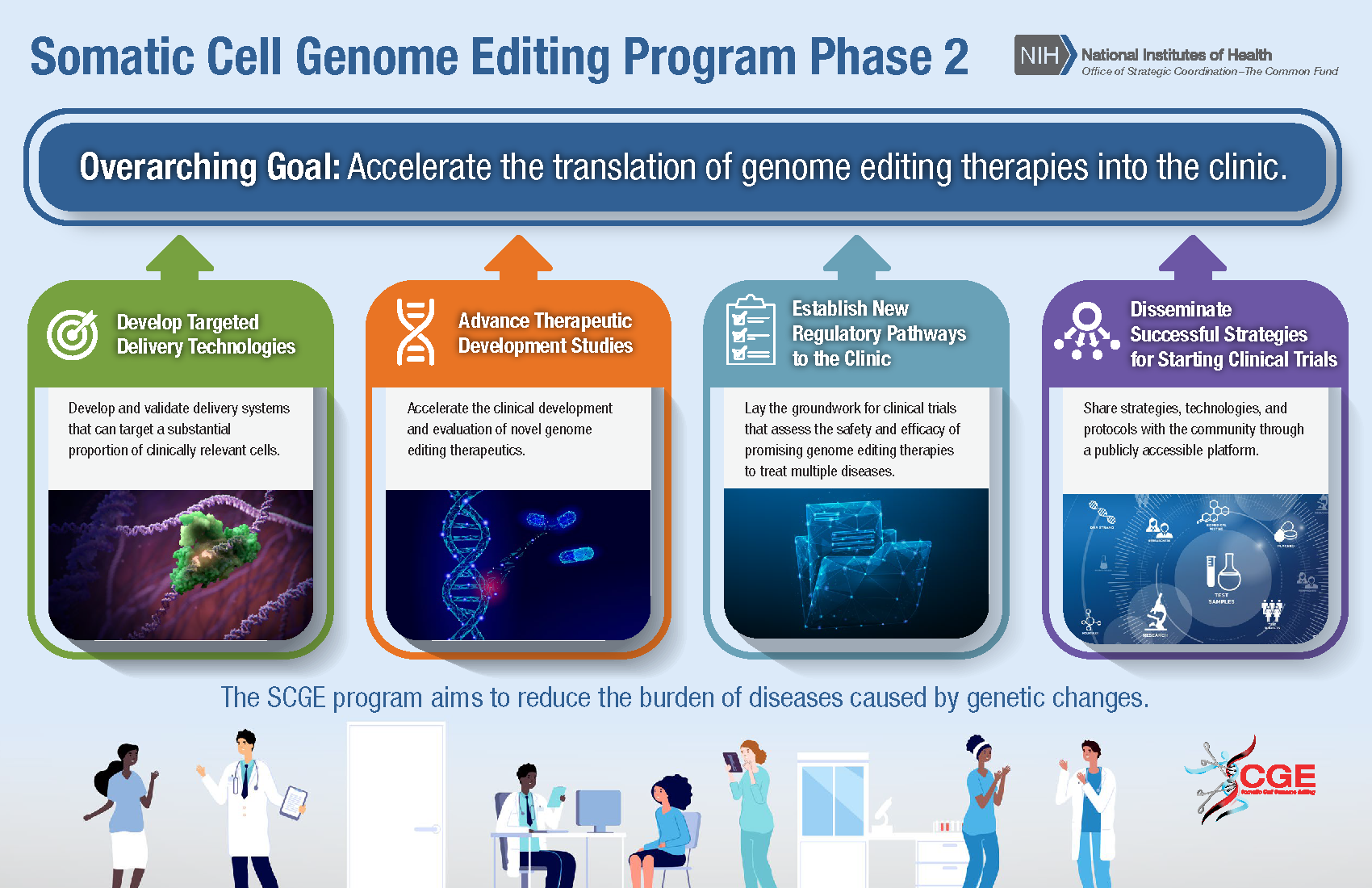
SCGE phase 2 will consist of four initiatives:
- Developing technologies and assays for safety and efficacy studies
- Optimizing genome editing-based therapeutic leads to support advancement towards clinical trials
- Supporting novel genome editing clinical trials for more than one disease
- Fostering collaboration and share new technologies and protocols with the public and research community
Existing gene editing technologies have great potential but are not able to deliver gene editing tools to many target tissues and cell types in sufficient quantities, which hinders clinical application. To realize the promise of genome editing for treating many genetic diseases, SCGE launched the multi-phase TARGETED (Targeted Genome Editor Delivery) Challenge to improve the current state of in vivo delivery technologies for genome editors in two Target Areas: 1. Programmable Delivery System for Gene Editing, and 2. Crossing the Blood-Brain Barrier. The TARGETED Challenge will help improve these technologies and speed their translation from the lab into the clinic.
Health Relevance
Many diseases are caused by harmful changes, or mutations, in a person’s DNA. These genetic diseases include common diseases such as cancer and diabetes. Most rare diseases are also caused by DNA mutations such as, Duchenne Muscular Dystrophy, Huntington’s Disease, and Cystic Fibrosis. While each of the many thousands of rare diseases affects a small number of individuals, millions of Americans live with rare diseases, many of which have no current treatment options available.
Recent scientific advances in correcting these DNA mutations have made the possibility of treating, and even curing, genetic diseases much closer to reality. Research in this technology, referred to as genome editing, has increased at a tremendous pace, and the first clinical trials to use genome editing in humans are already underway. However, to fully realize the vision of treating many genetic diseases, several obstacles need to be overcome. One significant challenge to treating specific diseases is that it will often require making changes to the DNA in the cells affected by the mutation. And there are a wide variety of cells - in different parts of the body - that can be compromised in different genetic diseases. Getting genome editing tools into the various cells of the body will require the development of delivery methods specialized to the target cell type and location within the body.
Because of this challenge, the SCGE program is funding multiple projects that focus on a variety of strategies for delivering genome editing tools to different cells within the body that can be affected by genetic diseases. The image below describes how these projects are working together to help reduce the burden of disease caused by genetic changes.
Follow SCGE
Subscribe to receive updates from SCGE.
News & Announcements
- NIH announces winners for second phase of the TARGETED Challenge
- SCGE-supported gene-editing platform successfully delivers personalized treatment to infant with incurable disease (announced May 15th)
- NIH launches the second phase of the TARGETED Challenge to revolutionize in vivo delivery technologies for genome editors
- NIH announces the Phase 1 winners of the TARGETED Challenge spanning two target areas: Programmable Delivery System for Gene Editing & Crossing the Blood-Brain Barrier
- New Notice of Funding Opportunity RFA-RM-24-007: Technologies and Assays for Therapeutic Genome Editing INDs (U01 Clinical Trial Not Allowed)
- SCGE launches second phase to accelerate the translation of genome editing approaches from the lab to the clinic
-
11.30AM-CF-Concept-SCGE-Phase-2-%28Brooks%29-REV090321-508.pdf (1.19 MB) - A new gene editing tool has the potential to correct most disease-causing DNA glitches (Journal Access Required)
- SCGE Announces Additional Awards to Advance Genome Editing
SCGE Phase II
NIH approves a second phase of the SCGE program
- September 17, 2021 - NIH Council of Councils presentation (at time 1:38)
-
11.30AM-CF-Concept-SCGE-Phase-2-%28Brooks%29-REV090321-508.pdf (1.19 MB)
NIH issued new funding opportunities to support the second phase of the SCGE program. A pre-application webinar was held for potential applicants on May 4, 2022. Click here to access the
SCGE Dissemination and Coordinating Center
Visit the SCGE Dissemination and Coordinating Center website for more information about the program.
Program Background
- Genome Editing to 'Re-write" Wrongs - a commentary on the rationale behind the SCGE program.
- SCGE Overview at NIH's Rare Disease Day 2018
- September 1, 2017 - NIH Council of Councils presentation (at time 2:53)
-
CoC-Sept-2017-1115AM-CF-Concept-Gene-Editing-Perry.pdf (930.28 KB)
What is Genome Editing?
Visit NHGRI's Genome Editing website to learn more about this technology.
Funded Research IND-enabling Studies for Platform Clinical Trials of Genome Editors in Multiple Diseases (U01 Clinical Trial Not Allowed)
| PI Name | Institution Name | Title |
|---|---|---|
| BAUER, DANIEL EVAN | BOSTON CHILDREN'S HOSPITAL | Robust verification of genetic variant-associated candidate off-target sites |
| HE, MEI | UNIVERSITY OF FLORIDA | Evaluation of High-throughput Extracellular Vesicle Loading Platform for Therapeutic Genome Editing INDs |
| TARANTAL, ALICE F | UNIVERSITY OF CALIFORNIA AT DAVIS | Validated Immunoassays to Accelerate Therapeutic Genome Editing INDs |
IND-enabling Studies for Platform Clinical Trials of Genome Editors in Multiple Diseases (U01 Clinical Trial Not Allowed)
| PI Name | Institution Name | Title |
|---|---|---|
| BAUER, DANIEL EVAN | BOSTON CHILDREN'S HOSPITAL | Robust verification of genetic variant-associated candidate off-target sites |
| HE, MEI | UNIVERSITY OF FLORIDA | Evaluation of High-throughput Extracellular Vesicle Loading Platform for Therapeutic Genome Editing INDs |
| TARANTAL, ALICE F | UNIVERSITY OF CALIFORNIA AT DAVIS | Validated Immunoassays to Accelerate Therapeutic Genome Editing INDs |
IND-enabling Studies for Platform Clinical Trials of Genome Editors in Multiple Diseases (U01 Clinical Trial Not Allowed) RFA-RM-24-001
| PI Name | Institution Name | Title |
|---|---|---|
| AHRENS-NICKLAS, REBECCA CLARE (contact) MUSUNURU, KIRAN | CHILDREN'S HOSP OF PHILADELPHIA | Personalized prime editing as a platform for hepatic inborn errors of metabolism |
| CHEN, ZHENG-YI | MASSACHUSETTS EYE AND EAR INFIRMARY | AAV-mediated editing to treat human autosomal dominant hearing loss DFNA41 and DFNA2 |
IND-enabling Studies for Platform Clinical Trials of Genome Editors in Multiple Diseases (U01 Clinical Trial Not Allowed) RFA-RM-24-001
| PI Name | Institution Name | Title |
|---|---|---|
| AHRENS-NICKLAS, REBECCA CLARE (contact) MUSUNURU, KIRAN | CHILDREN'S HOSP OF PHILADELPHIA | Personalized prime editing as a platform for hepatic inborn errors of metabolism |
| CHEN, ZHENG-YI | MASSACHUSETTS EYE AND EAR INFIRMARY | AAV-mediated editing to treat human autosomal dominant hearing loss DFNA41 and DFNA2 |
Technologies and Assays for Therapeutic Genome Editing INDs (U01, Clinical Trial Not Allowed)
| PI Name | Institution Name | Title |
|---|---|---|
| FREEDMAN, BENJAMIN SOLOMON | UNIVERSITY OF WASHINGTON | Utility of Human Organoids for Safety and Efficiency Evaluations of Genome Editing Therapeutics |
| GIANNIKOPOULOS, PETROS (contact) GURKAN, UMUT A | UNIVERSITY OF CALIFORNIA BERKELEY | A Modality-Agnostic Potency Assay Enabling Both Ex Vivo and In Vivo Genome Editing Therapeutics for Sickle Cell Disease |
| SPENCER, DAVID H (contact) DUNCAVAGE, ERIC J | WASHINGTON UNIVERSITY | Genome sequencing for evaluating the efficacy, specificity, and safety of human genome editing |
| TSAI, SHENGDAR | ST. JUDE CHILDREN'S RESEARCH HOSPITAL | Ultra-sensitive, unbiased, high-throughput, biochemical CHANGE-seq genome-wide activity and gRNA sequencing assays for therapeutic genome editing INDs |
| TSAI, SHENGDAR | ST. JUDE CHILDREN'S RESEARCH HOSPITAL | Sensitive, unbiased, high-throughput, cellular GUIDE-seq-2 genome-wide activity assay for therapeutic genome editing INDs |
Technologies and Assays for Therapeutic Genome Editing INDs (U01, Clinical Trial Not Allowed)
| PI Name | Institution Name | Title |
|---|---|---|
| FREEDMAN, BENJAMIN SOLOMON | UNIVERSITY OF WASHINGTON | Utility of Human Organoids for Safety and Efficiency Evaluations of Genome Editing Therapeutics |
| GIANNIKOPOULOS, PETROS (contact) GURKAN, UMUT A | UNIVERSITY OF CALIFORNIA BERKELEY | A Modality-Agnostic Potency Assay Enabling Both Ex Vivo and In Vivo Genome Editing Therapeutics for Sickle Cell Disease |
| SPENCER, DAVID H (contact) DUNCAVAGE, ERIC J | WASHINGTON UNIVERSITY | Genome sequencing for evaluating the efficacy, specificity, and safety of human genome editing |
| TSAI, SHENGDAR | ST. JUDE CHILDREN'S RESEARCH HOSPITAL | Ultra-sensitive, unbiased, high-throughput, biochemical CHANGE-seq genome-wide activity and gRNA sequencing assays for therapeutic genome editing INDs |
| TSAI, SHENGDAR | ST. JUDE CHILDREN'S RESEARCH HOSPITAL | Sensitive, unbiased, high-throughput, cellular GUIDE-seq-2 genome-wide activity assay for therapeutic genome editing INDs |
IND-enabling Studies of Somatic Genome Editing Therapeutic Leads (U19, Clinical Trial Not allowed)
| PI Name | Institution Name | Title |
|---|---|---|
| DOUDNA, JENNIFER A | UNIVERSITY OF CALIFORNIA, BERKELEY | Correction of Neurological Disease via Allele Specific Excision of Pathogenic Repeats |
| LUTZ, CATHLEEN M (contact) ARBAB, MANDANA GRAY, STEVEN J LIU, DAVID R MOURO PINTO, RICARDO | JACKSON LABORATORY | Preclinical Genome Editing for Rare Neurological Diseases |
| PERANTEAU, WILLIAM H (contact) MUSUNURU, KIRAN | CHILDREN'S HOSP OF PHILADELPHIA | Postnatal and Prenatal Therapeutic Base Editing for Metabolic Diseases |
| SAHA, KRISHANU | UNIVERSITY OF WISCONSIN-MADISON | The CRISPR Vision Program: Nonviral Genome Editing Platforms to Treat Inherited Retinal Channelopathies |
| VALLABH, SONIA MINIKEL | BROAD INSTITUTE, INC. | Therapeutic editing to lower PrP in prion disease |
IND-enabling Studies of Somatic Genome Editing Therapeutic Leads (U19, Clinical Trial Not allowed)
| PI Name | Institution Name | Title |
|---|---|---|
| DOUDNA, JENNIFER A | UNIVERSITY OF CALIFORNIA, BERKELEY | Correction of Neurological Disease via Allele Specific Excision of Pathogenic Repeats |
| LUTZ, CATHLEEN M (contact) ARBAB, MANDANA GRAY, STEVEN J LIU, DAVID R MOURO PINTO, RICARDO | JACKSON LABORATORY | Preclinical Genome Editing for Rare Neurological Diseases |
| PERANTEAU, WILLIAM H (contact) MUSUNURU, KIRAN | CHILDREN'S HOSP OF PHILADELPHIA | Postnatal and Prenatal Therapeutic Base Editing for Metabolic Diseases |
| SAHA, KRISHANU | UNIVERSITY OF WISCONSIN-MADISON | The CRISPR Vision Program: Nonviral Genome Editing Platforms to Treat Inherited Retinal Channelopathies |
| VALLABH, SONIA MINIKEL | BROAD INSTITUTE, INC. | Therapeutic editing to lower PrP in prion disease |
Platform Clinical Trials of Somatic Genome Editing for Multiple Diseases (UG3/UH3, Clinical Trial Required)
| PI Name | Institution Name | Title |
|---|---|---|
| JIANG, YONG-HUI (contact) BERRY-KRAVIS, ELIZABETH MARA ZHOU, JIANGBING | YALE UNIVERSITY | A non-viral CRISPR-mediated genome editing delivery platform as a potential therapy for neurogenetic diseases |
Platform Clinical Trials of Somatic Genome Editing for Multiple Diseases (UG3/UH3, Clinical Trial Required)
| PI Name | Institution Name | Title |
|---|---|---|
| JIANG, YONG-HUI (contact) BERRY-KRAVIS, ELIZABETH MARA ZHOU, JIANGBING | YALE UNIVERSITY | A non-viral CRISPR-mediated genome editing delivery platform as a potential therapy for neurogenetic diseases |
Somatic Cell Genome Editing Dissemination and Coordination Center (U24, Clinical Trial Not Allowed) RFA-RM-22-017
| PI Name | Institution Name | Title |
|---|---|---|
| DWINELL, MELINDA R | MEDICAL COLLEGE OF WISCONSIN | Translational Coordination and Dissemination Center for the SCGE Consortium |
Somatic Cell Genome Editing Dissemination and Coordination Center (U24, Clinical Trial Not Allowed) RFA-RM-22-017
| PI Name | Institution Name | Title |
|---|---|---|
| DWINELL, MELINDA R | MEDICAL COLLEGE OF WISCONSIN | Translational Coordination and Dissemination Center for the SCGE Consortium |
NIH Support for Conferences and Scientific Meetings (Parent R13 Clinical Trial Not Allowed)
| PI Name | Institution Name | Title |
|---|---|---|
| SHEPPARD, TERRY L. | KEYSTONE SYMPOSIA | Precision Genome Engineering |
NIH Support for Conferences and Scientific Meetings (Parent R13 Clinical Trial Not Allowed)
| PI Name | Institution Name | Title |
|---|---|---|
| SHEPPARD, TERRY L. | KEYSTONE SYMPOSIA | Precision Genome Engineering |
Innovative Technologies to Deliver Genome Editing Machinery to Disease-relevant Cells and Tissues (UG3/UH3 Clinical Trial Not Allowed) RFA-RM-18-023
In September 2022, the awards below transitioned into their UH3 phase
| PI Name | Institution Name | Title |
|---|---|---|
| BANKIEWICZ, KRYSTOF S (contact) MURTHY, NIREN | OHIO STATE UNIVERSITY | Development of a nanoparticle-based gene editing technology for neurological applications |
| CHAIKOF, ELLIOT | BETH ISRAEL DEACONESS MEDICAL CENTER | Delivery Technologies for In Vivo Genome Editing |
| DAHLMAN, JAMES (contact) SANTANGELO, PHILIP J | GEORGIA INSTITUTE OF TECHNOLOGY | Highly Specific ZFN-Based HSC Gene Editing Therapies Identified By In Vivo Barcode Nanoparticle Screens And Rationally Designed Mrna |
| LEONG, KAM W | COLUMBIA UNIVERSITY HEALTH SCIENCES | Focused Ultrasound-mediated Delivery of Gene-editing Elements to the Brain for Neurodegenerative Disorders |
| WILSON, ROSS (contact) DOUDNA, JENNIFER A | UNIVERSITY OF CALIFORNIA BERKELEY | Cas9 RNP delivery to immune cells in vivo via molecular targeting |
| ZHOU, JIANGBING | YALE UNIVERSITY | Novel grafted terpolymers for targeted delivery of CRISPR/Cas9- mediated precise genome editing to the brain |
Innovative Technologies to Deliver Genome Editing Machinery to Disease-relevant Cells and Tissues (UG3/UH3 Clinical Trial Not Allowed) RFA-RM-18-023
In September 2022, the awards below transitioned into their UH3 phase
| PI Name | Institution Name | Title |
|---|---|---|
| BANKIEWICZ, KRYSTOF S (contact) MURTHY, NIREN | OHIO STATE UNIVERSITY | Development of a nanoparticle-based gene editing technology for neurological applications |
| CHAIKOF, ELLIOT | BETH ISRAEL DEACONESS MEDICAL CENTER | Delivery Technologies for In Vivo Genome Editing |
| DAHLMAN, JAMES (contact) SANTANGELO, PHILIP J | GEORGIA INSTITUTE OF TECHNOLOGY | Highly Specific ZFN-Based HSC Gene Editing Therapies Identified By In Vivo Barcode Nanoparticle Screens And Rationally Designed Mrna |
| LEONG, KAM W | COLUMBIA UNIVERSITY HEALTH SCIENCES | Focused Ultrasound-mediated Delivery of Gene-editing Elements to the Brain for Neurodegenerative Disorders |
| WILSON, ROSS (contact) DOUDNA, JENNIFER A | UNIVERSITY OF CALIFORNIA BERKELEY | Cas9 RNP delivery to immune cells in vivo via molecular targeting |
| ZHOU, JIANGBING | YALE UNIVERSITY | Novel grafted terpolymers for targeted delivery of CRISPR/Cas9- mediated precise genome editing to the brain |
In September 2022, the awards below transitioned into their UH3 phase
| PI Name | Institution Name | Title |
|---|---|---|
| ASOKAN, ARAVIND | DUKE UNIVERSITY | Evolving High Potency AAV Vectors for Neuromuscular Genome Editing. |
| SALTZMAN, W. MARK (contact) GLAZER, PETER M | YALE UNIVERSITY | Poly(amine-co-ester)s for Targeted Delivery In Vivo of Gene Editing Agents to Bone Marrow and Lung |
Innovative Technologies to Deliver Genome Editing Machinery to Disease-relevant Cells and Tissues (UG3/UH3 Clinical Trial Not Allowed)
In September 2022, the awards below transitioned into their UH3 phase
| PI Name | Institution Name | Title |
|---|---|---|
| ASOKAN, ARAVIND | DUKE UNIVERSITY | Evolving High Potency AAV Vectors for Neuromuscular Genome Editing. |
| SALTZMAN, W. MARK (contact) GLAZER, PETER M | YALE UNIVERSITY | Poly(amine-co-ester)s for Targeted Delivery In Vivo of Gene Editing Agents to Bone Marrow and Lung |
| PI Name | Institution Name | Title |
|---|---|---|
| JARVIS, THALE CROSS | KEYSTONE SYMPOSIA | Precision Genome Engineering |
NIH Support for Conferences and Scientific Meetings (Parent R13 Clinical Trial Not Allowed)
| PI Name | Institution Name | Title |
|---|---|---|
| JARVIS, THALE CROSS | KEYSTONE SYMPOSIA | Precision Genome Engineering |
Innovative Technologies to Non-Invasively Monitor Genome Edited Cells In Vivo (UH2/UH3 Clinical Trial Not Allowed)
In September 2021, the awards below transitioned into their UH3 phase.
| PI Name | Institution Name | Title |
|---|---|---|
| BULTE, JEFF W | JOHNS HOPKINS UNIVERSITY | Non-Invasive Tracking of Genome-Corrected iPS cells in ALS |
| RONALD, JOHN ANDREW | UNIVERSITY OF WESTERN ONTARIO | Non-Invasive Monitoring of CRISPR/Cas-Edited Chimeric Antigen Receptor T (CAR-T) Cells with Reporter Gene-Based Magnetic Resonance Imaging and Positron Emission Tomography |
| TARANTAL, ALICE F (contact) SEGAL, DAVID J | UNIVERSITY OF CALIFORNIA AT DAVIS | Innovative Translational Imaging Technologies to Monitor Genome Edited Cells in Vivo |
| VANDSBURGER, MORIEL | UNIVERSITY OF CALIFORNIA BERKELEY | Molecular MRI for in vivo tracking of gene editing and gene edited cells |
Innovative Technologies to Non-Invasively Monitor Genome Edited Cells In Vivo (UH2/UH3 Clinical Trial Not Allowed)
In September 2021, the awards below transitioned into their UH3 phase.
| PI Name | Institution Name | Title |
|---|---|---|
| BULTE, JEFF W | JOHNS HOPKINS UNIVERSITY | Non-Invasive Tracking of Genome-Corrected iPS cells in ALS |
| RONALD, JOHN ANDREW | UNIVERSITY OF WESTERN ONTARIO | Non-Invasive Monitoring of CRISPR/Cas-Edited Chimeric Antigen Receptor T (CAR-T) Cells with Reporter Gene-Based Magnetic Resonance Imaging and Positron Emission Tomography |
| TARANTAL, ALICE F (contact) SEGAL, DAVID J | UNIVERSITY OF CALIFORNIA AT DAVIS | Innovative Translational Imaging Technologies to Monitor Genome Edited Cells in Vivo |
| VANDSBURGER, MORIEL | UNIVERSITY OF CALIFORNIA BERKELEY | Molecular MRI for in vivo tracking of gene editing and gene edited cells |
Innovative Technologies to Deliver Genome Editing Machinery to Disease-relevant Cells and Tissues (UG3/UH3 Clinical Trial Not Allowed) RFA-RM-18-016
In September 2021, the awards below transitioned into their UH3 phase.
Innovative Technologies to Deliver Genome Editing Machinery to Disease-relevant Cells and Tissues (UG3/UH3 Clinical Trial Not Allowed) RFA-RM-18-016
In September 2021, the awards below transitioned into their UH3 phase.
| PI Name | Institution Name | Title |
|---|---|---|
| BULTE, JEFF W | JOHNS HOPKINS UNIVERSITY | Non-Invasive Tracking of Genome-Corrected iPS cells in ALS |
| RONALD, JOHN ANDREW | UNIVERSITY OF WESTERN ONTARIO | Non-Invasive Monitoring of CRISPR/Cas-Edited Chimeric Antigen Receptor T (CAR-T) Cells with Reporter Gene-Based Magnetic Resonance Imaging and Positron Emission Tomography |
| TARANTAL, ALICE F (contact) SEGAL, DAVID J | UNIVERSITY OF CALIFORNIA AT DAVIS | Innovative Translational Imaging Technologies to Monitor Genome Edited Cells in Vivo |
| VANDSBURGER, MORIEL | UNIVERSITY OF CALIFORNIA BERKELEY | Molecular MRI for in vivo tracking of gene editing and gene edited cells |
Innovative Technologies to Non-Invasively Monitor Genome Edited Cells In Vivo (UH2/UH3 Clinical Trial Not Allowed)
| PI Name | Institution Name | Title |
|---|---|---|
| BULTE, JEFF W | JOHNS HOPKINS UNIVERSITY | Non-Invasive Tracking of Genome-Corrected iPS cells in ALS |
| RONALD, JOHN ANDREW | UNIVERSITY OF WESTERN ONTARIO | Non-Invasive Monitoring of CRISPR/Cas-Edited Chimeric Antigen Receptor T (CAR-T) Cells with Reporter Gene-Based Magnetic Resonance Imaging and Positron Emission Tomography |
| TARANTAL, ALICE F (contact) SEGAL, DAVID J | UNIVERSITY OF CALIFORNIA AT DAVIS | Innovative Translational Imaging Technologies to Monitor Genome Edited Cells in Vivo |
| VANDSBURGER, MORIEL | UNIVERSITY OF CALIFORNIA BERKELEY | Molecular MRI for in vivo tracking of gene editing and gene edited cells |
Expanding the Human Genome Engineering Repertoire (U01 Clinical Trial Not Allowed)
| PI Name | Institution Name | Title |
|---|---|---|
| GERSBACH, CHARLES A | DUKE UNIVERSITY | Epigenome Editing Technologies for Treating Diverse Disease |
| GLAZER, PETER M (contact) LY, DANITH H SALTZMAN, W. MARK | YALE UNIVERSITY | PNA Nanoparticles for Gene Editing In Vivo |
Expanding the Human Genome Engineering Repertoire (U01 Clinical Trial Not Allowed)
| PI Name | Institution Name | Title |
|---|---|---|
| GERSBACH, CHARLES A | DUKE UNIVERSITY | Epigenome Editing Technologies for Treating Diverse Disease |
| GLAZER, PETER M (contact) LY, DANITH H SALTZMAN, W. MARK | YALE UNIVERSITY | PNA Nanoparticles for Gene Editing In Vivo |
Innovative Technologies to Deliver Genome Editing Machinery to Disease-relevant Cells and Tissues (UG3/UH3 Clinical Trial Not Allowed)
Development of Cell and Tissue Platforms to Detect Adverse Biological Consequences of Somatic Cell Genome Editing (U01 Clinical Trial Not Allowed)
| PI Name | Institution Name | Title |
|---|---|---|
| FREEDMAN, BENJAMIN SOLOMON | UNIVERSITY OF WASHINGTON | Improving the Safety of Genome Editing With Human Kidney Organoids |
| GERSBACH, CHARLES A. (contact) BURSAC, NENAD TRUSKEY, GEORGE A | DUKE UNIVERSITY | Microphysiological Human Tissue Systems for Monitoring of Genome Editing Outcomes |
| HINSON, JOHN TRAVIS | UNIVERSITY OF CONNECTICUT SCH OF MED/DNT | Human cardiac microtissues with innate immune sensing to study adverse consequences of genome editing |
| MORIZANE, RYUJI (contact) LEWIS, JENNIFER A. SABBISETTI, VENKATA | MASSACHUSETTS GENERAL HOSPITAL | Vascularized kidney organoids on chip for efficacy and toxicity testing of somatic genome editing |
Development of Cell and Tissue Platforms to Detect Adverse Biological Consequences of Somatic Cell Genome Editing (U01 Clinical Trial Not Allowed)
| PI Name | Institution Name | Title |
|---|---|---|
| FREEDMAN, BENJAMIN SOLOMON | UNIVERSITY OF WASHINGTON | Improving the Safety of Genome Editing With Human Kidney Organoids |
| GERSBACH, CHARLES A. (contact) BURSAC, NENAD TRUSKEY, GEORGE A | DUKE UNIVERSITY | Microphysiological Human Tissue Systems for Monitoring of Genome Editing Outcomes |
| HINSON, JOHN TRAVIS | UNIVERSITY OF CONNECTICUT SCH OF MED/DNT | Human cardiac microtissues with innate immune sensing to study adverse consequences of genome editing |
| MORIZANE, RYUJI (contact) LEWIS, JENNIFER A. SABBISETTI, VENKATA | MASSACHUSETTS GENERAL HOSPITAL | Vascularized kidney organoids on chip for efficacy and toxicity testing of somatic genome editing |
Large Animal Testing Centers for Evaluation of Somatic Cell Genome Editing Tools (U42 Clinical Trial Not Allowed)
| PI Name | Institution Name | Title |
|---|---|---|
| TARANTAL, ALICE F (contact) SEGAL, DAVID J | UNIVERSITY OF CALIFORNIA AT DAVIS | Nonhuman Primate Testing Center for Evaluation of Somatic Cell Genome Editing Tools |
| WELLS, KEVIN DALE (contact) PRATHER, RANDALL S | UNIVERSITY OF MISSOURI-COLUMBIA | Swine Somatic Cell Genome Editing (SCGE) Center |
Large Animal Testing Centers for Evaluation of Somatic Cell Genome Editing Tools (U42 Clinical Trial Not Allowed)
| PI Name | Institution Name | Title |
|---|---|---|
| TARANTAL, ALICE F (contact) SEGAL, DAVID J | UNIVERSITY OF CALIFORNIA AT DAVIS | Nonhuman Primate Testing Center for Evaluation of Somatic Cell Genome Editing Tools |
| WELLS, KEVIN DALE (contact) PRATHER, RANDALL S | UNIVERSITY OF MISSOURI-COLUMBIA | Swine Somatic Cell Genome Editing (SCGE) Center |
Somatic Cell Genome Editing Dissemination and Coordination Center (U24 - Clinical Trial Not Allowed)
| PI Name | Institution Name | Title |
|---|---|---|
| DWINELL, MELINDA R (contact) SHIMOYAMA, MARY E | MEDICAL COLLEGE OF WISCONSIN | Dissemination and Coordinating Center for the SCGE Consortium |
Somatic Cell Genome Editing Dissemination and Coordination Center (U24 - Clinical Trial Not Allowed)
| PI Name | Institution Name | Title |
|---|---|---|
| DWINELL, MELINDA R (contact) SHIMOYAMA, MARY E | MEDICAL COLLEGE OF WISCONSIN | Dissemination and Coordinating Center for the SCGE Consortium |
Rodent Testing Centers for Development of Reporter Systems and Evaluation of Somatic Cell Genome Editing Tools (U42 Clinical Trial Not Allowed)
| PI Name | Institution Name | Title |
|---|---|---|
| HEANEY, JASON D (contact) DICKINSON, MARY E LAGOR, WILLIAM RAYMOND | BAYLOR COLLEGE OF MEDICINE | BCM-Rice resource for the analysis of somatic gene editing in mice |
| MURRAY, STEPHEN A (contact) LUTZ, CATHLEEN M | JACKSON LABORATORY | The Jackson Laboratory Gene Editing Testing Center (JAX-GETC) |
Rodent Testing Centers for Development of Reporter Systems and Evaluation of Somatic Cell Genome Editing Tools (U42 Clinical Trial Not Allowed)
| PI Name | Institution Name | Title |
|---|---|---|
| HEANEY, JASON D (contact) DICKINSON, MARY E LAGOR, WILLIAM RAYMOND | BAYLOR COLLEGE OF MEDICINE | BCM-Rice resource for the analysis of somatic gene editing in mice |
| MURRAY, STEPHEN A (contact) LUTZ, CATHLEEN M | JACKSON LABORATORY | The Jackson Laboratory Gene Editing Testing Center (JAX-GETC) |
Development of Large Animal Reporter Systems for Testing Somatic Cell Genome Editing Tools (U24 Clinical Trial Not Allowed)
| PI Name | Institution Name | Title |
|---|---|---|
| CARLSON, DANIEL FRED | RECOMBINETICS, INC. | Development of Swine Reporter Models for Testing Somatic Cell Genome Editing Tools |
| FENG, GUOPING | MASSACHUSETTS INSTITUTE OF TECHNOLOGY | Knockin marmoset reporters for non-invasive measuring of genome-editing efficiency |
| HENNEBOLD, JON D | OREGON HEALTH & SCIENCE UNIVERSITY | Rhesus Macaque Somatic Cell Gene Editing Resource |
Development of Large Animal Reporter Systems for Testing Somatic Cell Genome Editing Tools (U24 Clinical Trial Not Allowed)
| PI Name | Institution Name | Title |
|---|---|---|
| CARLSON, DANIEL FRED | RECOMBINETICS, INC. | Development of Swine Reporter Models for Testing Somatic Cell Genome Editing Tools |
| FENG, GUOPING | MASSACHUSETTS INSTITUTE OF TECHNOLOGY | Knockin marmoset reporters for non-invasive measuring of genome-editing efficiency |
| HENNEBOLD, JON D | OREGON HEALTH & SCIENCE UNIVERSITY | Rhesus Macaque Somatic Cell Gene Editing Resource |
Development of Cell and Tissue Platforms to Detect Adverse Biological Consequences of Somatic Cell Gene Editing (U01 Clinical Trial Not Allowed)
| PI Name | Institution Name | Title |
|---|---|---|
| KIANI, SAMIRA | UNIVERSITY OF PITTSBURGH AT PITTSBURGH | Multicell type human liver on chip microphysiological platform to examine CRISPR- based gene modulation |
| MCDEVITT, TODD C | J. DAVID GLADSTONE INSTITUTES | Human microtissues for in situ detection and functional measurement of adverse consequences caused by genome editing |
| SAHA, KRISHANU (contact) GAMM, DAVID M ROY, SUSHMITA SKALA, MELISSA CAROLINE | UNIVERSITY OF WISCONSIN-MADISON | Single Cell Profiling To Define Biomarkers Of Photoreceptor Dysfunction After Gene Editing Within PSC-Derived Organoids |
| TSAI, SHENGDAR | ST. JUDE CHILDREN'S RESEARCH HOSPITAL | A novel human T-cell platform to define biological effects of genome editing |
Development of Cell and Tissue Platforms to Detect Adverse Biological Consequences of Somatic Cell Gene Editing (U01 Clinical Trial Not Allowed)
| PI Name | Institution Name | Title |
|---|---|---|
| KIANI, SAMIRA | UNIVERSITY OF PITTSBURGH AT PITTSBURGH | Multicell type human liver on chip microphysiological platform to examine CRISPR- based gene modulation |
| MCDEVITT, TODD C | J. DAVID GLADSTONE INSTITUTES | Human microtissues for in situ detection and functional measurement of adverse consequences caused by genome editing |
| SAHA, KRISHANU (contact) GAMM, DAVID M ROY, SUSHMITA SKALA, MELISSA CAROLINE | UNIVERSITY OF WISCONSIN-MADISON | Single Cell Profiling To Define Biomarkers Of Photoreceptor Dysfunction After Gene Editing Within PSC-Derived Organoids |
| TSAI, SHENGDAR | ST. JUDE CHILDREN'S RESEARCH HOSPITAL | A novel human T-cell platform to define biological effects of genome editing |
Innovative Technologies to Deliver Genome Editing Machinery to Disease-relevant Cells and Tissues (UG3/UH3 Clinical Trial Not Allowed)
| PI Name | Institution Name | Title |
|---|---|---|
| DOUDNA, JENNIFER A (contact) BANFIELD, JILLIAN | UNIVERSITY OF CALIFORNIA BERKELEY | Expanding CRISPR-Cas editing technology through exploration of novel Cas proteins and DNA repair systems |
| EKKER, STEPHEN CARL (contact) CLARK, KARL J | MAYO CLINIC ROCHESTER | Building the mitochondrial genome editing repertoire |
| LIU, DAVID R | BROAD INSTITUTE, INC. | Expanding the Scope of Base Editing |
Expanding the Human Genome Engineering Repertoire (U01 Clinical Trial Not Allowed)
| PI Name | Institution Name | Title |
|---|---|---|
| DOUDNA, JENNIFER A (contact) BANFIELD, JILLIAN | UNIVERSITY OF CALIFORNIA BERKELEY | Expanding CRISPR-Cas editing technology through exploration of novel Cas proteins and DNA repair systems |
| EKKER, STEPHEN CARL (contact) CLARK, KARL J | MAYO CLINIC ROCHESTER | Building the mitochondrial genome editing repertoire |
| LIU, DAVID R | BROAD INSTITUTE, INC. | Expanding the Scope of Base Editing |
The Common Fund {"robots":"noindex, nofollow"}