 An official website of the United States government




Announcements
- With great sadness, MoTrPAC recognizes the loss of Russell P. Tracy, Ph.D. (1949–2026), who played a central role in advancing the knowledge of the molecular transducers of exercise. Dr. Tracy is remembered within MoTrPAC for his enduring legacy of discovery, leadership, and collaboration .
Congratulations to MoTrPAC on completing all participant visits! Many thanks to the MoTrPAC participant volunteers who completed the study. MoTrPAC researchers are now analyzing the data collected.
MoTrPAC publishes findings in top journals showing how exercise affects all tissues of the body, even those not normally associated with movement. Read the publication today.
Program Snapshot
The Molecular Transducers of Physical Activity Consortium (MoTrPAC) aims to uncover, at the molecular level, how exercise improves and maintains the health of the body’s tissues and organs. Tracking exercise’s impact on biological molecules through time will help MoTrPAC researchers create a map of molecular changes in the body. Studies in three human tissues will be complemented by more extensive studies in an animal model, allowing many additional tissue types to be explored and substantially increasing the impact of the consortium. Researchers will use the molecular map to better understand how exercise affects people of different ages, sexes, body compositions, and fitness levels. In the future, it may also enable clinicians to make more specific exercise recommendations to patients when using exercise as an intervention to improve health.
When the MoTrPAC study is completed, it will be the largest research study examining the link between exercise and its improvement of human health. To gather the considerable amount of data needed to develop a molecular map of exercise-related changes in the body, MoTrPAC researchers are:
- recruiting a diverse group of adult and child participants to study at Clinical Sites (CS),
- performing rodent exercise studies at Preclinical Animal Study Sites (PASS),
- identifying exercise-influenced biological molecules at Chemical Analysis Sites (CAS),
- integrating all collected data at the Bioinformatics Center (BIC),
- coordinating these many efforts, including storing and sharing samples, through the Consortium Coordinating Center (CCC).
The MoTrPAC program issued its first awards in December of 2016. During the first years of the program, the consortium developed the studies’ methods and other logistics. This included the establishment of clinical standards, data standards, animal study protocols, a data portal for researchers, and community outreach and recruitment materials and strategies. To date, the program has performed the full suite of planned animal studies and collected tissues for analysis. MoTrPAC clinical sites are currently recruiting both highly active and untrained participants. Please visit the consortium’s website for the latest news and updates regarding the study, or the data hub to access available data.
A lack of physical activity is at the root of many common chronic health problems. However, it is not understood what molecular changes are induced by movement or how they improve the function of different tissues and organs in the body. The NIH Common Fund's Molecular Transducers of Physical Activity in Humans program aims to catalogue the biological molecules affected by exercise in people, to assemble a comprehensive map of the molecular changes that occur in response to movement and, when possible, relate these changes to the benefits of physical activity. This molecular map will contain the many molecular signals that transmit the health effects of physical activity, and indicate how they are altered by age, sex, body composition, fitness level, and exposure to exercise. The program also aims to develop a user-friendly database that any researcher can access to develop hypotheses regarding the mechanisms whereby physical activity improves or preserves health, facilitating investigator-initiated studies and catalyzing the field of physical activity research.
Five interrelated components comprise the program’s Molecular Transducers of Physical Activity Consortium (MoTrPAC).
Clinical Centers
MoTrPAC investigators at six adult Clinical Centers are recruiting approximately 2300 healthy adults for an exercise study. They are collecting blood and tissue samples from active and sedentary volunteers who will perform resistance or aerobic exercises. These materials are shared with colleagues at MoTrPAC Chemical Analysis Sites, who extensively characterize a variety of molecules that change following exercise. These molecules may transmit the benefits of physical activity to organs and tissues that are not directly involved in movement.
Another Clinical Center is focusing on the molecular changes that occur when children and adolescents exercise. Scientists and clinicians increasingly recognize that physical activity is an essential component of health, growth, and development, and there are critical periods when exercise can lead to long-term improvements in health. When combined with data from the six Centers focusing on adults, the research conducted at the pediatric Clinical Center will show whether the molecules delivering health benefits differ between children and adults or during different stages of development.
Clinical Centers
MoTrPAC investigators at six adult Clinical Centers are recruiting approximately 2300 healthy adults for an exercise study. They are collecting blood and tissue samples from active and sedentary volunteers who will perform resistance or aerobic exercises. These materials are shared with colleagues at MoTrPAC Chemical Analysis Sites, who extensively characterize a variety of molecules that change following exercise. These molecules may transmit the benefits of physical activity to organs and tissues that are not directly involved in movement.
Another Clinical Center is focusing on the molecular changes that occur when children and adolescents exercise. Scientists and clinicians increasingly recognize that physical activity is an essential component of health, growth, and development, and there are critical periods when exercise can lead to long-term improvements in health. When combined with data from the six Centers focusing on adults, the research conducted at the pediatric Clinical Center will show whether the molecules delivering health benefits differ between children and adults or during different stages of development.
Research teams at three Preclinical Animal Study Sites are exploring the functions, sources, and target tissues of molecules that appear to be linked to physical activity’s health benefits. The rat exercise models used for these studies will complement the Clinical Centers’ work by allowing investigators to analyze tissues and organs that cannot be easily studied in people. Scientists also will use animal and cell models to investigate the roles of molecules of interest once the molecules are isolated and identified.
The Phase 2 Animal Study Sites joined the initial sites in 2020. Using MoTrPAC data, these three sites are also exploring the functions, sources, and target tissues of molecules that appear to be linked to physical activity's health benefits.
Preclinical Animal Study Sites
Research teams at three Preclinical Animal Study Sites are exploring the functions, sources, and target tissues of molecules that appear to be linked to physical activity’s health benefits. The rat exercise models used for these studies will complement the Clinical Centers’ work by allowing investigators to analyze tissues and organs that cannot be easily studied in people. Scientists also will use animal and cell models to investigate the roles of molecules of interest once the molecules are isolated and identified.
The Phase 2 Animal Study Sites joined the initial sites in 2020. Using MoTrPAC data, these three sites are also exploring the functions, sources, and target tissues of molecules that appear to be linked to physical activity's health benefits.
Investigators at seven Chemical Analysis Sites are extensively analyzing the human and rodent samples using various genomic, epigenomic, transcriptomic, proteomic, and metabolomic technologies. These cutting-edge tools, which allow for the rapid identification of many different biological molecules from large numbers of samples, will enable the characterization of a wide range of molecules that change following exercise and may mediate physical activity’s beneficial effects.
Chemical Analysis Sites
Investigators at seven Chemical Analysis Sites are extensively analyzing the human and rodent samples using various genomic, epigenomic, transcriptomic, proteomic, and metabolomic technologies. These cutting-edge tools, which allow for the rapid identification of many different biological molecules from large numbers of samples, will enable the characterization of a wide range of molecules that change following exercise and may mediate physical activity’s beneficial effects.
The Bioinformatics Center is responsible for establishing standards and protocols for data acquisition and storage, providing analytic tools for integrating and interrogating data generated through the Chemical Analysis Sites, and developing a user-friendly database that any researcher can access to develop hypotheses regarding the mechanisms whereby physical activity improves or preserves health.
Bioinformatics Center
The Bioinformatics Center is responsible for establishing standards and protocols for data acquisition and storage, providing analytic tools for integrating and interrogating data generated through the Chemical Analysis Sites, and developing a user-friendly database that any researcher can access to develop hypotheses regarding the mechanisms whereby physical activity improves or preserves health.
The Consortium Coordinating Center manages study protocol development and implementation. It also coordinates the collection and distribution of data and biological samples during the project. It organizes, monitors, and supports the MoTrPAC Steering Committee and any subcommittees that the Steering Committee may establish to ensure that all aspects of the clinical and animal protocols and the analysis plans contribute to the mapping of molecular changes in response to exercise.
Consortium Coordinating Center
The Consortium Coordinating Center manages study protocol development and implementation. It also coordinates the collection and distribution of data and biological samples during the project. It organizes, monitors, and supports the MoTrPAC Steering Committee and any subcommittees that the Steering Committee may establish to ensure that all aspects of the clinical and animal protocols and the analysis plans contribute to the mapping of molecular changes in response to exercise.
Consortium Website
Maintained by the MoTrPAC Coordinating Center for in-depth program information and access to program resources. Visit the Website
Data Hub
Maintained by the MoTrPAC Bioinformatics Center to access data releases and other news. Visit the Portal
Health Relevance
The Common Fund’s Molecular Transducers of Physical Activity program is currently underway. Although hundreds of studies show that physical activity provides benefit to virtually every aspect of health, the molecular mechanisms underlying these benefits are poorly understood. The Common Fund is in a unique position to be able to bring together scientists from diverse fields (exercise physiology, genetics, biochemistry, and computation biology) that will be required to discover and interpret the changes that occur in people in response to exercise. The consortium has developed and implemented protocols for pilot studies to determine the molecular mechanisms of how physical activity benefits human health. Over the course of the program, roughly 2,700 participants across the country from diverse cultural and ethnic backgrounds with varying degrees of physical activity will participate in the study to generate a molecular map of changes that occur with physical activity. The data collected will be supplemented by studies in a rodent model (close to completion), allowing for exploration of molecular changes in tissues not accessible in human participants. The resulting molecular map will be available for researchers to explore, permitting them to study their target of interest in relation to the benefits of physical activity. In the future, this knowledge should allow researchers and doctors to develop individually targeted exercise recommendations, as well as provide insights into the development of therapeutics for those unable to exercise.
NIH Director Dr. Collins Discusses The Physical Activity Program
What May We Find Out?
A goal of the Molecular Transducers of Physical Activity in Humans Program is to identify how the molecules within our bodies change following physical activity. Researchers across the country can then use this information to better understand how physical activity can benefit our health.
How To Get Involved
Not sure about participating? Listen to Astronaut Dr. Peggy Whitson, NIH Director Dr. Francis Collins and MoTrPAC representatives explain more about the program and the importance of joining the study.
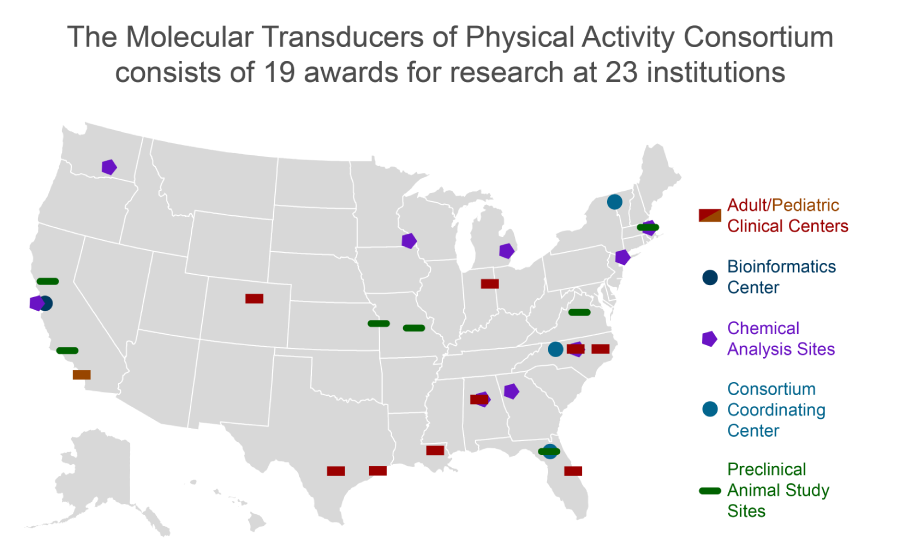
Are you interested in participating in the MoTrPAC study? The map below shows the location for all of the involved centers. You can follow us @NIH_CommonFund for announcements on general recruitment or check back with the MoTrPAC website: https://www.motrpac.org/join/volunteerHome.cfm .
Funded Research Limited Competition: Molecular Transducers of Physical Activity Chemical Analysis Sites (U24 Clinical Trial Not Allowed)
| PI NAME | INSTITUTION NAME | TITLE |
|---|---|---|
| ADKINS, JOSHUA N | BATTELLE PACIFIC NORTHWEST LABORATORIES | ProMoTr: A Proteomics Center for MoTrPAC |
| BURANT, CHARLES F (contact) EVANS, CHARLES ROBERT LI, JUN | UNIVERSITY OF MICHIGAN AT ANN ARBOR | Michigan MoTrPAC Chemical Analysis Site (MiCAS) |
| GERSZTEN, ROBERT E (contact) CARR, STEVEN A CLISH, CLARY B NEWGARD, CHRISTOPHER B | BROAD INSTITUTE, INC. | A biochemical roadmap of exercise signal |
| NAIR, K SREEKUMARAN (contact) LANZA, IAN R | MAYO CLINIC ROCHESTER | Mayo Clinic Physical Activity Research Center: Metabolomics and Proteomics Analysis Site |
| ORTLUND, ERIC A (contact) FERNANDEZ, FACUNDO MARTIN | EMORY UNIVERSITY | Georgia Comprehensive Metabolomics and Proteomics Unit for MoTrPAC |
| SEALFON, STUART C (contact) WALSH, MARTIN JOHN | ICAHN SCHOOL OF MEDICINE AT MOUNT SINAI | MoTrPAC Genomics, Epigenomics and Transcriptomics Chemical Analysis Site |
| SNYDER, MICHAEL P (contact) MONTGOMERY, STEPHEN | STANFORD UNIVERSITY | Stanford MoTrPAC Site for Genomes, Epigenomes and Transcriptomes |
Limited Competition: Molecular Transducers of Physical Activity Chemical Analysis Sites (U24 Clinical Trial Not Allowed)
| PI NAME | INSTITUTION NAME | TITLE |
|---|---|---|
| ADKINS, JOSHUA N | BATTELLE PACIFIC NORTHWEST LABORATORIES | ProMoTr: A Proteomics Center for MoTrPAC |
| BURANT, CHARLES F (contact) EVANS, CHARLES ROBERT LI, JUN | UNIVERSITY OF MICHIGAN AT ANN ARBOR | Michigan MoTrPAC Chemical Analysis Site (MiCAS) |
| GERSZTEN, ROBERT E (contact) CARR, STEVEN A CLISH, CLARY B NEWGARD, CHRISTOPHER B | BROAD INSTITUTE, INC. | A biochemical roadmap of exercise signal |
| NAIR, K SREEKUMARAN (contact) LANZA, IAN R | MAYO CLINIC ROCHESTER | Mayo Clinic Physical Activity Research Center: Metabolomics and Proteomics Analysis Site |
| ORTLUND, ERIC A (contact) FERNANDEZ, FACUNDO MARTIN | EMORY UNIVERSITY | Georgia Comprehensive Metabolomics and Proteomics Unit for MoTrPAC |
| SEALFON, STUART C (contact) WALSH, MARTIN JOHN | ICAHN SCHOOL OF MEDICINE AT MOUNT SINAI | MoTrPAC Genomics, Epigenomics and Transcriptomics Chemical Analysis Site |
| SNYDER, MICHAEL P (contact) MONTGOMERY, STEPHEN | STANFORD UNIVERSITY | Stanford MoTrPAC Site for Genomes, Epigenomes and Transcriptomes |
Limited Competition: Molecular Transducers of Physical Activity Bioinformatics Center (U24 Clinical Trial Not Allowed)
| PI NAME | INSTITUTION NAME | TITLE |
|---|---|---|
| ASHLEY, EUAN A (contact) WHEELER, MATTHEW THOMAS | STANFORD UNIVERSITY | Molecular Transducers of Physical Activity (MoTrPAC) |
Limited Competition: Molecular Transducers of Physical Activity Bioinformatics Center (U24 Clinical Trial Not Allowed)
| PI NAME | INSTITUTION NAME | TITLE |
|---|---|---|
| ASHLEY, EUAN A (contact) WHEELER, MATTHEW THOMAS | STANFORD UNIVERSITY | Molecular Transducers of Physical Activity (MoTrPAC) |
Limited Competition: Molecular Transducers of Physical Activity Clinical Centers (U01 Clinical Trial Required)
| PI Name | Institution Name | Title |
|---|---|---|
| KOHRT, WENDY M | UNIVERSITY OF COLORADO DENVER | Molecular Transducers of Physical Activity Consortium - Colorado Clinical Center |
| KRAUS, WILLIAM E (contact) HOUMARD, JOSEPH A | DUKE UNIVERSITY | Molecular Transducers of Physical Activity and Health: NC Consortium Clinical Site |
| MUSI, NICOLAS (contact) RASMUSSEN, BLAKE B | CEDARS-SINAI MEDICAL CENTER | Molecular Transducers of Physical Activity Consortium Adult Clinical Center |
| RADOM-AIZIK, SHLOMIT (contact) COOPER, DAN M | UNIVERSITY OF CALIFORNIA-IRVINE | Molecular Transducers of Physical Activity Consortium (MoTrPAC): Pediatric Clinical Center |
| RAVUSSIN, ERIC | LSU PENNINGTON BIOMEDICAL RESEARCH CTR | Pennington MoTrPAC Adults - Renewal |
| TRAPPE, SCOTT (contact) BUFORD, THOMAS W GOODPASTER, BRET H | BALL STATE UNIVERSITY | The Exercise and Physical Activity Collaborative Team (ExPACT): A MoTrPAC Clinical Center |
Limited Competition: Molecular Transducers of Physical Activity Clinical Centers (U01 Clinical Trial Required)
| PI Name | Institution Name | Title |
|---|---|---|
| KOHRT, WENDY M | UNIVERSITY OF COLORADO DENVER | Molecular Transducers of Physical Activity Consortium - Colorado Clinical Center |
| KRAUS, WILLIAM E (contact) HOUMARD, JOSEPH A | DUKE UNIVERSITY | Molecular Transducers of Physical Activity and Health: NC Consortium Clinical Site |
| MUSI, NICOLAS (contact) RASMUSSEN, BLAKE B | CEDARS-SINAI MEDICAL CENTER | Molecular Transducers of Physical Activity Consortium Adult Clinical Center |
| RADOM-AIZIK, SHLOMIT (contact) COOPER, DAN M | UNIVERSITY OF CALIFORNIA-IRVINE | Molecular Transducers of Physical Activity Consortium (MoTrPAC): Pediatric Clinical Center |
| RAVUSSIN, ERIC | LSU PENNINGTON BIOMEDICAL RESEARCH CTR | Pennington MoTrPAC Adults - Renewal |
| TRAPPE, SCOTT (contact) BUFORD, THOMAS W GOODPASTER, BRET H | BALL STATE UNIVERSITY | The Exercise and Physical Activity Collaborative Team (ExPACT): A MoTrPAC Clinical Center |
Limited Competition: Molecular Transducers of Physical Activity Consortium Coordinating Center (U24 Clinical Trial Not Allowed)
| PI Name | Institution Name | Title |
|---|---|---|
| MILLER, MICHAEL E (contact) ESSER, KARYN A REJESKI, WALTER JOHN TRACY, RUSSELL P | WAKE FOREST UNIVERSITY HEALTH SCIENCES | Molecular Transducers of Physical Activity Consortium Coordinating Center |
Limited Competition: Molecular Transducers of Physical Activity Consortium Coordinating Center (U24 Clinical Trial Not Allowed)
| PI Name | Institution Name | Title |
|---|---|---|
| MILLER, MICHAEL E (contact) ESSER, KARYN A REJESKI, WALTER JOHN TRACY, RUSSELL P | WAKE FOREST UNIVERSITY HEALTH SCIENCES | Molecular Transducers of Physical Activity Consortium Coordinating Center |
MoTrPAc Phase 2 Animal Studies (U01 Clinical Trial Not Allowed)
| PI Name | Institution Name | Title |
|---|---|---|
| HEVENER, ANDREA L (contact) LUSIS, ALDONS JAKE | UNIVERSITY OF CALIFORNIA LOS ANGELES | Systems-based approaches for investigating tissue communication during exercise |
| RECTOR, RANDY SCOTT (contact) BOOTH, FRANK W THYFAULT, JOHN P | UNIVERSITY OF MISSOURI-COLUMBIA | Molecular Transducers of Physical Activity: Liver Adaptations Drive Brain Benefits |
| YAN, ZHEN | UNIVERSITY OF VIRGINIA | Machine learning-based multi-omics modeling and CRISPR/Cas9-mediated gene editing in elucidating molecular transducer of physical activity |
MoTrPAc Phase 2 Animal Studies (U01 Clinical Trial Not Allowed)
| PI Name | Institution Name | Title |
|---|---|---|
| HEVENER, ANDREA L (contact) LUSIS, ALDONS JAKE | UNIVERSITY OF CALIFORNIA LOS ANGELES | Systems-based approaches for investigating tissue communication during exercise |
| RECTOR, RANDY SCOTT (contact) BOOTH, FRANK W THYFAULT, JOHN P | UNIVERSITY OF MISSOURI-COLUMBIA | Molecular Transducers of Physical Activity: Liver Adaptations Drive Brain Benefits |
| YAN, ZHEN | UNIVERSITY OF VIRGINIA | Machine learning-based multi-omics modeling and CRISPR/Cas9-mediated gene editing in elucidating molecular transducer of physical activity |
Molecular Transducers of Physical Activity Genomics, Epigenomics and Transcriptomics Chemical Analysis Sites (U24)
| PI Name | Institution Name | Title |
|---|---|---|
| SEALFON, STUART C. (contact) WALSH, MARTIN JOHN | ICAHN SCHOOL OF MEDICINE AT MOUNT SINAI PAGES | Pages: Physical Activity Genomics, Epigenomics/transcriptomics Site |
| SNYDER, MICHAEL P (contact) MONTGOMERY, STEPHEN BLAIR | STANFORD UNIVERSITY | Stanford/Salk MoTrPAC Site for Genomes, Epigenomes and Transcriptomes |
Molecular Transducers of Physical Activity Genomics, Epigenomics and Transcriptomics Chemical Analysis Sites (U24)
| PI Name | Institution Name | Title |
|---|---|---|
| SEALFON, STUART C. (contact) WALSH, MARTIN JOHN | ICAHN SCHOOL OF MEDICINE AT MOUNT SINAI PAGES | Pages: Physical Activity Genomics, Epigenomics/transcriptomics Site |
| SNYDER, MICHAEL P (contact) MONTGOMERY, STEPHEN BLAIR | STANFORD UNIVERSITY | Stanford/Salk MoTrPAC Site for Genomes, Epigenomes and Transcriptomes |
Molecular Transducers of Physical Activity Metabolomics and Proteomics Chemical Analysis Sites (U24)
| PI Name | Institution Name | Title |
|---|---|---|
| ADKINS, JOSHUA N. | BATTELLE PACIFIC NORTHWEST LABORATORIES | ProMoTr: A Proteomics Center for MoTrPAC |
| BURANT, CHARLES F (contact) LI, JUN | UNIVERSITY OF MICHIGAN | Michigan MoTrPAC Chemical Analysis Site (MiCAS) |
| GERSZTEN, ROBERT E (contact) CARR, STEVEN A CLISH, CLARY B NEWGARD, CHRISTOPHER B | BROAD INSTITUTE, INC. | A Biochemical Roadmap of Exercise Signaling |
| JONES, DEAN PAUL | EMORY UNIVERSITY | Georgia Comprehensive Metabolomics and Proteomics Unit for MoTrPAC |
| NAIR, K SREEKUMARAN (contact) LANZA, IAN R | MAYO CLINIC ROCHESTER | Mayo Clinic Physical Activity Research Center: Metabolomics and Proteomics Analysis Site |
Molecular Transducers of Physical Activity Metabolomics and Proteomics Chemical Analysis Sites (U24)
| PI Name | Institution Name | Title |
|---|---|---|
| ADKINS, JOSHUA N. | BATTELLE PACIFIC NORTHWEST LABORATORIES | ProMoTr: A Proteomics Center for MoTrPAC |
| BURANT, CHARLES F (contact) LI, JUN | UNIVERSITY OF MICHIGAN | Michigan MoTrPAC Chemical Analysis Site (MiCAS) |
| GERSZTEN, ROBERT E (contact) CARR, STEVEN A CLISH, CLARY B NEWGARD, CHRISTOPHER B | BROAD INSTITUTE, INC. | A Biochemical Roadmap of Exercise Signaling |
| JONES, DEAN PAUL | EMORY UNIVERSITY | Georgia Comprehensive Metabolomics and Proteomics Unit for MoTrPAC |
| NAIR, K SREEKUMARAN (contact) LANZA, IAN R | MAYO CLINIC ROCHESTER | Mayo Clinic Physical Activity Research Center: Metabolomics and Proteomics Analysis Site |
Molecular Transducers of Physical Activity Bioinformatics Center (U24)
| PI Name | Institution Name | Title |
|---|---|---|
| ASHLEY, EUAN A | STANFORD UNIVERSITY | Stanford MoTrPAC Bioinformatics Center |
Molecular Transducers of Physical Activity Bioinformatics Center (U24)
| PI Name | Institution Name | Title |
|---|---|---|
| ASHLEY, EUAN A | STANFORD UNIVERSITY | Stanford MoTrPAC Bioinformatics Center |
Molecular Transducers of Physical Activity Preclinical Animal Study Sites (U01)
| PI Name | Institution Name | Title |
|---|---|---|
| BODINE, SUE C (contact) BAAR, KEITH | UNIVERSITY OF CALIFORNIA AT DAVIS | MoTrPAC: UC Preclinical Animal Study Site |
| ESSER, KARYN A | UNIVERSITY OF FLORIDA | UF PASS: Regulation of exercise transducers |
| GOODYEAR, LAURIE J | JOSLIN DIABETES CENTER | Animal Studies Investigating Molecular Transducers of Physical Activity |
Molecular Transducers of Physical Activity Consortium Coordinating Center (CCC) (U24)
Molecular Transducers of Physical Activity Preclinical Animal Study Sites (U01)
| PI Name | Institution Name | Title |
|---|---|---|
| BODINE, SUE C (contact) BAAR, KEITH | UNIVERSITY OF CALIFORNIA AT DAVIS | MoTrPAC: UC Preclinical Animal Study Site |
| ESSER, KARYN A | UNIVERSITY OF FLORIDA | UF PASS: Regulation of exercise transducers |
| GOODYEAR, LAURIE J | JOSLIN DIABETES CENTER | Animal Studies Investigating Molecular Transducers of Physical Activity |
Molecular Transducers of Physical Activity Consortium Coordinating Center (CCC) (U24)
| PI Name | Institution Name | Title |
|---|---|---|
| PAHOR, MARCO (contact) MILLER, MICHAEL E. REJESKI, WALTER JOHN TRACY, RUSSELL P | UNIVERSITY OF FLORIDA | MoTrPAC Consortium Coordinating Center |
Molecular Transducers of Physical Activity Consortium Coordinating Center (CCC) (U24)
| PI Name | Institution Name | Title |
|---|---|---|
| PAHOR, MARCO (contact) MILLER, MICHAEL E. REJESKI, WALTER JOHN TRACY, RUSSELL P | UNIVERSITY OF FLORIDA | MoTrPAC Consortium Coordinating Center |
Molecular Transducers of Physical Activity Clinical Centers (U01)
Molecular Transducers of Physical Activity Clinical Centers (U01)
Program Resources
To learn more about MoTrPAC and its resources, please view the program's
Data Access
All data will be accessible through the MoTrPAC Data Hub maintained by the Bioinformatics Center. An integrative multi-omics analysis will be prioritized to develop a molecular map of exercise-related changes in the body. Find information about currently available data releases and instructions for accessing the data by visiting the Data Hub , or by clicking the Data Hub link on the consortium's website .
Ancillary Study Policy
The MoTrPAC study is designed to discover and perform preliminary characterization of the range of molecular transducers (the 'molecular map') that underlie the effects of physical activity in humans. To make the best possible use of this resource, MoTrPAC encourages investigators to develop ancillary studies (AS) in conjunction with the MoTrPAC study and to involve other investigators, within and outside of MoTrPAC, in this process. Towards this end, MoTrPAC has developed an interactive AS approval process that facilitates the development of AS and also assures the compatibility of the proposed AS with the resources, efficient execution, and mission of the overall MoTrPAC program.
To learn more about the AS study policy, or to submit an AS proposal, visit the consortium's website .
Recruitment Information
MoTrPAC study recruitment and enrollment is ongoing. If you are interested in participating, please visit the consortium’s website for more information or to check your eligibility.
Study Protocols and COVID Manual of Procedures (MOP)
Protocols for the MoTrPAC study, including the animal , adult , and pediatric MOPs, are available on the consortium’s website .
Because exercise is an aerosol-generating activity, the MoTrPAC study has also developed and made available a MOP Safety Appendix for COVID-19 .
{"robots":"noindex, nofollow"}