 An official website of the United States government




Disclaimer:
The information in these pages is meant to provide general guidance. Instructions and procedures outlined in the funding opportunity, SF424 Application Guide , and NIH Grants Policy Statement take precedence over any information provided and should be referred to for complete and comprehensive directions.
Learn more about applying for and managing a New Innovator Award . This guide contains information on:
- Eligibility
- Pre-Application Steps
- Application
- Application Submission
- Sample Applications
- Post-Submission Materials
- Review Process
- Pre-Award Activities
- Award Management
More questions? Contact us at NewInnovatorAwards@od.nih.gov .
SF424 (R&R) Application Guide
The SF424 (R&R) Application Guide provides comprehensive guidance on how to submit applications to NIH, the Centers for Disease Control and Prevention, the Food and Drug Administration, and the Agency for Healthcare Research and Quality.
Use the latest version of the SF424 (R&R) Application Guide and follow the Research (R) instructions.
The funding opportunity provides all the information needed to successfully assemble your application and will tell you when to refer to the SF424 (R&R) Application Guide for more detailed instructions. It will also tell you when to deviate from the SF424 (R&R) Application Guide. Instructions in the funding opportunity supersede instructions from the SF424 (R&R) Application Guide. Failure to comply with the instructions and requirements outlined in the funding opportunity may result in your application being administratively withdrawn for non-compliance.
Eligibility
The New Innovator Award supports Early Stage Investigators (ESI) of exceptional creativity who propose bold and highly innovative research projects with the potential to produce a major impact on broad, important areas relevant to the mission of NIH. Preliminary data are not required. Any ESI with the skills, knowledge, and resources necessary to carry out the proposed research is invited to work with their organization to develop an application for support.
Applications in any area within the biomedical sciences are welcome; topics may involve basic, translational, or clinical research. The primary requirements are that the research be highly innovative and have the potential for unusually broad impact.
Steps to Determine Your Eligibility
NIH seeks fundamental knowledge about the nature and behavior of living systems and the application of that knowledge to enhance health, lengthen life, and reduce illness and disability. The New Innovator Award welcomes any area within the biomedical sciences; topics may involve basic, translational, or clinical research. The primary requirements are that the research be highly innovative and have the potential for unusually broad impact.
The award supports unusually creative investigators with highly innovative research ideas at an early stage of their career when they may lack the preliminary data required for an R01 grant application. The emphasis is on innovation and creativity; preliminary data are not required but may be included. No detailed, annual budget is requested in the application. The review process emphasizes the individual’s creativity, the innovativeness of the research approaches, and the potential of the project, if successful, to have a significant impact on an important biomedical or behavioral research problem.
Any eligible individual with the skills, knowledge, and resources necessary to carry out the proposed research as the Program Director/Principal Investigator (PD/PI) is invited to work with their institution to develop an application for support.
Only single PD/PI applications are allowed.
Applicants must meet the definition of an Early Stage Investigator (ESI) at the time of application submission. An ESI is a PD/PI who has completed their terminal research degree or end of post-graduate clinical training (whichever is later) within the past 10 years and who has not previously competed successfully as a PD/PI for a substantial NIH independent research award. See the Office of Extramural Research website for a list of grants that do not disqualify a PD/PI as a new investigator and for frequently asked questions about the NIH ESI policy.
An extension to the 10-year period may be granted under certain circumstances (e.g., childbirth, family care responsibilities, clinical loan repayment requirements, disability or illness, natural or other disaster, etc.). It may take several weeks for the review process for the request, so applicants should plan accordingly. Note: If an applicant is not identified as an ESI in the eRA Commons, it may result in the application not being reviewed. Applicants are responsible for reviewing and/or updating their degree information in their eRA Commons account in a timely fashion.
Applicants must hold an independent research position at a domestic (U.S.) institution by September 1st of the year when they will start their project period. An “independent research position” is a position that automatically confers eligibility to the investigator (based on institutional policy) to apply for R01 grants with appropriate institutional commitment of facilities for the conduct of the proposed research. Investigators still in training or mentored status (such as postdoctoral fellows) are not eligible to apply unless they have a written commitment from the institution stating they will be in an independent faculty position by September 1st of the year when they will start their project period. The commitment is certified by the institution's submission of the application.
Applicants may submit or have an NIH R01 or other equivalent grant application pending concurrently with their New Innovator Award application if it does not overlap substantially with their New Innovator Award application. However, if that pending grant becomes active prior to the New Innovator Award, the applicant is no longer eligible to receive the New Innovator Award.
Award recipients are required to commit at least three person-months (25%) of their research effort each year to activities supported by the New Innovator Award.
If you still have questions about your eligibility, check out the Frequently Asked Questions (FAQ) section and past Q&A webinar posted on the website. You can also contact NIH staff at NewInnovatorAwards@mail.nih.gov .
Application Process
This section provides steps and information needed to prepare a New Innovator Award application for submission and includes samples of past New Innovator Award applications. The guidance found here is not detailed, but it is specific to the New Innovator Award. For more detailed guidance on each step, go to the NIH Grants & Funding Application Guide website .
The Application Process section includes:
1. PRE-APPLICATION STEPS
Before you can submit an application, you need to make sure you have all the necessary registrations and accounts. Work closely with your institution's business office to get registered and to determine its internal procedure for submitting an application to NIH.
Step 1: Ensure Applicant Institution Is Registered
Applicant institutions must complete and maintain the following registrations to apply and receive awards. Registration can take six weeks or more, so institutions should begin the registration process as soon as possible.
- System for Award Management (SAM) – Institutions must complete and maintain an active registration, which requires an annual renewal that may take as much time as the initial registration. SAM registration includes the assignment of a Commercial and Government Entity (CAGE) Code. A Unique Entity Identifier (UEI) is issued as part of the SAM.gov registration process. The same UEI must be used for all registrations, as well as on the grant application.
- eRA Commons – Institutions must have an active unique organization identifier to register. To submit an application, a Signing Official (SO) and Program Director/Principal Investigator (PD/PI) account must be designated.
- Grants.gov – Institutions must have an active SAM registration to complete registration.
Step 2: Ensure Applicant Is Registered
The PD/PI must have an eRA Commons account. The PD/PI should work with their institutional officials to either create a new account or to affiliate their existing account with the applicant institution in eRA Commons. Obtaining an eRA Commons account can take up to two weeks.
Step 3: Request an Application Package
The application forms package must be accessed through one of the following systems:
- Application Submission System & Interface for Submission Tracking (ASSIST) – ASSIST is used to prepare and submit applications electronically to NIH and other Public Health Service agencies.
- Grants.gov Workspace – Workspace is the standard way for organizations or individuals to apply for federal grants in Grants.gov.
- Institutional System-to-System – See your institution’s administrative office for instructions if you plan to use an institutional system-to-system solution.
Step 4 (Optional): Contact NIH Institute or Center for Instructions on Clinical Trials
The New Innovator Award welcomes any project relevant to the NIH mission, including clinical trials . Though technical and conceptual risks are expected in highly innovative projects, clinical research must also contend with potential risks to human subjects. Because awards are administered by the most topic-relevant NIH Institute or Center (IC), applicants proposing NIH-defined clinical trials should contact program staff at the appropriate IC to ensure their applications conform to NIH and IC-specific policies for clinical trials.
For a list of IC contacts for clinical trials research, see our page on NIH Clinical Trials Contacts .
1. PRE-APPLICATION STEPS
Before you can submit an application, you need to make sure you have all the necessary registrations and accounts. Work closely with your institution's business office to get registered and to determine its internal procedure for submitting an application to NIH.
Step 1: Ensure Applicant Institution Is Registered
Applicant institutions must complete and maintain the following registrations to apply and receive awards. Registration can take six weeks or more, so institutions should begin the registration process as soon as possible.
- System for Award Management (SAM) – Institutions must complete and maintain an active registration, which requires an annual renewal that may take as much time as the initial registration. SAM registration includes the assignment of a Commercial and Government Entity (CAGE) Code. A Unique Entity Identifier (UEI) is issued as part of the SAM.gov registration process. The same UEI must be used for all registrations, as well as on the grant application.
- eRA Commons – Institutions must have an active unique organization identifier to register. To submit an application, a Signing Official (SO) and Program Director/Principal Investigator (PD/PI) account must be designated.
- Grants.gov – Institutions must have an active SAM registration to complete registration.
Step 2: Ensure Applicant Is Registered
The PD/PI must have an eRA Commons account. The PD/PI should work with their institutional officials to either create a new account or to affiliate their existing account with the applicant institution in eRA Commons. Obtaining an eRA Commons account can take up to two weeks.
Step 3: Request an Application Package
The application forms package must be accessed through one of the following systems:
- Application Submission System & Interface for Submission Tracking (ASSIST) – ASSIST is used to prepare and submit applications electronically to NIH and other Public Health Service agencies.
- Grants.gov Workspace – Workspace is the standard way for organizations or individuals to apply for federal grants in Grants.gov.
- Institutional System-to-System – See your institution’s administrative office for instructions if you plan to use an institutional system-to-system solution.
Step 4 (Optional): Contact NIH Institute or Center for Instructions on Clinical Trials
The New Innovator Award welcomes any project relevant to the NIH mission, including clinical trials . Though technical and conceptual risks are expected in highly innovative projects, clinical research must also contend with potential risks to human subjects. Because awards are administered by the most topic-relevant NIH Institute or Center (IC), applicants proposing NIH-defined clinical trials should contact program staff at the appropriate IC to ensure their applications conform to NIH and IC-specific policies for clinical trials.
For a list of IC contacts for clinical trials research, see our page on NIH Clinical Trials Contacts .
2. APPLICATION
Follow the Instructions
It is critical that applicants follow the Research Instructions in the SF424 (R&R) Application Guide except when instructed in the funding opportunity to do otherwise. When the funding opportunity provides instructions that differ from the SF424 (R&R) Application Guide, the instructions given in the funding opportunity take precedence and should be followed.
All attachments should be formatted according to NIH format standards .
Adherence to the application requirements is mandatory and strictly enforced. Applications that are out of compliance with these instructions may not be accepted for review.
Required Forms
Refer to the funding opportunity and SF424 (R&R) Application Guide for complete instructions.
1. SF424 (R&R) Form
Follow all instructions in the SF424 (R&R) Application Guide .
Agency Routing Identifier
Enter Science Area Designations in the Agency Routing Identifier (in Field 4b). Using the list below, designate the two most appropriate scientific areas (a primary and secondary) for the proposal.
1 CB - Chemical Biology
2 CTR - Clinical and Translational Research
3 IDI - Infectious Diseases and Immunology
4 IE - Instrumentation and Engineering
5 MCB - Molecular and Cellular Biology
6 NS - Neuroscience
7 HIB - High-Throughput and Integrative Biology
8 BCB - Bioinformatics and Computational Biology
For each area, enter the one-digit code and abbreviation (e.g., 1 BSS). List the primary area first followed by a semicolon, then add the secondary area (e.g., 1 BSS; 7 NS).
The areas of science listed above are very broad and frequently overlap. Choose the primary and secondary science areas that are most appropriate for your proposed project. The scientific areas are used solely as an aid to assign panel reviewers, who are chosen for their breadth of knowledge and expertise and will be able to review a broad range of applications. Science area designations do not affect an application’s funding potential, and application requirements and instructions are identical for all science areas. All applications are reviewed in the same time period, with the same review criteria, and compete for a single source of dedicated funds.
Note: The science area designations (two one-digit codes with abbreviations) must also be included at the beginning of the Research Strategy essay.
Type of Application
Must be "New."
Proposed Project
The start date should be September 1st of the funding year, and the end date should be August 31st, 5 years after the start year.
Estimated Project Funding
Total Federal Funds Requested: $2,375,000
Total Non-Federal Funds: $0
Total Federal & Non-Federal Funds: $2,375,000
Estimated Program Income: $0
Note: The total direct costs for the 5-year project period of the award is $2,375,000 and is entered in the "Total Federal Funds Requested" and "Total Federal & Non-Federal Funds" fields (as described above). Applicable Facilities and Administrative costs (F&A) will be determined at the time of award and should not be included in the budget request. A detailed budget and other budget forms are not required and will not be accepted. Funds may be used for personnel (including collaborators), supplies, equipment, subcontracts, data management and sharing costs, and other allowable costs.
2. PHS 398 Cover Page Supplement Form
Follow all instructions in the SF424 (R&R) Application Guide .
3. R&R Other Project Information Form
Follow all instructions in the SF424 (R&R) Application Guide with additional instructions for the Facilities & Other Resources section outlined in the funding opportunity.
Project Summary/Abstract
There is a limit of 30 lines of text.
Project Narrative
There is a limit of three sentences.
Bibliography & References Cited
Do not use. Provide essential reference citations in the essay.
Facilities & Other Resources
Upload a brief statement (one-page maximum) of the facilities to be used for the conduct of the research.
Equipment
Do not use.
Other Attachments
Only attach Foreign Justification, if applicable.
Other Tips
- For more help on human subjects, visit the NIH Grants & Funding website .
- Foreign components are defined as the performance of any significant scientific element or segment of a project outside of the United States, either by the recipient or by a researcher employed by a foreign organization, whether or not grant funds are expended. It is crucial that you disclose all foreign components, which include foreign collaborations that will result in co-authorship. See the definition of Foreign Components for more details.
4. Project/Performance Site Location(s)
Follow all instructions in the SF424 (R&R) Application Guide .
5. R&R Senior/Key Person Profile Form
Follow all instructions in the SF424 (R&R) Application Guide , with the following modifications:
- Profile - Project Director/Principal Investigator: Attach a list of current and pending support from all sources, including current year direct costs and percent effort devoted to each project in person-months.
- Profile - Senior Key Person 1: Do not use. Submit information only for the PD/PI. Information on collaborators or other key personnel is not required but may be included in the Research Strategy essay.
- Research and Related Senior/Key Person Profile (Expanded) - Additional Senior/Key Person Profile(s): Do not use. Only the PD/PI may serve as senior/key personnel.
- Research and Related Senior/Key Person Profile (Expanded) - Additional Biographical Sketch(es): Do not use. Only the PD/PI may submit a Biographical Sketch.
6. R&R Budget Form
Do not use or submit. Itemized budget information is not required and will not be accepted. Instead, the total requested Direct Cost amount of $2,375,000 for the entire project period is required on the SF424 (R&R) Form (as instructed above). Awards of $475,000 in Direct Costs plus applicable Facilities and Administrative (F&A) costs, will be issued annually.
7. R&R Subaward Budget Attachment(s) Form
Do not use or submit.
8. PHS 398 Research Plan Form
Follow all instructions in the SF424 (R&R) Application Guide with additional instructions in the funding opportunity.
Specific Aims
Do not use.
Research Strategy
The Research Strategy essay is the major component of the application and is limited to ten pages. The essay should address:
- The significance and potential impact of the project
- What makes the approaches exceptionally innovative
- How risks and challenges will be addressed
- The applicant’s qualifications for the award
The essay should include the following sections with headings, in order, and within the ten-page limit:
- Project Science Areas: Provide the 1-digit code and abbreviation for primary and secondary science areas at the beginning of the essay. See "Agency Routing Identifier" information above for codes and format.
Project Description: The description of the scientific plan should be written at a level appropriate for reviewers who are broadly knowledgeable but may not be topic experts in the proposed area of research. Do not provide a detailed experimental plan, and do not structure the proposed research as a series of specific aims. The focus should be on the goals of the New Innovator Award and the review criteria. Preliminary data are allowed but not required. The project description should:
- Describe the scientific challenge or opportunity that will be addressed, its importance, and how addressing this would have a major impact on a broad area of research relevant to NIH.
- Provide scientific context by summarizing the current landscape of the field and how your research, if successful, would substantially extend beyond current boundaries.
- Describe the overall approach to be taken.
- State prominently that to comply with instructions in the funding opportunity, a detailed experimental plan and extensive preliminary data are not being provided. While details and preliminary data are not required, reviewers should still get a clear sense of what is being proposed and why and be convinced that the research will be performed in a robust and rigorous manner.
- Innovativeness: Given what is considered state-of-the-art in the field, state clearly and concisely what makes the project unusually innovative. And since the approaches may be highly innovative and risky, what will be done if these approaches are not successful?
- Investigator Qualifications: Provide evidence to support your claim of innovativeness and creativity in your prior research. For example, what personal qualities and experiences demonstrate your inclination to question paradigms and work with intellectual uncertainties, develop unique collaborations, integrate diverse sources of information, or develop novel approaches when new challenges or opportunities arise?
- Suitability for the New Innovator Award Program: Why is the planned research uniquely suited to the New Innovator Award rather than a more “traditional” grant mechanism?
- Statement of Research Effort Commitment: Include a statement affirming that if you are chosen to receive an award, you will commit a minimum of three person-months (25%) of research effort to the New Innovator Award project.
Additional Notes:
- All bibliographic citations must fit within the ten-page limit. The most critical citations should be included to aid in the assessment of scientific rigor.
- Figures and illustrations may be included but must fit within the ten-page limit.
- Letters of collaboration will not be accepted. Information on collaborators may be included in the essay and their names and affiliations should be listed in the PHS Assignment Request Form as individuals who should not review your application because they are collaborators.
- Applicants considering clinical trial research are strongly advised to discuss their research with the most scientifically relevant NIH Institutes or Centers (ICs) to ensure the research conforms to the clinical trial research policies of those ICs. Funding of applications involving clinical trials is contingent upon conformance to the policies of the IC administering the award. A list of IC contacts are on our website .
Consortium/Contractual Arrangements
Do not use.
Letters of Support
Do not use. Letters of support from collaborators are not allowed.
Resource Sharing Plan
Follow all instructions in the SF424 (R&R) Application Guide , but Resource Sharing Plans will be expected as Just in Time information if an award is being considered.
Appendix
Follow all instructions in the SF424 (R&R) Application Guide . Limited materials are allowed. Publications and other material, with the exception of blank questionnaires or blank surveys, may not be included.
9. PHS Human Subjects and Clinical Trials Information
Follow all instructions in the SF424 (R&R) Application Guide .
10. PHS Assignment Request Form
Follow all instructions in the SF424 (R&R) Application Guide , but do not request an assignment to a particular review panel (integrated review group) or awarding component (NIH Institute or Center). All applications are automatically received as "Office of the Director" applications and reviewed by a single Special Emphasis Panel convened by the Center for Scientific Review.
Since letters of collaboration and biosketches of collaborators are not allowed, provide the names of collaborators and their institutional affiliations. Also, if you wish to request that certain individuals not review your application, list their names, institutional affiliations, and the reasons why they should not serve as reviewers. NIH will consider this request but is not obligated to accept it.
2. APPLICATION
Follow the Instructions
It is critical that applicants follow the Research Instructions in the SF424 (R&R) Application Guide except when instructed in the funding opportunity to do otherwise. When the funding opportunity provides instructions that differ from the SF424 (R&R) Application Guide, the instructions given in the funding opportunity take precedence and should be followed.
All attachments should be formatted according to NIH format standards .
Adherence to the application requirements is mandatory and strictly enforced. Applications that are out of compliance with these instructions may not be accepted for review.
Required Forms
Refer to the funding opportunity and SF424 (R&R) Application Guide for complete instructions.
1. SF424 (R&R) Form
Follow all instructions in the SF424 (R&R) Application Guide .
Agency Routing Identifier
Enter Science Area Designations in the Agency Routing Identifier (in Field 4b). Using the list below, designate the two most appropriate scientific areas (a primary and secondary) for the proposal.
1 CB - Chemical Biology
2 CTR - Clinical and Translational Research
3 IDI - Infectious Diseases and Immunology
4 IE - Instrumentation and Engineering
5 MCB - Molecular and Cellular Biology
6 NS - Neuroscience
7 HIB - High-Throughput and Integrative Biology
8 BCB - Bioinformatics and Computational Biology
For each area, enter the one-digit code and abbreviation (e.g., 1 BSS). List the primary area first followed by a semicolon, then add the secondary area (e.g., 1 BSS; 7 NS).
The areas of science listed above are very broad and frequently overlap. Choose the primary and secondary science areas that are most appropriate for your proposed project. The scientific areas are used solely as an aid to assign panel reviewers, who are chosen for their breadth of knowledge and expertise and will be able to review a broad range of applications. Science area designations do not affect an application’s funding potential, and application requirements and instructions are identical for all science areas. All applications are reviewed in the same time period, with the same review criteria, and compete for a single source of dedicated funds.
Note: The science area designations (two one-digit codes with abbreviations) must also be included at the beginning of the Research Strategy essay.
Type of Application
Must be "New."
Proposed Project
The start date should be September 1st of the funding year, and the end date should be August 31st, 5 years after the start year.
Estimated Project Funding
Total Federal Funds Requested: $2,375,000
Total Non-Federal Funds: $0
Total Federal & Non-Federal Funds: $2,375,000
Estimated Program Income: $0
Note: The total direct costs for the 5-year project period of the award is $2,375,000 and is entered in the "Total Federal Funds Requested" and "Total Federal & Non-Federal Funds" fields (as described above). Applicable Facilities and Administrative costs (F&A) will be determined at the time of award and should not be included in the budget request. A detailed budget and other budget forms are not required and will not be accepted. Funds may be used for personnel (including collaborators), supplies, equipment, subcontracts, data management and sharing costs, and other allowable costs.
2. PHS 398 Cover Page Supplement Form
Follow all instructions in the SF424 (R&R) Application Guide .
3. R&R Other Project Information Form
Follow all instructions in the SF424 (R&R) Application Guide with additional instructions for the Facilities & Other Resources section outlined in the funding opportunity.
Project Summary/Abstract
There is a limit of 30 lines of text.
Project Narrative
There is a limit of three sentences.
Bibliography & References Cited
Do not use. Provide essential reference citations in the essay.
Facilities & Other Resources
Upload a brief statement (one-page maximum) of the facilities to be used for the conduct of the research.
Equipment
Do not use.
Other Attachments
Only attach Foreign Justification, if applicable.
Other Tips
- For more help on human subjects, visit the NIH Grants & Funding website .
- Foreign components are defined as the performance of any significant scientific element or segment of a project outside of the United States, either by the recipient or by a researcher employed by a foreign organization, whether or not grant funds are expended. It is crucial that you disclose all foreign components, which include foreign collaborations that will result in co-authorship. See the definition of Foreign Components for more details.
4. Project/Performance Site Location(s)
Follow all instructions in the SF424 (R&R) Application Guide .
5. R&R Senior/Key Person Profile Form
Follow all instructions in the SF424 (R&R) Application Guide , with the following modifications:
- Profile - Project Director/Principal Investigator: Attach a list of current and pending support from all sources, including current year direct costs and percent effort devoted to each project in person-months.
- Profile - Senior Key Person 1: Do not use. Submit information only for the PD/PI. Information on collaborators or other key personnel is not required but may be included in the Research Strategy essay.
- Research and Related Senior/Key Person Profile (Expanded) - Additional Senior/Key Person Profile(s): Do not use. Only the PD/PI may serve as senior/key personnel.
- Research and Related Senior/Key Person Profile (Expanded) - Additional Biographical Sketch(es): Do not use. Only the PD/PI may submit a Biographical Sketch.
6. R&R Budget Form
Do not use or submit. Itemized budget information is not required and will not be accepted. Instead, the total requested Direct Cost amount of $2,375,000 for the entire project period is required on the SF424 (R&R) Form (as instructed above). Awards of $475,000 in Direct Costs plus applicable Facilities and Administrative (F&A) costs, will be issued annually.
7. R&R Subaward Budget Attachment(s) Form
Do not use or submit.
8. PHS 398 Research Plan Form
Follow all instructions in the SF424 (R&R) Application Guide with additional instructions in the funding opportunity.
Specific Aims
Do not use.
Research Strategy
The Research Strategy essay is the major component of the application and is limited to ten pages. The essay should address:
- The significance and potential impact of the project
- What makes the approaches exceptionally innovative
- How risks and challenges will be addressed
- The applicant’s qualifications for the award
The essay should include the following sections with headings, in order, and within the ten-page limit:
- Project Science Areas: Provide the 1-digit code and abbreviation for primary and secondary science areas at the beginning of the essay. See "Agency Routing Identifier" information above for codes and format.
Project Description: The description of the scientific plan should be written at a level appropriate for reviewers who are broadly knowledgeable but may not be topic experts in the proposed area of research. Do not provide a detailed experimental plan, and do not structure the proposed research as a series of specific aims. The focus should be on the goals of the New Innovator Award and the review criteria. Preliminary data are allowed but not required. The project description should:
- Describe the scientific challenge or opportunity that will be addressed, its importance, and how addressing this would have a major impact on a broad area of research relevant to NIH.
- Provide scientific context by summarizing the current landscape of the field and how your research, if successful, would substantially extend beyond current boundaries.
- Describe the overall approach to be taken.
- State prominently that to comply with instructions in the funding opportunity, a detailed experimental plan and extensive preliminary data are not being provided. While details and preliminary data are not required, reviewers should still get a clear sense of what is being proposed and why and be convinced that the research will be performed in a robust and rigorous manner.
- Innovativeness: Given what is considered state-of-the-art in the field, state clearly and concisely what makes the project unusually innovative. And since the approaches may be highly innovative and risky, what will be done if these approaches are not successful?
- Investigator Qualifications: Provide evidence to support your claim of innovativeness and creativity in your prior research. For example, what personal qualities and experiences demonstrate your inclination to question paradigms and work with intellectual uncertainties, develop unique collaborations, integrate diverse sources of information, or develop novel approaches when new challenges or opportunities arise?
- Suitability for the New Innovator Award Program: Why is the planned research uniquely suited to the New Innovator Award rather than a more “traditional” grant mechanism?
- Statement of Research Effort Commitment: Include a statement affirming that if you are chosen to receive an award, you will commit a minimum of three person-months (25%) of research effort to the New Innovator Award project.
Additional Notes:
- All bibliographic citations must fit within the ten-page limit. The most critical citations should be included to aid in the assessment of scientific rigor.
- Figures and illustrations may be included but must fit within the ten-page limit.
- Letters of collaboration will not be accepted. Information on collaborators may be included in the essay and their names and affiliations should be listed in the PHS Assignment Request Form as individuals who should not review your application because they are collaborators.
- Applicants considering clinical trial research are strongly advised to discuss their research with the most scientifically relevant NIH Institutes or Centers (ICs) to ensure the research conforms to the clinical trial research policies of those ICs. Funding of applications involving clinical trials is contingent upon conformance to the policies of the IC administering the award. A list of IC contacts are on our website .
Consortium/Contractual Arrangements
Do not use.
Letters of Support
Do not use. Letters of support from collaborators are not allowed.
Resource Sharing Plan
Follow all instructions in the SF424 (R&R) Application Guide , but Resource Sharing Plans will be expected as Just in Time information if an award is being considered.
Appendix
Follow all instructions in the SF424 (R&R) Application Guide . Limited materials are allowed. Publications and other material, with the exception of blank questionnaires or blank surveys, may not be included.
9. PHS Human Subjects and Clinical Trials Information
Follow all instructions in the SF424 (R&R) Application Guide .
10. PHS Assignment Request Form
Follow all instructions in the SF424 (R&R) Application Guide , but do not request an assignment to a particular review panel (integrated review group) or awarding component (NIH Institute or Center). All applications are automatically received as "Office of the Director" applications and reviewed by a single Special Emphasis Panel convened by the Center for Scientific Review.
Since letters of collaboration and biosketches of collaborators are not allowed, provide the names of collaborators and their institutional affiliations. Also, if you wish to request that certain individuals not review your application, list their names, institutional affiliations, and the reasons why they should not serve as reviewers. NIH will consider this request but is not obligated to accept it.
3. APPLICATION SUBMISSION
NIH expects that applications be submitted on time, which means the application is submitted error free no later than 5:00 PM local (applicant institution) time on the application due date. There is no deadline extension to correct for errors in the application, so all errors must be corrected by the submission deadline.
Institutions often have their own internal deadlines, so be sure to check when your institution needs your application.
About Submitting
Electronic submission of your application is required. Your institution may submit using the NIH Application Submission System and Interface for Submission Tracking (ASSIST) , Grants.gov Workspace , or an institutional system-to-system. If your institution uses a proprietary application system, keep in mind that the system may have its own forms, layouts, or special fields.
Regardless of the application method, all applications pass through Grants.gov for a timestamp and validation checks. To be on time, Grants.gov must successfully timestamp your application by 5:00 PM of your institution's local time on the receipt date listed in the funding opportunity.
Submitting your application may not be straightforward, so be sure to learn more about the process and work with your institution’s business office. If you encounter any problems, contact the NIH Service Desk immediately. They will document the date and time you contacted them, which is helpful in case there are delays in resolving the issue and there are downstream effects.
For technical support and information, use the following links:
- Avoiding Common Errors
- Annotated SF424 Grant Application Forms for field-by-field tips on avoiding common application mistakes
- eRA Training
- NIH Service Desk
- Grants.gov Support
Late Applications
As stated in the funding opportunity, late applications will not be accepted.
3. APPLICATION SUBMISSION
NIH expects that applications be submitted on time, which means the application is submitted error free no later than 5:00 PM local (applicant institution) time on the application due date. There is no deadline extension to correct for errors in the application, so all errors must be corrected by the submission deadline.
Institutions often have their own internal deadlines, so be sure to check when your institution needs your application.
About Submitting
Electronic submission of your application is required. Your institution may submit using the NIH Application Submission System and Interface for Submission Tracking (ASSIST) , Grants.gov Workspace , or an institutional system-to-system. If your institution uses a proprietary application system, keep in mind that the system may have its own forms, layouts, or special fields.
Regardless of the application method, all applications pass through Grants.gov for a timestamp and validation checks. To be on time, Grants.gov must successfully timestamp your application by 5:00 PM of your institution's local time on the receipt date listed in the funding opportunity.
Submitting your application may not be straightforward, so be sure to learn more about the process and work with your institution’s business office. If you encounter any problems, contact the NIH Service Desk immediately. They will document the date and time you contacted them, which is helpful in case there are delays in resolving the issue and there are downstream effects.
For technical support and information, use the following links:
- Avoiding Common Errors
- Annotated SF424 Grant Application Forms for field-by-field tips on avoiding common application mistakes
- eRA Training
- NIH Service Desk
- Grants.gov Support
Late Applications
As stated in the funding opportunity, late applications will not be accepted.
Sample Applications
Always follow the funding opportunity and SF424 Application Guide's instructions for application format. Time has passed since these award recipients applied, and the samples may not reflect the latest format or rules.
The text of these applications is copyrighted. You may use it only for nonprofit educational purposes provided the document remains unchanged and the PI, the award recipient organization, and NIH are credited.
Note on Section 508 Conformance and Accessibility: We have reformatted these samples to improve accessibility for people with disabilities and users of assistive technology. If you have trouble accessing the content, please contact NIH staff at NewInnovatorAwards@mail.nih.gov .
Thank you to the PIs and institutions for allowing us to publicly post their New Innovator Award applications. We appreciate their assistance and willingness to share.
After Submission
There's still more to do after you push the submit button. Learn more about what happens after your application is submitted, including information on:
1. POST-SUBMISSION MATERIALS
Post-submission materials are those submitted after submission of the grant application but prior to initial peer review. They are not intended to correct oversights or errors discovered after submission of the application, but rather allow applicants the opportunity to respond to unforeseen events. See NOT-OD-19-083 for more details.
Only documents to inform of unforeseen events, such as natural disasters, that substantially affect the ability to execute the proposed research will be accepted. No publication updates will be allowed as post-submission material.
1. POST-SUBMISSION MATERIALS
Post-submission materials are those submitted after submission of the grant application but prior to initial peer review. They are not intended to correct oversights or errors discovered after submission of the application, but rather allow applicants the opportunity to respond to unforeseen events. See NOT-OD-19-083 for more details.
Only documents to inform of unforeseen events, such as natural disasters, that substantially affect the ability to execute the proposed research will be accepted. No publication updates will be allowed as post-submission material.
2. REVIEW PROCESS
NIH seeks the highest level of ethical standards for peer review. NIH policy is intended to promote a bias-free process that evaluates grant applications in a fair, equitable, and timely manner. Peer review is conducted at two levels as mandated by statute and federal regulation. All review criteria and considerations are specified in the funding opportunity.
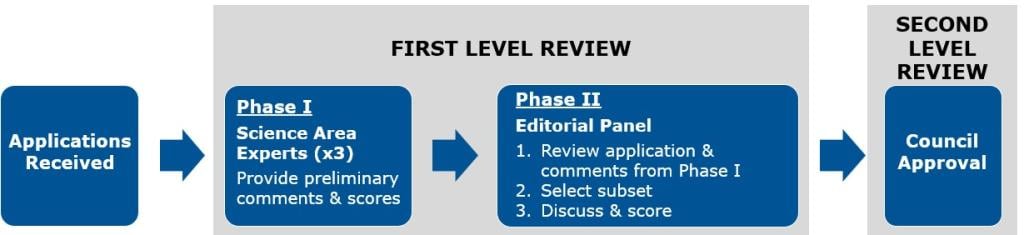
The first level of review for the New Innovator Award is conducted in two phases in a Special Emphasis Panel that will review all New Innovator Award applications. The process is overseen by a Scientific Review Officer (SRO) from the Center for Scientific Review (CSR). All applications are automatically sent to the Special Emphasis Panel, and reviewers change from year to year.
The second level of review is performed by the NIH Office of the Director’s national advisory council called the Council of Councils . The council is composed of both scientific and public representatives chosen for their expertise, interest, or activity in matters related to health and disease. Applications must receive approval at both levels of review to be eligible for funding.
Below is a diagram of the New Innovator Award review process. Each aspect is discussed in more detail below.
Role of the Scientific Review Officer
The Scientific Review Officer (SRO) is responsible for ensuring that each application receives an objective and fair initial peer review, and that all applicable laws, regulations, and policies are followed. The duties of the SRO include:
- Analyzing the content of each application and checking for completeness
- Documenting and managing conflicts of interest
- Recruiting qualified reviewers based on scientific and technical qualifications and other considerations, including
- Authority in their scientific field
- Dedication to high quality, fair, and objective reviews
- Ability to work collegially in a group setting
- Experience in research grant review
- Balanced representation
- Assigning applications to reviewers for critique preparation and assignment of individual criterion scores
- Attending and overseeing administrative and regulatory aspects of peer review meetings
- Preparing summary statements for all applications reviewed
The SRO is the point of contact for all review-related questions and issues.
First Level of Review
The New Innovator Award differs from traditional NIH reviews in that the first level of review occurs in two phases by two separate groups of reviewers with different perspectives. Applications are reviewed by science area experts ("mail" reviewers) in Phase I and by a broad thinking editorial panel in Phase II.
The New Innovator Award supports innovative research that has the potential to produce a major impact on a broad area of biomedical or behavioral research. The application does not have extensive background material, preliminary data are not required, and the essay focuses on the goals of the New Innovator Award. While all standard NIH criteria are used to evaluate applications, reviewers will emphasize: 1) the importance of the scientific problem and the potential impact of the research, 2) the novelty and innovativeness of the approach, and 3) evidence of the applicant's potential for creative and innovative research as an early stage investigator.
Phase I
Phase I review is conducted by "mail" reviewers, who submit independent assessments electronically and do not discuss the applications with other reviewers. Phase I reviewers are assigned based on the application's broad science areas chosen by the applicant and designated in the "Agency Routing Identifier." Though they have expertise within the broad designated science area, their expertise may not be closely matched with the specific topic of the application. Each application will have three assigned "mail" reviewers, who will provide comments and scores.
Phase II
Phase II is conducted by an editorial panel composed of scientists from an array of scientific backgrounds that captures a wide breadth of scientific expertise, experiences, and perspectives. Each application is assigned to three panel members and is not matched by area of expertise. Panel members are tasked with reviewing the proposal from a broad viewpoint with the aid of the comments from the "mail" reviewers and identifying a subset of applications for panel discussion. Typically, only about 17-20% of applications are chosen for discussion. Panel members provide preliminary scores and lead a panel discussion of their assigned applications. Following the panel discussion, the applications are scored by the whole panel. The panel discussion is captured by the SRO and is summarized in the summary statement.
Scoring & Summary Statement
Each panel member privately scores each discussed application. A raw score of 1 is the best, while 9 is the worst. The SRO collects and averages all the panel scores and multiplies the resulting number by 10 to yield an overall impact score. A discussed application can have an overall impact score of 10 (best) to 90 (worst). The panel has access to the full range of scores to provide discrimination among applications within this select subset. These scores should not be compared to a regular R01 study section review.
After the meeting, all discussed applications will receive an overall impact score within three business days through the PD/PI's eRA Commons account. The overall impact score indicates the panel's judgment of the qualifications and readiness of the investigator, the commitment and resources of the host institution, and the quality and impact potential of the research proposal. There is a correlation between a strong impact score and funding, but there is no strict cutoff or pay line for funding. And because applications are responding to a Request for Applications (RFA), the scores are not percentiled, which makes their interpretation difficult. NIH staff cannot disclose where an impact score falls relative to other application scores.
A summary statement prepared by the SRO will be available within 30 days of the review through the PD/PI's eRA Commons account. The summary statement of discussed applications includes critiques from the assigned editorial panel members and a brief summary of the panel discussion. Applications that are considered "not discussed" are given a summary statement with critiques from the "mail" reviewers but no comments from the editorial panel. The information provided in the summary statement is valuable and provides critical feedback. However, it is not intended to be an exhaustive critique and will not contain every point reviewers found to be problematic.
After Receiving the Summary Statement
If you have any questions about your summary statement, you should reach out to the scientific contact for the New Innovator Award (listed in the funding opportunity). The scientific contact attends the review and may be able to provide more insight into the panel discussion and help clarify some of the comments. You can also ask about the probability of funding and get advice on what to do if your application is outside of the likely pay range. Contacting NIH staff to “sell” your application or to express differences in scientific opinion related to the reviewers’ comments will not affect the likelihood of funding.
It is best to contact NIH staff by email to schedule a time for a meeting. That gives staff time to read your summary statement and review any notes. And be patient. They receive numerous inquiries and may not be able to respond to yours immediately.
PD/PIs of discussed applications are given an opportunity to submit an optional two-page response to their summary statement. The response may be used to address issues and concerns brought up by reviewers and reinforce the strengths of the application. The response will not be seen by reviewers and is not a part of the review. The response remains an internal NIH document used only by NIH staff during funding deliberations. The scientific contact will reach out to eligible applicants directly with more information on the response and the deadline.
Second Level of Review
The Council of Councils performs the second level of review for the New Innovator Award and assesses the first level of review for fairness and uniformity in the application of review criteria. It is meant to ensure the initial review was conducted with the appropriate expertise, procedures, and without conflicts of interest. The Council of Councils is not tasked with reviewing the applications for scientific or technical merit and is not asked to provide recommendations on which applications should be funded. The Council of Councils votes en bloc for concurrence with the first level review recommendations. Applications must receive approval from the council to be eligible for funding.
2. REVIEW PROCESS
NIH seeks the highest level of ethical standards for peer review. NIH policy is intended to promote a bias-free process that evaluates grant applications in a fair, equitable, and timely manner. Peer review is conducted at two levels as mandated by statute and federal regulation. All review criteria and considerations are specified in the funding opportunity.
The first level of review for the New Innovator Award is conducted in two phases in a Special Emphasis Panel that will review all New Innovator Award applications. The process is overseen by a Scientific Review Officer (SRO) from the Center for Scientific Review (CSR). All applications are automatically sent to the Special Emphasis Panel, and reviewers change from year to year.
The second level of review is performed by the NIH Office of the Director’s national advisory council called the Council of Councils . The council is composed of both scientific and public representatives chosen for their expertise, interest, or activity in matters related to health and disease. Applications must receive approval at both levels of review to be eligible for funding.
Below is a diagram of the New Innovator Award review process. Each aspect is discussed in more detail below.
Role of the Scientific Review Officer
The Scientific Review Officer (SRO) is responsible for ensuring that each application receives an objective and fair initial peer review, and that all applicable laws, regulations, and policies are followed. The duties of the SRO include:
- Analyzing the content of each application and checking for completeness
- Documenting and managing conflicts of interest
- Recruiting qualified reviewers based on scientific and technical qualifications and other considerations, including
- Authority in their scientific field
- Dedication to high quality, fair, and objective reviews
- Ability to work collegially in a group setting
- Experience in research grant review
- Balanced representation
- Assigning applications to reviewers for critique preparation and assignment of individual criterion scores
- Attending and overseeing administrative and regulatory aspects of peer review meetings
- Preparing summary statements for all applications reviewed
The SRO is the point of contact for all review-related questions and issues.
First Level of Review
The New Innovator Award differs from traditional NIH reviews in that the first level of review occurs in two phases by two separate groups of reviewers with different perspectives. Applications are reviewed by science area experts ("mail" reviewers) in Phase I and by a broad thinking editorial panel in Phase II.
The New Innovator Award supports innovative research that has the potential to produce a major impact on a broad area of biomedical or behavioral research. The application does not have extensive background material, preliminary data are not required, and the essay focuses on the goals of the New Innovator Award. While all standard NIH criteria are used to evaluate applications, reviewers will emphasize: 1) the importance of the scientific problem and the potential impact of the research, 2) the novelty and innovativeness of the approach, and 3) evidence of the applicant's potential for creative and innovative research as an early stage investigator.
Phase I
Phase I review is conducted by "mail" reviewers, who submit independent assessments electronically and do not discuss the applications with other reviewers. Phase I reviewers are assigned based on the application's broad science areas chosen by the applicant and designated in the "Agency Routing Identifier." Though they have expertise within the broad designated science area, their expertise may not be closely matched with the specific topic of the application. Each application will have three assigned "mail" reviewers, who will provide comments and scores.
Phase II
Phase II is conducted by an editorial panel composed of scientists from an array of scientific backgrounds that captures a wide breadth of scientific expertise, experiences, and perspectives. Each application is assigned to three panel members and is not matched by area of expertise. Panel members are tasked with reviewing the proposal from a broad viewpoint with the aid of the comments from the "mail" reviewers and identifying a subset of applications for panel discussion. Typically, only about 17-20% of applications are chosen for discussion. Panel members provide preliminary scores and lead a panel discussion of their assigned applications. Following the panel discussion, the applications are scored by the whole panel. The panel discussion is captured by the SRO and is summarized in the summary statement.
Scoring & Summary Statement
Each panel member privately scores each discussed application. A raw score of 1 is the best, while 9 is the worst. The SRO collects and averages all the panel scores and multiplies the resulting number by 10 to yield an overall impact score. A discussed application can have an overall impact score of 10 (best) to 90 (worst). The panel has access to the full range of scores to provide discrimination among applications within this select subset. These scores should not be compared to a regular R01 study section review.
After the meeting, all discussed applications will receive an overall impact score within three business days through the PD/PI's eRA Commons account. The overall impact score indicates the panel's judgment of the qualifications and readiness of the investigator, the commitment and resources of the host institution, and the quality and impact potential of the research proposal. There is a correlation between a strong impact score and funding, but there is no strict cutoff or pay line for funding. And because applications are responding to a Request for Applications (RFA), the scores are not percentiled, which makes their interpretation difficult. NIH staff cannot disclose where an impact score falls relative to other application scores.
A summary statement prepared by the SRO will be available within 30 days of the review through the PD/PI's eRA Commons account. The summary statement of discussed applications includes critiques from the assigned editorial panel members and a brief summary of the panel discussion. Applications that are considered "not discussed" are given a summary statement with critiques from the "mail" reviewers but no comments from the editorial panel. The information provided in the summary statement is valuable and provides critical feedback. However, it is not intended to be an exhaustive critique and will not contain every point reviewers found to be problematic.
After Receiving the Summary Statement
If you have any questions about your summary statement, you should reach out to the scientific contact for the New Innovator Award (listed in the funding opportunity). The scientific contact attends the review and may be able to provide more insight into the panel discussion and help clarify some of the comments. You can also ask about the probability of funding and get advice on what to do if your application is outside of the likely pay range. Contacting NIH staff to “sell” your application or to express differences in scientific opinion related to the reviewers’ comments will not affect the likelihood of funding.
It is best to contact NIH staff by email to schedule a time for a meeting. That gives staff time to read your summary statement and review any notes. And be patient. They receive numerous inquiries and may not be able to respond to yours immediately.
PD/PIs of discussed applications are given an opportunity to submit an optional two-page response to their summary statement. The response may be used to address issues and concerns brought up by reviewers and reinforce the strengths of the application. The response will not be seen by reviewers and is not a part of the review. The response remains an internal NIH document used only by NIH staff during funding deliberations. The scientific contact will reach out to eligible applicants directly with more information on the response and the deadline.
Second Level of Review
The Council of Councils performs the second level of review for the New Innovator Award and assesses the first level of review for fairness and uniformity in the application of review criteria. It is meant to ensure the initial review was conducted with the appropriate expertise, procedures, and without conflicts of interest. The Council of Councils is not tasked with reviewing the applications for scientific or technical merit and is not asked to provide recommendations on which applications should be funded. The Council of Councils votes en bloc for concurrence with the first level review recommendations. Applications must receive approval from the council to be eligible for funding.
3. PRE-AWARD ACTIVITIES
Roles & Responsibilities
Timely and effective communication between the award recipient and NIH staff is critical throughout pre-award, award, and post award processes. At this stage the following people will work closely together:
NIH Staff
- Grants Management Officer (GMO) : The GMO signs the Notice of Award (NoA) and is the NIH official responsible for the business management and other non-programmatic aspects of the award. GMOs ensure that laws, regulations, and administrative policies are followed.
- Grants Management Specialist (GMS) : The GMS works with the GMO on the day-to-day management of the grant. The name and contact information of the GMS assigned to a particular grant appears on the NoA.
- Program Official (PO) : The PO is responsible for the programmatic, scientific, and/or technical aspects of assigned applications and grants. The PO coordinates with grants management on post-award administration.
Recipient Organization Participants
- Authorized Organizational Representative (AOR) : The AOR, also known as Signing Official (SO) in the eRA Commons, is the designated representative of the recipient organization in matters related to the award and its administration. Their signature certifies that the applicant organization will comply and is accountable for all assurances and certifications referenced in the application. This individual's signature further certifies that the applicant organization will be accountable both for the appropriate use of funds awarded and for the performance of the grant-supported project or activities resulting from the application.
- Program Director/ Principal Investigator (PD/PI) : The PD/PI is the individual designated by the applicant organization to have the appropriate level of authority and responsibility to direct the project or program supported by the award. The PI is responsible and accountable to the recipient organization for the proper conduct of the project or program, including the submission of all required reports.
The PD/PI is the core member of the award recipient team responsible for ensuring compliance with the financial and administrative aspects of the award. The PD/PI work closely within the recipient organization to develop and maintain necessary documentation, such as technical and administrative reports, preparing justifications, appropriately acknowledging federal support of research findings in publications, announcements, news programs, and other media, and ensuring compliance with other federal and organizational requirements.
NIH encourages the PD/PI to maintain contact with the NIH PO with respect to the scientific aspects of the project and the grants management officer concerning the business and administrative aspects of the award.
Just-in-Time Request
Some important time-sensitive information isn’t included in your application. Instead, you prepare it separately and send it in before awarding in a process called Just-in-Time (JIT) .
After initial peer review, NIH sends an automatic email requesting JIT information for applications within a competitive funding range. The notification is NOT a Notice of Award, nor should it be construed as an indicator of possible award.
Requested JIT information includes:
- Other support
- Certification of Institutional Review Board (IRB) approval
- Certification of Institutional Animal Care and Use Committee (IACUC) approval
- Human subjects training certification for all key personnel
- Resource Sharing Plan
JIT information must be submitted for NIH review and evaluation prior to making an award. This information may be submitted via the Just-In-Time function within eRA Commons . If you have questions about the JIT process, contact the Grants Management Specialist assigned to your grant.
Funding Deliberations
Following review of all applicable information, the NIH Office of the Director and the High-Risk, High-Reward Research program working group (composed of staff from other NIH institutes and centers) will determine whether an award will be made.
The score given to an application during the initial peer review process is an important factor and best indicator of likely funding, but it is not the sole factor used in making funding decisions. The following are also considered in making funding decisions:
- Scientific and technical merit of the proposed project as determined by scientific peer review with consideration of the PD/PI’s optional summary statement response
- Availability of funds
- Conformance to clinical trial research policies of the administering Institute or Center
- Relevance of programmatic priorities, including:
- The potential for the investigator to lead groundbreaking and broadly impactful research, despite its inherent risks
- Unusually cross-cutting science
- Scientific balance in the portfolio of New Innovator Award-supported research
- Potential to invigorate exceptionally innovative and impactful science broadly across the nation
The NIH Office of the Director funds the majority of awards. However, other NIH Institutes and Centers are invited to fund New Innovator Award applications that they deem meritorious and that fit within their mission and priorities. The NIH Office of the Director does not play a role in the funding deliberations of other Institutes and Centers, but the process is managed by the Institute/Center’s member of the High-Risk, High-Reward Research program working group.
Pre-Award Negotiation
The pre-award process involves significant communication between the NIH and the applicant organization and includes negotiation if significant adjustments are required prior to award. Some of the issues NIH staff will be considering during award negotiations include:
- Initial peer review recommendations: Peer reviewers may recommend changes to the Specific Aims. These recommendations are provided in the summary statement. Under these circumstances, NIH staff will include these recommendations in consideration of a potential award.
- Overlap: Program and grants management staff will review the other support information to ensure there is no overlap with already funded projects (e.g., support, commitment, or budgetary).
- Level of effort: Program and grants management staff will ensure sufficient levels of effort are committed to support the approved project.
- Facilities and Administrative (F&A) Costs: Grants management staff will utilize the negotiated F&A costs (also known as indirect costs) for each grant. More information on the reimbursement of F&A costs can be found in the NIH Grants Policy Statement .
Notice of Award
You may receive communications from NIH staff regarding the intent to make an award, but nothing is official until you receive the Notice of Award (NoA).
The NoA is the legal document issued to notify the award recipient that an award has been made and that funds are now available for the project. The NoA includes the terms and conditions of the award, your project's start and end dates, and how much money you will receive for current and future years. It also provides contact information for the assigned Program Officer and Grants Management Specialist. It is important that you read and understand your NoA.
NoAs are issued annually for each budget period and are contingent upon annual assessment of research progress and the availability of funds.
3. PRE-AWARD ACTIVITIES
Roles & Responsibilities
Timely and effective communication between the award recipient and NIH staff is critical throughout pre-award, award, and post award processes. At this stage the following people will work closely together:
NIH Staff
- Grants Management Officer (GMO) : The GMO signs the Notice of Award (NoA) and is the NIH official responsible for the business management and other non-programmatic aspects of the award. GMOs ensure that laws, regulations, and administrative policies are followed.
- Grants Management Specialist (GMS) : The GMS works with the GMO on the day-to-day management of the grant. The name and contact information of the GMS assigned to a particular grant appears on the NoA.
- Program Official (PO) : The PO is responsible for the programmatic, scientific, and/or technical aspects of assigned applications and grants. The PO coordinates with grants management on post-award administration.
Recipient Organization Participants
- Authorized Organizational Representative (AOR) : The AOR, also known as Signing Official (SO) in the eRA Commons, is the designated representative of the recipient organization in matters related to the award and its administration. Their signature certifies that the applicant organization will comply and is accountable for all assurances and certifications referenced in the application. This individual's signature further certifies that the applicant organization will be accountable both for the appropriate use of funds awarded and for the performance of the grant-supported project or activities resulting from the application.
- Program Director/ Principal Investigator (PD/PI) : The PD/PI is the individual designated by the applicant organization to have the appropriate level of authority and responsibility to direct the project or program supported by the award. The PI is responsible and accountable to the recipient organization for the proper conduct of the project or program, including the submission of all required reports.
The PD/PI is the core member of the award recipient team responsible for ensuring compliance with the financial and administrative aspects of the award. The PD/PI work closely within the recipient organization to develop and maintain necessary documentation, such as technical and administrative reports, preparing justifications, appropriately acknowledging federal support of research findings in publications, announcements, news programs, and other media, and ensuring compliance with other federal and organizational requirements.
NIH encourages the PD/PI to maintain contact with the NIH PO with respect to the scientific aspects of the project and the grants management officer concerning the business and administrative aspects of the award.
Just-in-Time Request
Some important time-sensitive information isn’t included in your application. Instead, you prepare it separately and send it in before awarding in a process called Just-in-Time (JIT) .
After initial peer review, NIH sends an automatic email requesting JIT information for applications within a competitive funding range. The notification is NOT a Notice of Award, nor should it be construed as an indicator of possible award.
Requested JIT information includes:
- Other support
- Certification of Institutional Review Board (IRB) approval
- Certification of Institutional Animal Care and Use Committee (IACUC) approval
- Human subjects training certification for all key personnel
- Resource Sharing Plan
JIT information must be submitted for NIH review and evaluation prior to making an award. This information may be submitted via the Just-In-Time function within eRA Commons . If you have questions about the JIT process, contact the Grants Management Specialist assigned to your grant.
Funding Deliberations
Following review of all applicable information, the NIH Office of the Director and the High-Risk, High-Reward Research program working group (composed of staff from other NIH institutes and centers) will determine whether an award will be made.
The score given to an application during the initial peer review process is an important factor and best indicator of likely funding, but it is not the sole factor used in making funding decisions. The following are also considered in making funding decisions:
- Scientific and technical merit of the proposed project as determined by scientific peer review with consideration of the PD/PI’s optional summary statement response
- Availability of funds
- Conformance to clinical trial research policies of the administering Institute or Center
- Relevance of programmatic priorities, including:
- The potential for the investigator to lead groundbreaking and broadly impactful research, despite its inherent risks
- Unusually cross-cutting science
- Scientific balance in the portfolio of New Innovator Award-supported research
- Potential to invigorate exceptionally innovative and impactful science broadly across the nation
The NIH Office of the Director funds the majority of awards. However, other NIH Institutes and Centers are invited to fund New Innovator Award applications that they deem meritorious and that fit within their mission and priorities. The NIH Office of the Director does not play a role in the funding deliberations of other Institutes and Centers, but the process is managed by the Institute/Center’s member of the High-Risk, High-Reward Research program working group.
Pre-Award Negotiation
The pre-award process involves significant communication between the NIH and the applicant organization and includes negotiation if significant adjustments are required prior to award. Some of the issues NIH staff will be considering during award negotiations include:
- Initial peer review recommendations: Peer reviewers may recommend changes to the Specific Aims. These recommendations are provided in the summary statement. Under these circumstances, NIH staff will include these recommendations in consideration of a potential award.
- Overlap: Program and grants management staff will review the other support information to ensure there is no overlap with already funded projects (e.g., support, commitment, or budgetary).
- Level of effort: Program and grants management staff will ensure sufficient levels of effort are committed to support the approved project.
- Facilities and Administrative (F&A) Costs: Grants management staff will utilize the negotiated F&A costs (also known as indirect costs) for each grant. More information on the reimbursement of F&A costs can be found in the NIH Grants Policy Statement .
Notice of Award
You may receive communications from NIH staff regarding the intent to make an award, but nothing is official until you receive the Notice of Award (NoA).
The NoA is the legal document issued to notify the award recipient that an award has been made and that funds are now available for the project. The NoA includes the terms and conditions of the award, your project's start and end dates, and how much money you will receive for current and future years. It also provides contact information for the assigned Program Officer and Grants Management Specialist. It is important that you read and understand your NoA.
NoAs are issued annually for each budget period and are contingent upon annual assessment of research progress and the availability of funds.
Award Management
Learn what to expect after your application is selected for funding.
Administering NIH Institute/Center
The Office of the Director (OD) receives all New Innovator applications and funds the majority of the awards. However, applications that are selected for funding are transferred to the most scientifically relevant NIH Institute or Center (as determined by the High-Risk, High-Reward Research program (HRHR) working group) for award administration. The administering NIH Institute or Center will assign program and grants management staff to manage the award, but Dr. Patricia Labosky (Program Leader for HRHR) oversees all New Innovator Awards and will remain an important contact for award recipients.
Administering NIH Institute/Center
The Office of the Director (OD) receives all New Innovator applications and funds the majority of the awards. However, applications that are selected for funding are transferred to the most scientifically relevant NIH Institute or Center (as determined by the High-Risk, High-Reward Research program (HRHR) working group) for award administration. The administering NIH Institute or Center will assign program and grants management staff to manage the award, but Dr. Patricia Labosky (Program Leader for HRHR) oversees all New Innovator Awards and will remain an important contact for award recipients.
The Notice of Award (NoA) provides information on the project's start and end dates, terms and conditions of award, and how much money will be received for current and future years. A NoA is issued for every budget period of the award.
You can find the NoA in eRA Commons using the Status module or Notice of Award query. Note that grants management staff may issue a revised NoA to reflect any of the following changes:
- Increase or decrease of funds
- Lifting of a restriction
- Change in budget period
- Carryover or offset
Notice of Award (NoA)
The Notice of Award (NoA) provides information on the project's start and end dates, terms and conditions of award, and how much money will be received for current and future years. A NoA is issued for every budget period of the award.
You can find the NoA in eRA Commons using the Status module or Notice of Award query. Note that grants management staff may issue a revised NoA to reflect any of the following changes:
- Increase or decrease of funds
- Lifting of a restriction
- Change in budget period
- Carryover or offset
Research Performance Progress Report (RRPR)
NIH requires award recipients to submit annual Research Performance Progress Reports (RPPR) through eRA Commons. The progress report must be approved by NIH to fund each budget period. Late progress reports will delay awards until all reporting elements are complete.
The RPPR asks award recipients about accomplishments towards the goal of the project, plans for the next year of the project, manuscripts and publications produced, personnel who have worked on the project, changes to level of effort of key personnel on the project, actual or planned challenges or delays in the projects and plans for resolving them, significant changes regarding human or animal subjects, inclusion enrollment reports for clinical studies, and more.
The Program Officer reviews each progress report to determine whether funding for the project will continue, and the Grants Management Specialist evaluates the grant's administrative and fiscal status. Both must approve a progress report before an award can be issued. Program and grants management officials may follow up if additional information is needed.
A final RPPR, invention statement, and the expenditure data portion of the Federal Financial Report are required for closeout of an award, as described in the NIH Grants Policy Statement .
Research Performance Progress Report (RRPR)
NIH requires award recipients to submit annual Research Performance Progress Reports (RPPR) through eRA Commons. The progress report must be approved by NIH to fund each budget period. Late progress reports will delay awards until all reporting elements are complete.
The RPPR asks award recipients about accomplishments towards the goal of the project, plans for the next year of the project, manuscripts and publications produced, personnel who have worked on the project, changes to level of effort of key personnel on the project, actual or planned challenges or delays in the projects and plans for resolving them, significant changes regarding human or animal subjects, inclusion enrollment reports for clinical studies, and more.
The Program Officer reviews each progress report to determine whether funding for the project will continue, and the Grants Management Specialist evaluates the grant's administrative and fiscal status. Both must approve a progress report before an award can be issued. Program and grants management officials may follow up if additional information is needed.
A final RPPR, invention statement, and the expenditure data portion of the Federal Financial Report are required for closeout of an award, as described in the NIH Grants Policy Statement .
Project or Budget Changes
There may be times when adjustments are needed to your project or budget. Some of the adjustments can be made by the award recipient without NIH approval due to “expanded authorities” laws, which gives greater autonomy and flexibility to award recipients.
Without NIH approval, you can:
- Carry over unobligated balances from one budget period to the next.
- Transfer work to a third party through a consortium agreement, contract, or other means, as long as you retain a substantive role in the research.
- Make cost-related changes, including rebudgeting of funds, as long as the scope of the research remains the same.
- Spend money up to 90 days before the grant's start date with your institution's permission.
Actions that require NIH pre-approval include:
- Taking an action that changes the scope of the approved research.
- Reducing PD/PI effort by 25 percent or more. Note that research effort must remain at least 25 percent for the New Innovator Award.
- Changing the recipient organization.
- Taking a no-cost extension of a final budget period.
- Changing the award terms and conditions, or undertaking any activities disapproved or restricted as a term of award.
- Adding, removing, or transferring a foreign sub-award or foreign site.
The request must be endorsed by your Authorized Organization Representative and sent to the grants management specialist at least 30 days before your proposed change. Contact your grants management specialist with questions on pre-approvals.
Project or Budget Changes
There may be times when adjustments are needed to your project or budget. Some of the adjustments can be made by the award recipient without NIH approval due to “expanded authorities” laws, which gives greater autonomy and flexibility to award recipients.
Without NIH approval, you can:
- Carry over unobligated balances from one budget period to the next.
- Transfer work to a third party through a consortium agreement, contract, or other means, as long as you retain a substantive role in the research.
- Make cost-related changes, including rebudgeting of funds, as long as the scope of the research remains the same.
- Spend money up to 90 days before the grant's start date with your institution's permission.
Actions that require NIH pre-approval include:
- Taking an action that changes the scope of the approved research.
- Reducing PD/PI effort by 25 percent or more. Note that research effort must remain at least 25 percent for the New Innovator Award.
- Changing the recipient organization.
- Taking a no-cost extension of a final budget period.
- Changing the award terms and conditions, or undertaking any activities disapproved or restricted as a term of award.
- Adding, removing, or transferring a foreign sub-award or foreign site.
The request must be endorsed by your Authorized Organization Representative and sent to the grants management specialist at least 30 days before your proposed change. Contact your grants management specialist with questions on pre-approvals.
Change of Institution
If you wish to change institutions, you must ask the awarded institution to relinquish the award to your new one. The new institution must be a U.S. domestic institution capable of supporting the research and must fulfill all the requirements in the funding opportunity.
Your new institution must submit a new application in response to the Change of Recipient Organization (Type 7 Parent) announcement . NIH staff will review the application to ensure all the requirements in the funding opportunity are met.
For more information, see:
- NIH Change of Institutions/Relinquishing Statements FAQs
- Section 8 of the NIH Grants Policy Statement
If your institution does not agree to transfer your grant or the new institution cannot meet all the requirements in the funding opportunity, the grant must be terminated.
Change of Institution
If you wish to change institutions, you must ask the awarded institution to relinquish the award to your new one. The new institution must be a U.S. domestic institution capable of supporting the research and must fulfill all the requirements in the funding opportunity.
Your new institution must submit a new application in response to the Change of Recipient Organization (Type 7 Parent) announcement . NIH staff will review the application to ensure all the requirements in the funding opportunity are met.
For more information, see:
- NIH Change of Institutions/Relinquishing Statements FAQs
- Section 8 of the NIH Grants Policy Statement
If your institution does not agree to transfer your grant or the new institution cannot meet all the requirements in the funding opportunity, the grant must be terminated.
Change in Scope
There may be times when your research plans need adjustment because of a new research path or a dead end. Talk with your Program Officer about whether it makes sense to modify your research. You will need approval from your Grants Management Specialist to change the scope of your research.
Actions that may change the scope of your research include:
- Changing the Specific Aims
- Shifting the research emphasis from one disease area to another
- Changing any aspects of research involving animals or human subjects
- Using a new technology
- Purchasing equipment that costs more than $25,000
- Rebudgeting funds in or out of a budget category by more than 25 percent of the total costs of the award
For a list of all actions that constitute a change in scope, see Section 8 of the NIH Grants Policy Statement .
Change in Scope
There may be times when your research plans need adjustment because of a new research path or a dead end. Talk with your Program Officer about whether it makes sense to modify your research. You will need approval from your Grants Management Specialist to change the scope of your research.
Actions that may change the scope of your research include:
- Changing the Specific Aims
- Shifting the research emphasis from one disease area to another
- Changing any aspects of research involving animals or human subjects
- Using a new technology
- Purchasing equipment that costs more than $25,000
- Rebudgeting funds in or out of a budget category by more than 25 percent of the total costs of the award
For a list of all actions that constitute a change in scope, see Section 8 of the NIH Grants Policy Statement .
High-Risk, High-Reward Research Symposium
The High-Risk, High-Reward Research Symposium is held annually in Bethesda, MD. The symposium brings together recipients of the NIH Director's Pioneer, New Innovator, Transformative Research, and Early Independence Awards to share their groundbreaking research and discoveries. The symposium is free and open to the public. Symposium attendees enjoy:
- Scientific talks and posters from High-Risk, High-Reward Research program award recipients
- Networking with some of the most creative scientists in the U.S.
- Scheduled one-on-one meetings with NIH staff during "Office Hours"
High-Risk, High-Reward Research award recipients are strongly encouraged to attend the symposium annually. Award recipient lab members, NIH staff and fellows, and members of the general public are also welcome to attend. NIH does not pay for or make travel arrangements for symposium attendees and presenters.
High-Risk, High-Reward Research Symposium
The High-Risk, High-Reward Research Symposium is held annually in Bethesda, MD. The symposium brings together recipients of the NIH Director's Pioneer, New Innovator, Transformative Research, and Early Independence Awards to share their groundbreaking research and discoveries. The symposium is free and open to the public. Symposium attendees enjoy:
- Scientific talks and posters from High-Risk, High-Reward Research program award recipients
- Networking with some of the most creative scientists in the U.S.
- Scheduled one-on-one meetings with NIH staff during "Office Hours"
High-Risk, High-Reward Research award recipients are strongly encouraged to attend the symposium annually. Award recipient lab members, NIH staff and fellows, and members of the general public are also welcome to attend. NIH does not pay for or make travel arrangements for symposium attendees and presenters.
The Common Fund {"robots":"noindex, nofollow"}