An official website of the United States government




A history of discovery
For more than a century, NIH scientists and supported scientists have paved the way for important discoveries that improve health and save lives.
In fact, hundreds of scientists who won the Nobel Prize conducted their work at NIH or were supported by NIH funds. Their studies have led to the development of MRI, understanding of how viruses can cause cancer, insights into cholesterol control, and knowledge of how our brain processes visual information, among dozens of other advances.

The Roots of NIH
The National Institutes of Health traces its roots to 1887, when a one-room laboratory was created within the Marine Hospital Service (MHS), predecessor agency to the U.S. Public Health Service (PHS).
The MHS had been established in 1798 to provide for the medical care of merchant seamen. In the 1880s, the MHS had been charged by Congress with examining passengers on arriving ships for clinical signs of infectious diseases, especially for the dreaded diseases cholera and yellow fever, in order to prevent epidemics.
Milestones in NIH history
Chronology of Events
Significant events and major research advances in NIH history.
Legislative Chronology
Federal legislation that had a major influence on the growth of the NIH, from its beginning as the Marine Hospital Service in 1798.
NIH Reauthorization
NIH is responsive to Congressional legislation that adjusts NIH's programs to meet changing research needs. As a result of the NIH reauthorization process, NIH is able to respond strategically in an era when medical research requires constant innovation and increased interdisciplinary efforts.
Scientific recognition

Nobel Laureates
Discover the scientists who conducted research at NIH or whose research was supported by NIH funds and went on to receive the Nobel Prize.
Lasker Awards
Explore NIH-supported researchers and institutions recognized with Lasker Awards for groundbreaking contributions to biomedical research and public health.
Stories from NIH history

Ruth L. Kirschstein, M.D.
Learn about Ruth L. Kirschstein, M.D., a pioneering scientist and NIH leader who contributed to polio vaccine research and championed biomedical research training and diversity.

The Tree of Hippocrates
A living symbol of medicine and its enduring traditions. Learn the story of the Tree of Hippocrates at NIH and its connection to the history of healing.

History of the NIH Logo
Trace the evolution of the NIH logo, from the agency’s early use of federal seals to the familiar symbol of scientific advancement used today.
NIH’s Scientific Legacy
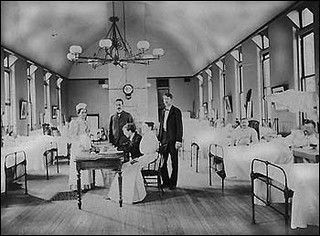
The Office of NIH History educates the public about the process of biomedical research and its achievements, like Dr. Joseph Goldberger's discovery of the cause of pellagra in 1916 (above). Visit our virtual exhibits to learn more.