 An official website of the United States government




Former Fogarty HIV trainee Dr William Duke helps lead Dominican Republic's COVID response
Q and A with William Duke, M.D., MPH
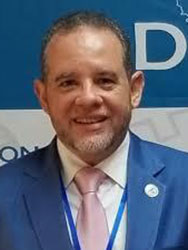
William Duke, M.D., MPH
Focus on the Fogarty community's response to COVID-19
- COVID-19 creates new syndemic on US-Mexico border
- Researcher collaborates to solve pandemic inequities at home and abroad
- Scientists study intersection of COVID-19 and HIV
- Fogarty fellow captures 'lived experiences' of frontline health care workers, COVID-19 patients in South Africa
- Profile: Fogarty fellow Dr Mark Brady’s tuberculosis training in Peru useful in combatting COVID-19
Dr. William Duke, a physician and epidemiologist, is dean of health sciences and epidemiology at the Universidad Nacional Pedro Henriquez Urena (UNPHU) in the Dominican Republic. Early in his career, he received infectious disease research training through a Fogarty grant to the University of California, Berkeley. Since then, Duke has served as a scientific advisor to the Dominican Government’s Ministry of Public Health and provided leadership for PEPFAR-supported HIV/AIDS projects. He earned his black belt in Jujitsu and is a certified chief medical officer for Paralympic Sport. Recently, Duke was named a member and advisor to his country’s COVID-19 Prevention and Control National Commission.
What Fogarty-funded training did you receive?
While a Fogarty trainee in 1990, I was able to improve my research skills - including use of biostatistics - and learned to critically analyze epidemiological data and publish the findings. I also designed and conducted serosurveillance research among the general population and high-risk groups. I received this training at UC Berkeley through Fogarty’s AIDS International Training and Research Program (AITRP) under the mentorship of its principal investigator, Dr. Art Reingold, who spearheaded their Center for AIDS Prevention Studies (CAPS) program there. I was representing the Dominican Republic as part of a consortium of Latin- American health ministries with the goal of improving my nation’s HIV/AIDS National Program.
How did that experience impact your career?
My mentor Dr. Reingold influenced me in my decision to continue with an academic focus on HIV, in addition to tuberculosis. I recognize now, after nearly three decades in this field, that without Fogarty I would never have achieved my current professional life and career successes.
For these reasons, I must express my deepest gratitude to Dr. Reingold. The San Francisco HIV/AIDS Program and the UC Berkeley program were also instrumental during my Fogarty fellowship because they provided unique opportunities. I gained a great deal by collaborating with other trainees, conducting community epidemiology surveys, updating interventions for the San Francisco region, working with NGOs on HIV/AIDS prevention and control, and even treating patients. Each of these experiences shaped my future. Since 2009, I have served as the Coinfection TB/HIV national advisor in the Dominican Republic’s Ministry of Health.
How were you able to apply what you learned?
After my training I used my expertise to improve the research interventions in my country’s national program for HIV/AIDS/STDs, including establishing a new methodology and best practices for both the general population and high-risk populations. Having influenced the National Health Plan and the health system in this way, I spent the next 30 or so years working to save lives and mitigate risk among LGBTQ populations, pregnant women with HIV, children living with HIV, Haitian immigrants and inmates to prevent, control and treat HIV/AIDS.
How did Fogarty training prepare you for this?
Fogarty’s most significant message was the need to cooperate and influence all levels of the health system as well as all stakeholders, both national and international. Because of Fogarty, I understood I would need to integrate all existing professionals and systems if I wanted to create a new and effective model of intervention for people living with HIV. Collaboration, then, is what led to the opening of new treatment sites that provided antiretroviral therapy and follow-up medical care throughout the Dominican Republic.
How are you involved in the COVID response?
In February 2020, the Ministry of Health selected me to act as National Epidemiology Advisor and member of the COVID-19 Prevention and Control National Commission. In March, the National Health Science and Dominican School of Medicine Association asked me to provide a COVID-19 epidemiology data analysis and intervention plan and protocol for medical students during their training. The goal is to improve the control and prevention of the pandemic disease using contact tracing with COVID patients and people they have interacted with in poor provinces. Specifically, we use the “triple T” method - tracing, testing and treatment - when patients test positive for the coronavirus. During the quarantine period, we not only re-test patients and their contacts, we also provide training in physical distancing and psychological support for a population of 500,000 people.
More Information
- Universidad Nacional Pedro Henríquez Ureña (UNPHU)
- Fogarty-supported HIV research training:
- HIV Research Training Program
- Archive: AIDS International Training and Research Program (AITRP)
- AITRP grant to University of California, Berkeley, supported by Fogarty 2001-2014:
UCB/UCSF AIDS International Training and Research Program (AITRP) - Archive: Celebrating 25 years of research training to combat HIV/AIDS
Jul / Aug 2012 Global Health Matters
- This NIH [HIV research training] program is crucial to global health - and its future is in danger
Berkeley Blog post by Dr Arthur Reingold, March 29, 2017 - Sistema de salud de RD visto por la academia: RD necesita formar mejore s recurs os humanos
Hoy, August 30, 2019
To view Adobe PDF files, download current, free accessible plug-ins from Adobe's website .